


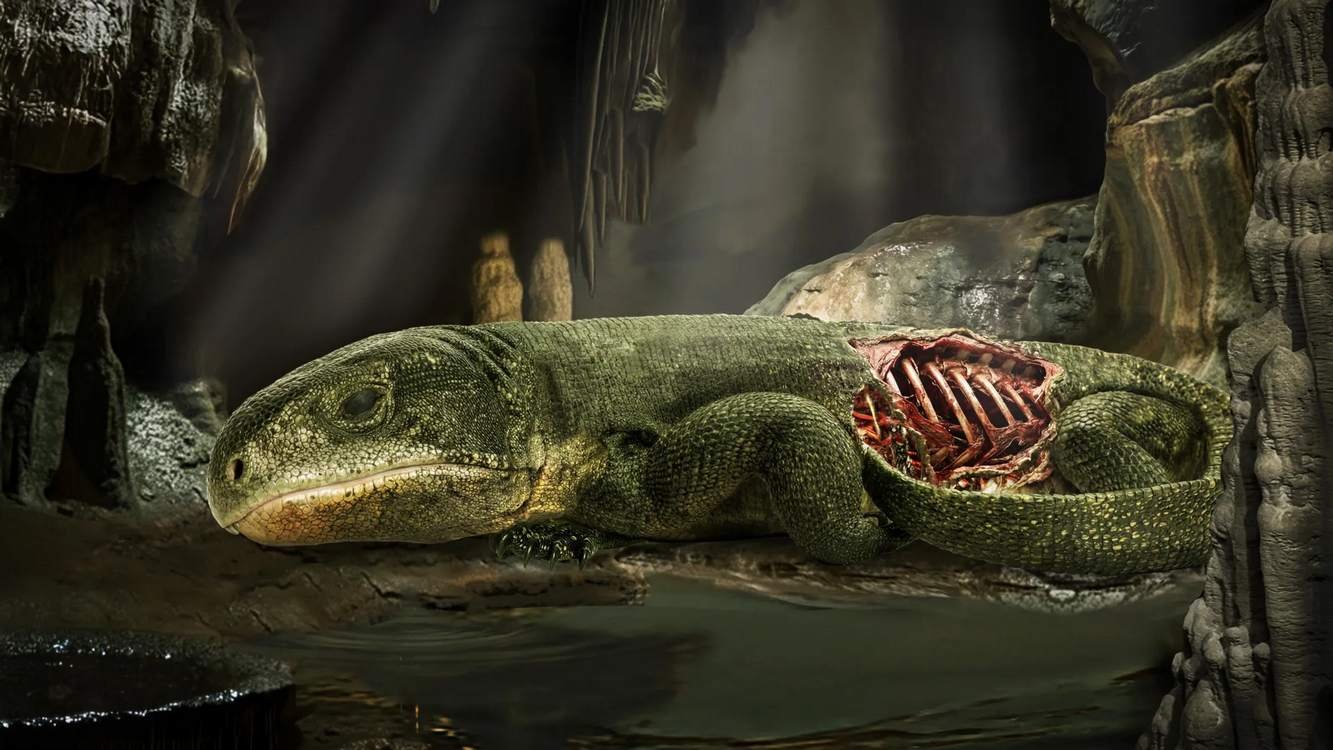
Captorhinus according to an artist’s impression – credit, Dr. Michael DeBraga
Every breath you take is part of a very ancient story, a remarkably preserved reptile that died in an Oklahoma cave about 289 million years ago has revealed.
The steady movement of your chest, the muscles between your ribs pulling outward, and the air filling your lungs may feel completely routine, yet this familiar process traces back hundreds of millions of years.
In a study published in Nature, scientists describe the exceptional preservation of a small, lizard-like reptile called Captorhinus aguti from the early Permian period. Although only a few inches long, this fossil contains far more than bones.
It preserves three dimensional skin, calcified cartilage, and even traces of proteins. These protein remnants are nearly 100 million years older than any previously identified in fossils—which in and of itself makes the find remarkably special.
“Captorhinus is an interesting lizard-looking critter that is critical to understanding early amniote evolution,” said Ethan Mooney, who co-led the study while a student at the University of Toronto in co-author Professor Robert R. Reisz’s.
The fossil was discovered in cave systems near Richards Spur, Oklahoma, a site known for its extraordinary record of late Paleozoic life. This location contains the most diverse collection of terrestrial vertebrates from that period, which was already rich in species. Unique environmental conditions helped preserve the remains. Oil seep hydrocarbons and oxygen-free mud protected not only bones but also delicate tissues such as skin and cartilage.
As a result, the specimen appears as a three dimensional mummified fossil, frozen in its final position with one arm tucked beneath its body. This level of preservation is extremely rare and offers an unusually detailed view of ancient anatomy.
Harvard University details that Mooney and his colleagues used neutron computed tomography (nCT) at a specialized facility in Australia to examine the fossil without damaging it. The scans allowed them to see beneath the rock and uncover fine details hidden inside.
“I started to see all these structures wrapped around the bones,” he said, “they were very thin and textured. And lo and behold, there was a nice wrapping of skin around the torso of this animal. The scaly skin has this wonderful accordion-like texture, with these concentric bands covering much of the body from the torso and up to the neck.”
The pattern closely resembles the scales seen in modern worm lizards, which are small burrowing reptiles still alive today, but the preserved skin was only one part of the discovery.
By studying three Captorhinus specimens from Richards Spur, researchers were able to piece together how this animal breathed. One fossil revealed a segmented cartilaginous sternum, along with sternal ribs, intermediate ribs, and connections linking the ribcage to the shoulder girdle.
For the first time, scientists could see these structures clearly in an early reptile and reconstruct a complete breathing system in an early amniote. This provided direct evidence of costal aspiration breathing, where muscles between the ribs expand and compress the chest cavity to pull air into the lungs.
Before this system evolved, amphibians relied on a different method. They breathed through their skin and pushed air into their lungs using movements of the mouth and throat. While this approach still works for many amphibians today, it limits activity levels. Rib-based breathing allows for deeper, more efficient airflow, bringing in more oxygen and removing carbon dioxide more effectively.
“We propose that the system found in Captorhinus represents the ancestral condition for the kind of rib assisted respiration present in living reptiles, birds, and mammals” said Professor Reisz.
RELATED: 500 Million Year-Old Jellyfish–Oldest Ever Found–May Have Swallowed Prey Whole
The use of ribcage muscles for breathing was a major evolutionary step. It gave early amniotes the ability to sustain more active lifestyles, which likely helped them spread and diversify across land environments.
“It was a game changer that allowed these animals to adopt a much more active lifestyle,” said Mooney.
This innovation may have played a major role in the success of reptiles and their descendants, setting the foundation for their dominance in terrestrial ecosystems.
THE DAWN OF AMPHIBIANS: New Study of Triassic Fossils Reveal the Origins of Living Amphibians Through a Tiny “Funky Worm”
The discovery also included a surprising finding. Using synchrotron infrared spectroscopy, researchers detected traces of original proteins preserved within the fossil’s bone, cartilage, and skin. These molecules are the oldest of their kind ever identified, dating back nearly 100 million years earlier than previous examples found in dinosaur fossils.
“The protein remnant finding is exceptional,” Mooney said, “it dramatically pushes our understanding of what is possible in terms of soft tissue preservation in the fossil record.”
MORE MUMMIFIED ANIMALS: Prehistoric Saber-Tooth Cub Is First to Be Found Mummified in Ice – and it Still Has Hair
The fossils are now housed at the Royal Ontario Museum in Toronto, where they will remain available for further study. Mooney has since continued his research at Harvard, focusing on early reptiles and their evolutionary history.
Findings like this provide a clearer picture of how early vertebrates adapted to life on land and how key innovations such as efficient breathing helped shape the course of evolution.
SHARE This Truly Amazing Fossil And The Secrets It’s Revealing…
