


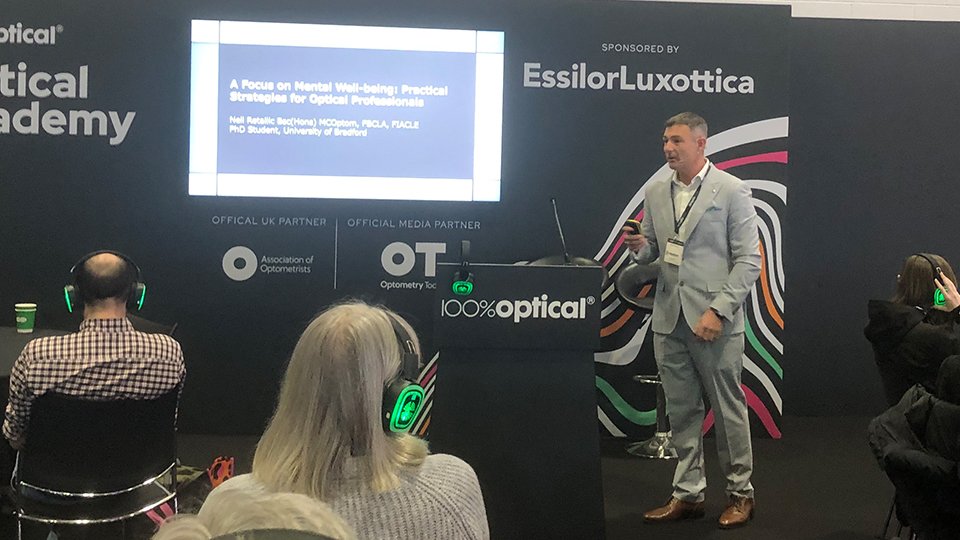
Neil Retallic, head of optometry development at Specsavers, led a session at 100% Optical (2 March) on wellbeing for practitioners.
The session, A focus on mental wellbeing – practical strategies for optical professionals, provided a snapshot of the PhD research Retallic has been conducting into wellbeing and also saw delegates discuss methods for managing different stressful scenarios in practice.
Retallic drew on his PhD research to explore work-related stress and the ways this can be managed.
His research has analysed data from surveys with 1300 optometrists and 236 pre-registration optometrists using validated measures to assess psychological distress.
Using these measures, the research found that 71% of pre-reg scores were indicative of concerning levels of distress, compared with 37% of qualified optometrists.
Approximately half of pre-registration optometrists had positive screening scores indicating depression or anxiety. A lower proportion of positive scores was found among qualified optometrists, at around a quarter.
“Death by a thousand papercuts”
Retallic began with definitions of stress, burnout, and anxiety, highlighting that stress can be beneficial at times due to the adrenaline response, which can support productivity.
Retallic shared the Health and Safety Executive definition of work-related stress, which identifies several areas that can be most impactful: demand, control, relationships, support, role, and change.
“These are areas where you may want to look to reduce stress levels,” he said.
Burnout, Retallic explained, occurs when stress becomes constant.
“Built up over time, it’s that concept of death by a thousand papercuts, where you have the same stresses that get to the point where it is becoming uncomfortable, your energy levels go down, you have mental dissonance, and reduced performance,” he said.
Retallic noted that it takes the average person up to 15 months to recover from burnout, but the average person only takes three months off from work.
He also noted that anxiety is a mental health condition, and while stress is usually short-term, those with anxiety might require treatment, therapy, or other support mechanisms.
Strategies for managing stress
The research asked respondents to share the ways they personally deal with work-related stress.
“The most popular were physical activities: things like going to the gym, going for a walk, and doing exercise,” Retallic said. “Leisure activities came up, such as cinema, ways to distract yourself, and the importance of spending time with friends and family.”
The importance of work-life balance and boundaries were referenced in the survey results, Retallic said, sharing: “Some people said they are very strict, so at eight o’clock they may silence their work apps to make sure they have got protected time for themselves and family.”
“They leave work and have things booked in the diary to make sure that they do the things they enjoy,” he added.
Respondents also talked about the location of their work, with some preferring to work close to home so they have more time outside of work, while others prefer a commute to have time to unwind.
Some respondents also spoke about personal and professional interventions, such as mindset adjustments, yoga, mindfulness exercises, and lifestyle choices.
Retallic referenced the importance of taking breaks and the sense of guilt that can sometimes be felt around taking a break when others in the practice aren’t.
He noted that a study in nurses found that breaks are important for interacting with colleagues and forming relationships.
Workload and demands were common themes in the survey, Retallic found, suggesting that there may be conversations to have around how the work can be structured differently, whether it could be spread out, or if some admin tasks could be delegated.
Retallic highlighted that while there is evidence to support various methods for supporting stress reduction, such as yoga, many of these studies are short-term.
“It’s different for every individual and is multifactorial, so many approaches will be beneficial,” he said.
“We need to take a whole-system approach. What that means is having things in place for everyone at every level, from the employee, through to the manager, [and] the business owner.”
Learning to manage emotions in others
Retallic noted that, in the survey, a lot of optometrists in managerial positions felt that they had not been taught how to manage people’s emotions.
“If people come to me with a clinical scenario, I’m very comfortable dealing with that, I’m very experienced. If it’s commercial, we know what the targets are and could work towards that. But if someone says they are not feeling great – I don’t know what to do and I don’t want to get it wrong.”
One answer could be to introduce the topic into management training.
The survey indicated that implementing daily huddles, such as after lunch or at the end of the day, could provide an opportunity to check in with the emotions of the team.
“Some people say just being heard and having a bit of a rant and a bar of chocolate is simple enough to pick them up for the afternoon.”
He recommended having a conversation about how the individual themselves would like to be managed.
When talking about issues or concerns, he recommended keeping an open and neutral approach.
“Let them recount that situation, keep it factual and don’t use opinions: ‘Let’s look at this together. How are we going to come to a solution?’”
Seeking help
Retallic noted that the survey results indicated that, despite the numbers of concerning scores, particularly in the pre-reg population, many had not sought mental health support.
Questioning why this might be, Retallic suggested: “There is still some stigma out there that we’ve not normalised this conversation.”
Optometrists could be concerned around the potential impact on performance at work, for example, which was a fear seen in the literature amongst mental health in doctors.
“We always say the patient comes first, and that’s our mantra, but it’s important we look at our own health alongside that to balance it – otherwise patient care could suffer as well,” Retallic said.
He added: “If you look at nursing, there are a lot more errors in those who are burned out than those who are not.”
Researching wellbeing in optometrists
OT met with Retallic at 100% Optical to learn more details about his research into wellbeing and work-related stress in optometrists.
How has your PhD research informed and shaped your approach to optometrist wellbeing?
We analysed the data of more than 1500 people and what it helped me understand is that these things are different for every individual and they are also multifactorial – so there are lots of different things that can affect it. You can’t really have a one-size-fits-all approach.
Everything in the research suggests early intervention and detection is the best way forward, rather than letting the problem develop.
I think it’s important to be normalising the conversations and behaviours, and giving people small steps and plans.
Did anything surprise you from the research?
What surprised me more than anything was that there is a full spectrum. What came through when we asked what people enjoy about optometry is that people enjoy the job, but there are little things they could do differently – like making sure they take regular breaks or having that work-life balance. Some of the most powerful things that people were doing was exercise – nothing involving massive changes or cost – but making those little health habits and routines.
The session touched on practical strategies – could you pick out one that you think is particularly important for employees and employers to consider?
On an individual level, those who involved themselves in self-care seemed to be potentially healthier. It’s probably the easiest thing to drop and feel guilty about doing, especially with a very busy life, but if you’re not healthy, you’re not really able to deliver the best eye health to your patients.
What surprised me in the research was how many people had concerning scores but hadn’t accessed any support, especially in the pre-reg population, who are at a significantly risk higher than the general optometry sample.
From an employer point of view, I think it’s enabling those conversations – while our businesses will focus on clinical care and some of the commercial aspects, actually making time for huddles and asking ‘how are you today?’ Those little things that give people that vehicle to communicate how they’re feeling and having those organisation level systems in place for signposting.
