


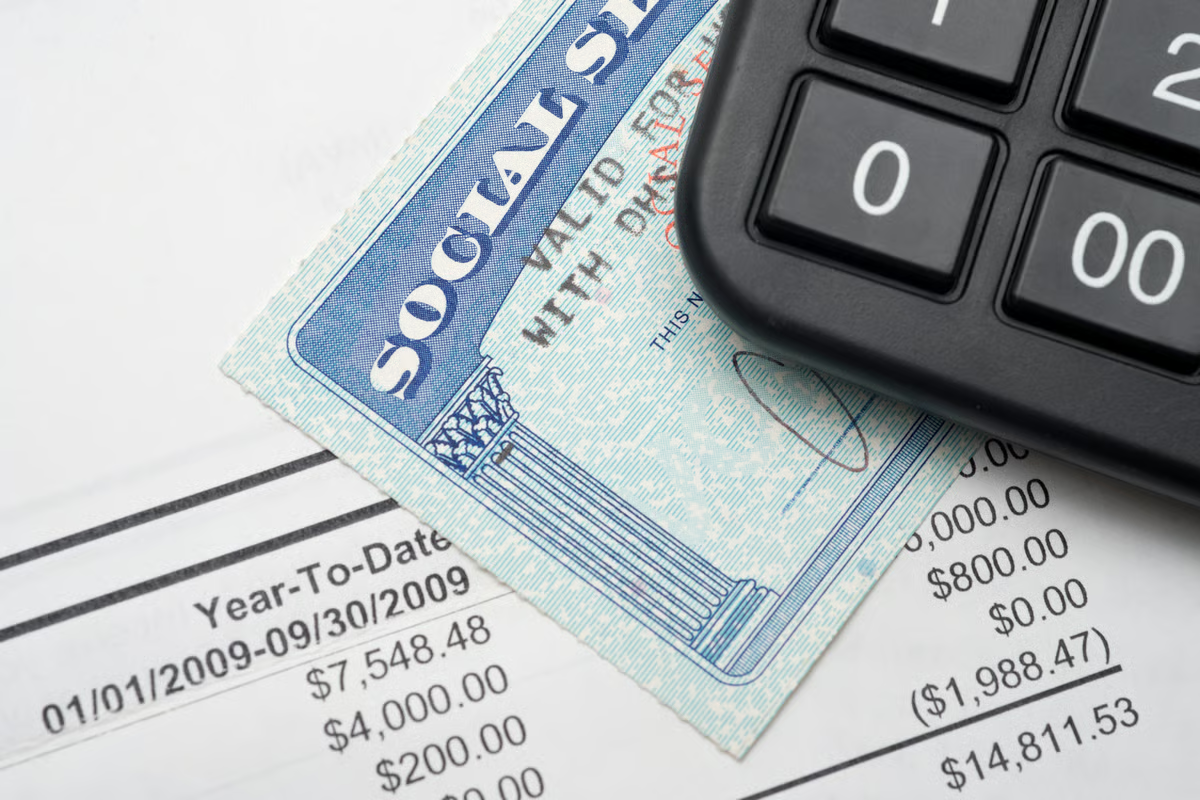
About 40% of Social Security recipients will work at some point after claiming retirement benefits, according to research from the Center for Retirement Research. Understanding exactly how working while collecting Social Security can impact your monthly payments can significantly affect your budgeting in retirement.
Unfortunately for many, working in your 60s could result in Social Security temporarily reducing your payments. In the long run, however, it could work out for the best with significantly larger payments as soon as next year. Here are the major factors to consider when working while collecting Social Security retirement benefits.
Image source: Getty Images.
Why you might see a reduction in benefits this year
The biggest challenge of working while collecting Social Security is that you might be subject to the retirement earnings test. Anyone who has not yet reached full retirement age could see a reduction in their total annual benefits if their wages from work exceed certain limits. And those limits are relatively low.
For 2026, anyone earning over $24,480 from work before the year they reach full retirement age will see a reduction. The amount of that reduction is equal to $1 for every $2 earned above that limit. If your monthly benefit is $1,500, you could see it completely eliminated if you earn $60,480 this year.
The limit is significantly higher in the year you reach full retirement age. For 2026, the limit is $65,160 before seeing any reduction. Additionally, the reduction is only $1 per $3 earned above that limit.
The Social Security Administration uses self-reporting for expected wages when you apply for Social Security to calculate the impact of the earnings test on your benefits. It then reconciles your self-reported wages with any W-2s it receives the following year. If you go back to work after applying for benefits, you should update your information with Social Security to ensure proper withholdings. Otherwise, you’ll receive overpayments, which will come out of your future benefit payments.
How working can boost your future benefits
When Social Security withholds a monthly payment due to the retirement earnings test, it doesn’t just take that money and keep it for the government. It credits your account for the amount withheld. In effect, each month of benefits withheld due to the earnings test is as if you delayed your initial Social Security application by one month. The Social Security Administration then recalculates your monthly benefit based on that effective application date once you reach full retirement age.
Let’s say you retire at age 62 and start collecting a monthly Social Security benefit of $1,500 per month. Between age 62 and full retirement age, the retirement earnings test withheld benefits for a total of 12 months. When Social Security recalculates your benefit at age 67, you’ll see a boost of about 7% to your payment. That’s on top of the annual cost-of-living adjustments (COLAs) you’ve received since claiming benefits.
Another way working while collecting benefits can increase your future payments is by increasing the wages used to calculate your Social Security. The Social Security Administration uses your 35 highest inflation-adjusted earnings years to calculate your benefit. If you haven’t worked 35 years, continuing to work while collecting Social Security will certainly increase your benefits in the long run.
But even if you have worked for 35 years, working in your 60s could be very valuable. That’s because the inflation index Social Security uses to adjust your past earnings is tied to the year you turn 60. So, if you’re currently collecting benefits, earnings from your 20s and 30s are tied to inflation from several years ago, not this year. As such, even if you only earn modestly more in your 60s than you did in your 20s or 30s on an inflation-adjusted basis, more recent earnings may end up being worth more in the eyes of Social Security. The Social Security Administration will recalculate your benefit in the following year and increase your monthly payment.
Making sure you understand how working while collecting Social Security in your mid-60s will impact your benefits, both today and in the future, can help you plan your finances and ensure you don’t get hit with any surprises.
