


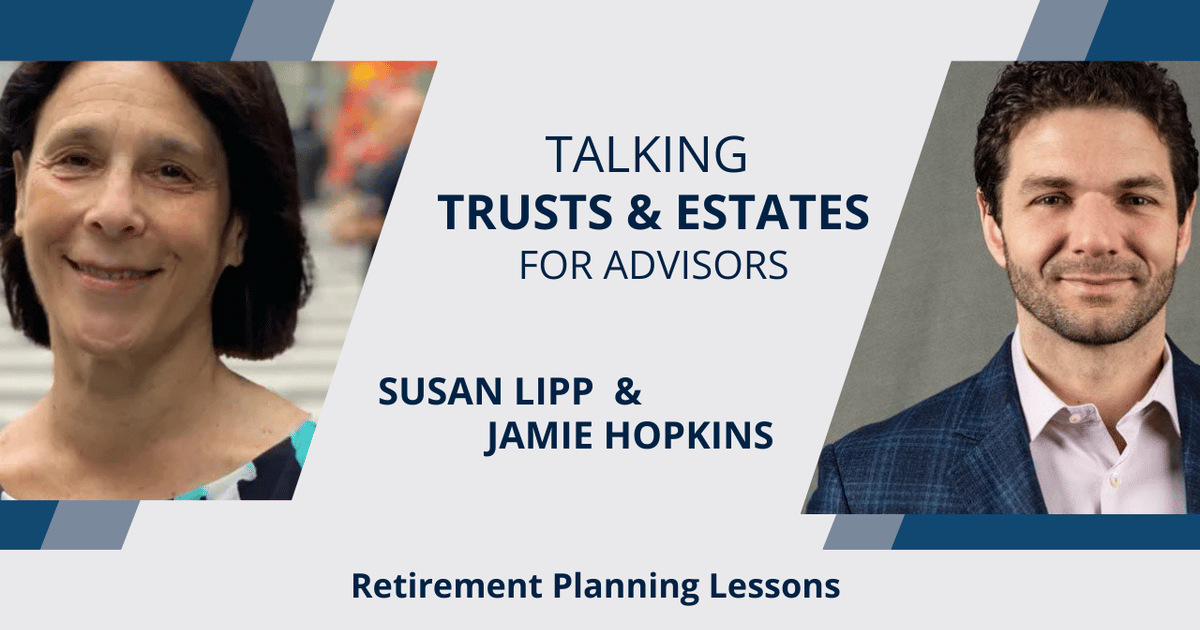
Welcome to Talking T&E for Advisors, where Trusts & Estates Editor in Chief Susan Lipp and Jamie Hopkins, chief wealth officer at Bryn Mawr Trust, take seemingly complex estate planning issues and break them down for financial advisors.
In this video, they discuss Jamie’s new book, Your Retirement Sketchbook, and how advisors can effectively help clients with retirement planning.
What motivated you to write this book on retirement?
How do you help clients with “involuntary retirement?”
What are some of the tax issues involved when considering retirement?
What are some common misconceptions clients have about retirement?
Read the full raw transcript below:
Susan Lipp: Hi, I’m Susan Lipp. I’m editor in chief of Trusts & Estates, and I’m speaking with Jamie Hopkins, the CEO of Bryn Mawr Trust Advisors and the chief wealth officer of Bryn Mawr Trust, and now author of a new book on retirement issues called Your Retirement Sketchbook that has 125 retirement planning lessons. So we’ll be discussing some retirement tips you can share with your clients. I know I was very interested when Jamie gave me that book that you know, that’s something my husband and I have been discussing, and we were just very excited when we saw the title and all the helpful information. So, let’s get started with Jamie.
What was your motivation to write the book?
Jamie Hopkins: Well, I love you starting off with the story of you and your husband looking at it because, you know, that’s part of it, right? I want it to be a helpful tool for people and guide and something that feels less scary and a little bit more fun. I think you said like you saw the sketchbook thing and the drawings, you’re like, oh, we could actually like look at this, and that was really the goal is to make something more fun in our space. A lot of retirement planning boils down to spreadsheets and Monte Carlo analysis instead of the way people want to live their lives.
The other part is the power of visualizations. I’ve been using visualizations for years. I’m a whiteboard and, you know, drawler by nature. If there’s a whiteboard in the room, I will draw on it. I’ve always done this with clients and when I teach. And so I want to put that in the book and kind of challenge advisors to figure out ways to bring visualizations into their own practices. So there’s actually 3 really strong research-backed findings around visualization. So one is use visual metaphors.
I talk a lot about in our space, we really only have two that I hear about is the buckets for bucketing and the mountain for retirement. You go up the one side on savings and come down the other side on the spending, but those are very helpful. But think about other ones you can use in your practice when you’re explaining complex topics.
The other thing is, don’t be afraid to draw things in front of clients. If it’s messy and bad, it’s actually good. So there’s research that shows that messier drawings, when you’re, we used to call these, pencil sales, where you draw on the paper and slide it across and somebody else writes something on it, you invite collaboration when it feels unfinished. And so then they, as the client, partake in this journey of filling out what the sketch is like.
And then the last one is called visual variation, and that’s drawing multiple iterations of the same thing to show a progression. And people really don’t understand concepts until we’ve seen it multiple different ways. You probably know that when you learn and study things, you have to look at it from a bunch of angles. So don’t just think you need to do one picture, draw a couple things, show it changing, and this brings people into the conversation.
Susan Lipp: All right. Well, one of the things I noticed in the book was there was a section on involuntary retirement. That was a sort of scary section, but can you talk a little bit about that?
Jamie Hopkins: Involuntary retirement’s a reality for millions of Americans. Their jobs might be cut, their health might deteriorate, they might have to, you know, the boomerang world of kids coming back or taking care of parents too, and they might just be pushed out of the workforce, not because they want to, but because they have to.
And if you look at some data around retirement planning, what you see is about 45% of people actually retire when they plan to retire. About 45% of people retire earlier than they expected, and only about 10% of people work longer than they expected.
So it is just as likely that you will retire earlier than planned as it is that you actually retire when you plan. So, I always tell people, you need a plan for early retirement, whether you choose to or you get pushed into it from an external factor. So, plan around it, know what does retirement look like if I don’t have those last 3 to 5 years of work? How do I cut back? How do I spend? What does life look like? But just doing that planning in the front end for that contingency puts you in such a better place in case it happens.
Susan Lipp: Are there any tax saving issues that are involved when you’re thinking about retirement?
Jamie Hopkins: Yeah, I mean, for advisors, we know a lot of these things and the question is usually, how do we get them to all of our clients equally. So when we think about Roth conversions, you know, 529 accounts, we actually talked briefly in there too, and how do they play a role if you overfund them. And, you know, you now have the ability to roll a little bit to a Roth, but HSAs, I’m a huge fan of. I’ve been a proponent of using HSAs for the triple tax benefit of tax deductible, tax-deferred gross, tax-free savings, but then also looking at the estate side, you know, where should these assets be sitting? In previous videos, we’ve talked about leveraging trusts potentially to pass on assets to your kids to minimize taxes, but taxes, your house, and healthcare are your three biggest retirement expenses.
So understand how Social Security is taxed, right? Understand how Medicare surcharge kicks in and people get surprised by that one a lot. And then other things to do to manage your tax brackets year to year in retirement, and that’s a huge value add in my opinion of advisers. I actually believe it’s, you know, the biggest area we add value outside of the behavioral side is on effective tax management for clients.
Susan Lipp: Another part of the book that I found really interesting was your advice about maybe right before retirement, like spending some more money, you know, don’t worry so much about savings and actually maybe work a little bit longer because that can increase, you know, what you’re saving for retirement by a lot. And that I think that’s something that most people don’t realize, so I thought maybe you could explain that and if there were sort of other misconceptions that people may have about what they should do around retirement.
Jamie Hopkins: Yeah, I think, Susan, that’s probably one of the ones that shocks people the most when I talk about it is when I say spend more, give yourself permission to spend, take that vacation two years before retirement, go away, and if you can start telling yourself it’s OK to spend nearing retirement, what you actually see is people can stay in the workforce longer.
And if you stay in 6 months longer, it actually is beneficial to stop saving for retirement the 3 years before. Now, depending on how you model that, but just think about it. Saving $10,000 or $20,000 for three years doesn’t have a huge impact. But if you can work six months longer, or, you know, a whole year longer and you’re making $120,000 you get to live off of that again. You don’t have to take the distribution from your portfolio. You don’t have to claim Social Security earlier. And by pushing that year off, it’s actually equivalent to saving about 1% for 30 years prior. That’s kind of the, there’s research out there that talks about that and the delayed and how big of an impact that is. And so that’s often for people, the single biggest thing they can do to improve their retirement security is actually just work a little bit longer.
And I’m not saying work a decade longer, but think about 6 months a year. If I do those nice vacations, I buy a nice car, can I feel that incentive to keep working? And I have a friend. He saw me present this, I think now 2018. He was getting ready to retire in 2019. He took this advice. He takes his family on a great trip every year now and uses that. He stopped saving for retirement and he is still working. He did tell me he’s going to retire this year, but he’s made it about 6 to 7 years longer, and he’s loved it because he was like, I was fearful of like, I didn’t want to pay for all my kids and grandkids to go on this trip, but then when I was working, I took that 20,000, 250, and I used that for a trip. And it gave me the encouragement to keep working. And so, you know, it does work, people do it, and I love that it’s a piece of advice out there.
Susan Lipp: Yeah, I know, I love that idea too, especially the part about, you know, spending the money and going on vacation because that is something I’m always telling my husband, you know, we should do it while we still can and travel, and all that. So, but I think that sounds like really good advice. And again, thank you for sending me the book. It was really very helpful and it has a lot of good suggestions, if any, you know, for anybody with clients who are considering retirement.
Jamie Hopkins: Yeah, well, thank you and thanks for talking about it today. And if you’re an advisor or someone out there, I think one of my big challenges is figure out how to bring visualizations into your work, right? Better client engagement, better storytelling, better understanding from them. Anytime we can tell a story with pictures, it’s gonna be better off.
Susan Lipp: OK, thanks a lot, Jamie.
