


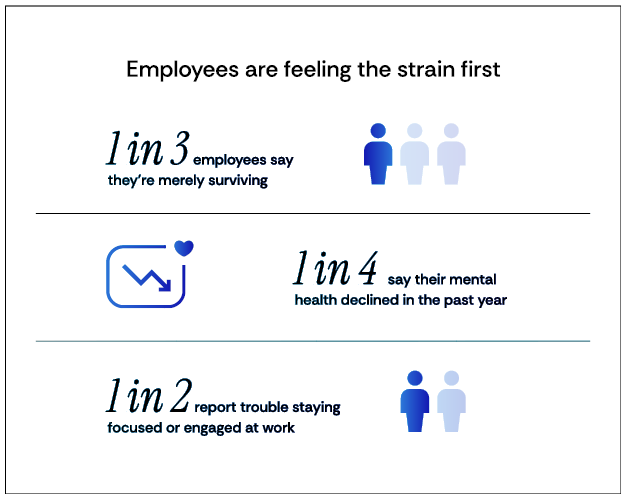
Globally, one in three employees report “merely surviving” the workday—getting by, but not thriving.
This strain is central to of Lyra Health’s 2026 State of Workforce Mental Health report. The study surveyed over 500 benefits leaders and 7,500 employees across six countries. It reveals multiple crises hitting at once, creating an environment that’s tough on HR leaders as well as the workforce.
“The question is no longer whether mental health support exists,” says Jennifer Schulz, CEO of Lyra Health. “It’s whether it intervenes early and effectively enough to truly improve lives.”
Complexity as a clinical issue
The data shows a rise of complex, severe conditions. A decade ago, most workforce mental health conversations centered on stress, anxiety and mild depression. This is the territory where EAPs and short-term therapy were designed to help. According to the study, the territory has expanded.
Ten percent of the global workforce now reports a complex condition such as PTSD or bipolar disorder, a 67% increase year over year. More than one-third of employees report personal or family experience with serious conditions, including severe depression, eating disorders and substance use challenges.
When those employees seek care, they run into a system built for a different level of need. According to researchers, 56% struggled to find the right level of care, 55% faced long waitlists and 54% couldn’t find a specialist or specialty program.
“Complexity isn’t just a clinical issue, it’s a design challenge,” says Sean McBride, president of employer solutions at Lyra Health. “The way benefits are structured determines whether employees get stuck navigating systems or reach the right care quickly enough to make a difference.”
Researchers found that nearly seven in 10 benefits leaders say employee mental health challenges significantly hurt performance over the past year, and 65% report more mental health–related disability leave. Costs that were once hard to quantify are now visible in lost productivity and rising leave claims.
Read more: The impact of unmet mental health needs
Family-inclusive benefits are good for retention
The pediatric mental health crisis is not staying in pediatrics. Nearly half of working parents supported a child or dependent with mental health needs in the past year. Sixty percent experienced increased stress or burnout as a result. More than a third report reduced productivity or focus at work. Researchers say this is a direct, measurable transfer of strain from the family system to the organization.
But the left hand doesn’t seem to know what the right hand is doing on this point. Ninety-five percent of benefits leaders believe child and teen mental healthcare is easy to find through their benefits. Employees increasingly disagree, with fewer saying they can access timely pediatric mental healthcare year over year.
The issue, the data suggests, is not the availability of general therapy. The greater tangle is that specialized care for ADHD, trauma, eating disorders and neurodevelopmental needs has long waitlists and is difficult to navigate.
HR leaders may want to consider that family-inclusive benefits are not a perk but a retention sticking point. Seventy-eight percent of employees say they would stay at a job because of strong, family-inclusive mental health benefits. Fifty-four percent say they would consider leaving without mental health benefits at all.
AI is splitting the workforce
AI is not uniformly helping or hurting employee mental health. It is doing both, simultaneously, and the difference comes down to how organizations deploy it.
Forty-eight percent of employees say AI makes them more productive. Forty-three percent say it improves work/life balance. But 46% feel pressure to always be “on” because of AI, 44% feel anxiety about job security and 36% feel more isolated.
“AI adoption succeeds or fails based on its human impact,” says Joe Grasso, vice president of workforce transformation at Lyra Health. “Organizations that treat AI as a change initiative, with clear communication, expectations and feedback loops, see productivity gains without added burnout.”
Read more | The overlooked skills gap: Mental health training for managers
The manager model ‘isn’t sustainable’
Benefits leaders and managers see mental health very differently:
- 93% of benefits leaders believe their managers are mentally healthy and thriving.
- 54% of managers report the role has harmed their mental health.
- 48% have considered quitting due to mental health pressures.
Meanwhile, 94% of benefits leaders say their company offers mental health support for managers. Clearly, that support isn’t reaching or helping them effectively.
The report attributes the disconnect to how support is designed. Organizations invest in tools that help managers support their teams while providing fewer resources focused on managers’ own development, workload and decision-making authority. Managers are being asked to absorb organizational strain without the structural authority to address its sources.
“Managers have become the shock absorbers of organizational strain,” Grasso says. “They’re expected to deliver results, support mental health and absorb change, often without the authority to fix the conditions creating the pressure. That model isn’t sustainable.”
One challenge, different realities
The global dimension of the report adds important texture for HR leaders at multinational organizations. While the underlying challenge is shared, the local expressions are not. For HR leaders managing global workforces, a single mental health strategy will not hold across these markets.
- In Germany, 75% of employees report long waitlists for inpatient or specialty care, the highest of any market surveyed.
- In France, only 9% report improved mental health, also the lowest globally, and 55% of those who didn’t access care simply didn’t know their benefits existed.
- In Canada, 31% report a drop in coping ability and cost remains a meaningful barrier.
- In the U.K., 66% of managers feel expected to handle crises without adequate training.
- Mexico stands out as a relative bright spot, with 26% reporting improved mental health, but 49% accessed care out of pocket, signaling unmet expectations for benefits breadth.
The report’s theme is not that mental health benefits don’t work; but the standard for what “working” looks like needs to rise. Expanding access was a necessary first step. The next chapter, the report argues, requires clinical excellence, integration across systems and accountability for outcomes.
