


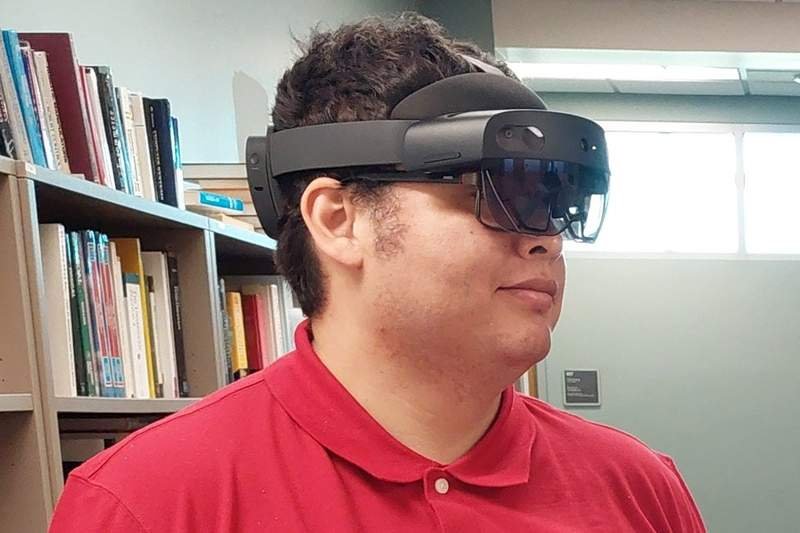
Before the headset went on, Armand could complete exactly one step of the task correctly. One out of ten. He wasn’t struggling because he wasn’t trying. The task, shelving library books in assigned locations, involves reading, pattern recognition, and spatial navigation. Without guidance, it stayed just out of reach.
Then a researcher handed him a Microsoft HoloLens.
Within a single session, Armand completed 80 percent of the task steps correctly and independently. By the fourth session, he was at 100 percent. Nineteen days after the intervention ended, with no headset, no coach, no prompting of any kind, he was still at 100 percent.
Three other participants in the study followed a nearly identical arc.
Researchers at Florida Atlantic University wanted to know whether augmented reality could change that equation. (CREDIT: Shutterstock)
The 15% Problem
Only about 15 percent of people with intellectual and developmental disabilities hold competitive, integrated employment. That number has remained stubbornly low despite decades of federal investment in supported employment programs and policy frameworks designed to open the workforce to people with significant disabilities.
The gap isn’t for lack of effort. Supported employment uses trained job coaches to help people find and keep work, with coaching gradually reduced as independence grows. The model works, but it’s expensive, labour-intensive, and fragile. Job coaches turn over frequently, institutional knowledge disappears with them, and the personalised support that makes the difference in early training is difficult to sustain over time.
Researchers at Florida Atlantic University wanted to know whether augmented reality could change that equation. Their study, published in Focus on Autism and Other Developmental Disabilities, tested an AR application designed to function as a virtual job coach, delivering step-by-step guidance through a wearable headset in real time.
“Our findings show that augmented reality can dramatically accelerate job training for individuals with intellectual and developmental disabilities by breaking complex tasks into manageable, real-time supports,” said study senior author Ayse Torres, an associate professor in counselor education at FAU’s College of Education.
Designed to Be Hard
The researchers deliberately chose a demanding task.
Library assistant work requires active listening, reading comprehension, critical thinking, and pattern recognition. It sits above the skill level of many jobs typically assigned to people with IDD in supported employment settings. That was the point. If AR could support someone through a cognitively complex task, it would say more about the technology’s potential than demonstrating performance on simple, repetitive work.
Task Analysis of Shelving a Book in Pre-Assigned Location. (CREDIT: Focus on Autism and Other Developmental Disabilities)
The four participants were young adults, ages 20 to 26, all with diagnosed intellectual disabilities. Two also had autism spectrum disorder. None had prior paid work experience, though two had done volunteer or training work. All were enrolled in a university transition program and communicated verbally in English at roughly a fourth-grade reading level.
During baseline, participants were asked to shelve books with no guidance. The result was consistent across all four: an average of 14 percent of task steps completed correctly, ranging between 10 and 30 percent. That baseline stability confirmed the task’s genuine difficulty before the intervention began.
What the Headset Does
The AR application works through a sequence of prompts tied to the actual environment. A participant puts on the headset, scans the barcode on a book, and the device generates blue virtual lines overlaid on the real room, directing them to the shelf where the book belongs. An audio cue confirms the final placement step. The whole interaction is hands-free. No coach speaks. No researcher prompts. The guidance comes entirely from the software.
Training participants to use the headset took fifteen minutes.
Once the intervention began, performance shifted immediately. Average task accuracy across all four participants climbed to 93 percent, with two participants reaching 100 percent after just two sessions. All four met the study’s mastery threshold, completing at least 90 percent of steps correctly and independently across four consecutive sessions.
The 15-minute orientation to the headset produced results that traditional supported employment coaching typically takes two to four months to achieve.
Retention Without the Device
One question any job training study has to answer is whether skills persist once the support is removed. Here, the answer was clear. The researchers conducted maintenance checks between seven and 49 days after the final intervention session, with participants working through the task under the same conditions as baseline, no headset, no coaching, no prompts.
Percentage of Steps Completed Correctly and Independently. (CREDIT: Focus on Autism and Other Developmental Disabilities)
All four participants maintained 100 percent accuracy. Armand held that level at both 19 and 49 days. Gary and Jared did the same. Geraldo maintained full accuracy at his 21-day check.
The effect size calculations reinforced what the individual results showed. The percentage of non-overlapping data between baseline and intervention phases was 100 percent for every participant, and the aggregate Tau-U effect size, a statistical measure of intervention strength well-suited to small single-case studies, came out at 1.0.
The Cost Argument
Beyond accuracy, the researchers see a financial case for AR in supported employment programs. Job coaching scales linearly with participants: more people, more coaches, more cost. An AR application, once developed, doesn’t. Adding participants requires hardware, but not proportional hours from trained staff. The system delivers guidance consistently regardless of how many people use it.
“If we can use technology to help people work more independently while allowing programs to stretch their resources further, we create a system that benefits individuals, employers and service providers alike,” Torres said.
The upfront costs are real. AR headsets remain expensive, and application development requires software engineering. But the researchers argue those costs look different when measured against the alternative of months of one-on-one coaching that still depends heavily on the experience and consistency of individual staff members.
Honest About the Limits
The study is a proof of concept, and the researchers say so plainly. Four participants at a single university site, working through one task, is not a basis for broad claims about what AR can do across the full range of jobs and settings where supported employment operates.
The study also didn’t examine job satisfaction, social dynamics at work, or how the technology interacts with the presence of coworkers and supervisors. Whether the precision and independence participants demonstrated in a controlled hallway setting would transfer to a real library, a warehouse, or a retail stockroom remains to be tested. Long-term job retention, not just task accuracy in training, is the outcome that actually matters for people’s lives.
Cost-benefit analysis at industrial scale is still needed. And the study didn’t investigate what happens when employers, not just participants, are asked to engage with the technology or accommodate its use in a live workplace.
Practical Implications
The employment rate for people with IDD has not moved meaningfully in years. The barriers are structural, systemic, and persistent. No single intervention resolves them.
What this study adds is a specific, measurable demonstration that a technology widely used in manufacturing, healthcare training, and logistics can produce rapid, durable skill acquisition in a population that conventional training timelines have consistently underserved. The skills involved, scanning, navigation, spatial organization, transfer directly to shelf-stocking, inventory management, and other roles that represent real employment pathways.
For supported employment programs operating under tight budgets and high coach turnover, a tool that compresses months of training into sessions and maintains its guidance consistently regardless of staff changes addresses a genuine operational problem. The question of scale, whether that promise holds across more people, more jobs, and more varied workplaces, is where the next phase of research needs to go.
Research findings are available online in the journal Focus on Autism and Other Developmental Disabilities.
The original story “AR headset transforms workplace training for people with disabilities” is published in The Brighter Side of News.
Related Stories
Like these kind of feel good stories? Get The Brighter Side of News’ newsletter.
