


Introduction
Traumatic injury affects individuals and entire populations; social drivers of health (SDOH) not only impact risk of injury but subsequent recovery and quality of life after injury.1 2 Medical therapy has historically focused on the biologic nature and medical management of disease processes with less attention to the complex psychosocial factors that contribute to health outcomes. We now better understand that socioeconomic factors, physical environment, and health behaviors play pivotal roles in analyzing an individual’s health status and the health of entire communities. More recently, the synergistic importance of both medical and psychosocial support has been considered at the forefront of healthcare, including trauma care.3–5 This more holistic, biopsychosocial model, requires consideration of the social factors that influence health outcomes to systematically address them.
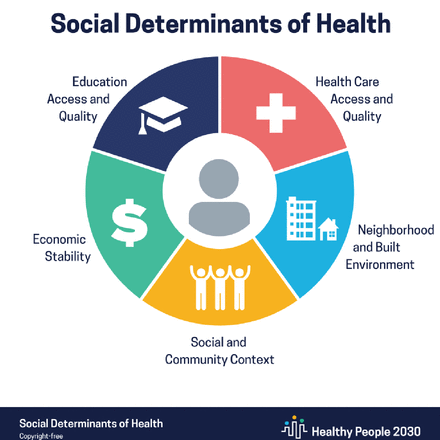
The health outcomes affected by SDOH include medical outcomes, as well as quality of life, functional status and mental health.6 The Centers for Disease Control and Prevention (CDC) categorizes SDOH into five domains: healthcare access and quality, education access and quality, social and community context, economic stability, and neighborhood and built environment (figure 1).6–8 The WHO, along with other key health agencies, estimates that SDOH may account for up to 80% of health outcomes.3 Despite evidence reinforcing the significant impact of SDOH on recovery from injury, trauma centers do not universally screen for SDOHs. Physicians and care teams may therefore have limited understanding of patients’ specific needs for a more comprehensive approach to recovery. Trauma centers are, however, uniquely positioned to play an impactful role in the mitigation of health inequities often faced by trauma patients, and addressing the SDOH brings forth the potential for improving an individual’s life trajectory. When injured patients present to a trauma center, an opportunity exists to identify and address the health-related social needs (HRSNs) of patients that stem from an unequal distribution of SDOH, and capitalizing on this unique opportunity ultimately influences morbidity, mortality, and quality of life.9–11
Five domains of the Social Determinants of Health.6
In recognition that SDOH are a key component to reducing injury risk and improving injury recovery, the Improving Social Determinants of Health to Attenuate Violence (ISAVE) workgroup was established by the American College of Surgeons Committee on Trauma. This multidisciplinary work group was created with the overarching goal of understanding SDOH and addressing the root causes of violence using a multifaceted public health approach. Four key recommendations have been developed by the ISAVE workgroup, one of which is the integration of social care into trauma care.12 ISAVE advocates for the widespread screening for SDOH across inpatient and outpatient trauma settings and provides a framework for implementation of these screenings. Screening and documenting SDOHs can help practitioners develop precise interventions to address the root causes of violence in partnership with local communities most impacted by violence.
In this article, we will (1) describe the impact of SDOH on injuries and outcomes in trauma patients, (2) describe the value and importance of screening, and (3) provide examples of effective and impactful interventions trauma centers have or may use to improve SDOH in the communities they serve.
The impact of SDOH on injuries and outcomes in trauma patients
SDOH contribute significantly to both injury risk and clinical outcomes. Epidemiologic data consistently demonstrate that individuals from structurally vulnerable communities experience disproportionately higher rates of injury, often due to systemic inequities and limited access to preventive resources.13 14 These factors not only increase the likelihood of injury but also contribute to disparities in recovery and adversely influence long-term health outcomes, as marginalized populations are more likely to encounter barriers to timely and effective medical care, rehabilitation services, and social support.15 Understanding the intricate interplay between SDOH and injury outcomes is essential so that designing equitable interventions that address root causes, reduce disparities and enhance health equity can be designed.
Social vulnerability at the neighborhood level can be assessed using a number of different indices, including the Area Deprivation Index, Social Vulnerability Index, and Distressed Communities Index.16–18 There are 15 measures that are commonly used in the literature.18 Each of these indices includes different domains, such as economic status, education, transportation, race and ethnicity, and insurance status. Domains used in common socioeconomic deprivation indices are listed in table 1.
Domains used in six common socio-economic deprivation indices
Existing evidence supports the idea that addressing disparate SDOH will improve overall health, but enacting meaningful change is complicated, and easier said than done. In many communities, the disparities across all five SDOH domains result from generations of inequitable distribution of public resources, structural racism, redlining, and many other factors. Further, each individual SDOH domain interconnects with the other domains creating a dense web. For example, opening a healthy food store in a community without considering communal culture and affordability will likely not produce the intended results. However, the interdependence of the domains warrants a multipronged approach. Addressing multiple domains and inequities has the potential to produce positive and sustainable change. For instance, a vacant lot might be transformed into a volunteer-run community garden where food is grown and distributed to residents. This improves the built environment, gives access to free or nearly-free healthy food, teaches children about nutrition and life skills, provides an avenue for stress reduction and extracurricular activities, creates spaces for community gatherings, and promotes social connectedness. Such “urban blight remediation” efforts have been shown to reduce violent crime.19 Addressing SDOH and political determinants of health (ie, the policies that often lead to adverse SDOH) requires meaningful partnership and engagement with communities most impacted in order for the solutions to be relevant and context appropriate.
Specifically, trauma and adverse SDOH are bidirectionally linked, in that, the same structural conditions that increase the risk of injury also render trauma patients particularly vulnerable to their downstream effects. Housing insecurity defined as unstable or inadequate shelter including substandard quality, lack of safety, overcrowding, risk of eviction or homelessness is an illustrative example. In a single institution cohort study of trauma survivors in Atlanta, 37.8% reported housing insecurity which exceeds national averages.20 Individuals with unstable housing had significantly higher rates of penetrating injury. This study suggested that housing insecurity may not only be a risk factor that predisposes people to trauma but also that traumatic injury may exacerbate housing instability, creating a vicious cycle.20
Screening for SDOH
Current evidence suggests an overwhelming benefit of screening patients for SDOH and addressing identified needs including improved patient health outcomes and well-being.21 22 As of January 1, 2024, Centers for Medicare and Medicaid Services (CMS) requires screening all patients for five social domains that impact health and outcomes: interpersonal safety, food insecurity, housing instability, transportation needs, and utility needs. HRSNs Screening Tool is a comprehensive measure of social risks as part of the CMS Accountable Health Communities model.23 In addition to the five core social risk domains, additional questions evaluate financial strain, employment, family and community support, education, physical activity, substance abuse, mental health, and disabilities. To date, there are no studies specifically using the expanded HRSN supplemental screening tool in trauma populations which highlights an underused method of addressing health needs and achieving health equity.
For injured patients, screening methods vary among trauma centers but should seek to discover past experiences (eg, ACEs, acute and chronic stress disorders, victimization, allostatic load) and present HRSNs (eg, food insecurity and mirage, lack of insurance and transportation, illiteracy, lack of familial or communal support) that negatively impact recovery and health outcomes.24 Several screening tools exist to identify at-risk individuals either within a specific domain or across all five domains. Inquiring about interpersonal violence can be integrated into the early assessments of injured patients by use of validated surveys such as HITS (Hurt, Insult, Threaten, Scream) and SAVE (sexual violence) or by asking simple questions like “Do you feel safe at home?”. In a multicenter study by Zakrison et al, one in nine patients seen for any traumatic injury mechanism was found to be at risk for intimate partner violence when universal screening was implemented using HITS and SAVE.25
In addition to the information learned from the screening tools, the act of screening itself is valuable. Patients reflecting on their responses may learn about the interconnectedness of past experiences, social needs, current medical conditions, recovery, and quality of life. Identifying and addressing social needs and operating under the principles of trauma-informed care helps healthcare workers build trust with patients.26 Strengthening the patient–provider relationship promotes patient autonomy, participation, and collaboration in shared medical decision-making.27 Traditional measures of healthcare quality, such as morbidity, mortality, hospital length of stay, readmission rates, patient satisfaction, and other outcomes are improved when holistic biopsychosocial care is provided.28 29 Additionally, addressing SDOHs has been shown to lower healthcare costs, improve patient experience, and demonstrate other positive outcomes.30–32
For screenings to reach maximum effect, they must be continued throughout recovery. To accomplish this, trauma centers and trauma systems must engage in community partnerships. Significant resources are required to implement and sustain partnerships; however, the benefit is the creation of a trauma-informed ecosystem. Such systems provide survivors access to a network of organizations and resources that promote individual and communal resilience and recovery.
Although evidence clearly supports the screening of SDOHs and implementation of programs to address SDOHs, reimbursement of this complex level of care does not yet exist. Although there is taxonomy to identify medical complexity, there are no such codes to identify social complexity and increase reimbursement. For example, a −22 modifier can be added to surgical cases that are outside of the usual level of procedural complexity. Although many patients have complex social circumstances that lengthen their hospitalization or require increased resources, there is little means by which a hospital can recover the costs of these investments. This may disincentivize hospitals from implementing additional screening or services beyond the baseline regulatory requirements.
As SDOH screening becomes more widespread and particularly with the 2024 mandate from CMS, it is critical for healthcare systems to consider the ethical dilemma of identifying problems for which no intervention is available or offered. Psychological injury to the patient can result from identifying barriers to improved health outcomes without providing resources to overcome those barriers.33 Additionally, a recent survey found that screening for SDOH without resources and services to address identified needs leads to physician burnout.34 This burnout is of particular concern given the potential compounded effect with the known stressors of the field of trauma.35 As such, healthcare systems should pre-emptively identify resources for patients and make every attempt to assist patients with accessing those resources. Fortunately, several publicly available repositories to help identify local resources exist. Meaningful partnerships with local communities can lead to opportunities to engage culturally appropriate community health workers and patient navigators in the journey to address SDOH and mental healthcare. An example of this is the inclusion of violence prevention professionals (officially part of CMS taxonomy), into the fabric of trauma centers as part of hospital-based violence intervention programs (HVIP). Some states now provide reimbursement for the services of community health workers and violence prevention professionals.
Exemplary programs
Despite challenges with implementation of universal SDOH screening, there are examples of effective and impactful programs. For example, though food insecurity, defined as limited or uncertain access to nutritious food sources, impacts nearly 34 million people in the USA and is linked to worse health outcomes, very few trauma centers screen for hunger.36–38 In a single institution study in Atlanta, Smith and colleagues described the correlation of food insecurity and firearm injury with shared root causes of poverty and other negative SDOH.37 The same center identified food insecurity in nearly a quarter (22.8%) of injured patients using a validated screening tool, The Hunger Vital Sign. This data has been translated into action and has led to partnerships with the institutional Food as Medicine program that provides nutritional education and support to individuals with a positive screen.38 39
As introduced above, other exemplary programs have used various SDOH screening to guide the resources and support provided to trauma patients through their Hospital-based Violence Intervention Program (HVIP). The tenets of the HVIP model include employment of credible messengers from the community (violence prevention professionals) who first interface with patients quickly after they are injured and provide mentorship and tailored risk reduction resources. At the core of this is the necessary screening for specific psychosocial determinants impacting their clients. In an assessment of a decade of services, Juillard et al discovered education, employment, financial compensation and other social drivers significantly impact recurrent injury and recovery.40
Social care and health justice: examples of the impact of policy initiatives
Addressing SDOH within trauma systems requires more than regulatory mandates and individual patient screening; it requires structural investment aligned with health justice, defined as the fair distribution of opportunities, resources and protections for achieving health. Trauma populations illustrate the consequences of structural inequities clearly. Policy initiatives that expand access to care, such as Medicaid expansion, have been associated with decreased in-hospital trauma mortality and improved access to rehabilitation services, demonstrating that upstream policy decisions can directly affect trauma outcomes.41
Additionally, Hospital-based Violence Intervention Programs (HVIPs), which are supported in some jurisdictions through a mix of local, state, philanthropic and health-system funding, demonstrate the impact of integrating social care into trauma systems. HVIPs have reduced recurrent injury, arrests, and system-level costs.42–46 Community health workers and medical-legal partnerships embedded within trauma centers further address barriers such as follow-up care, housing and disability navigation, all of which shape trauma recovery trajectories. Together, these examples underscore that advancing health justice within trauma requires policies that strengthen the social and structural supports essential for recovery and long-term well-being after trauma.
