

Close Menu

    Subscribe to Updates

    Get the latest creative news from FooBar about art, design and business.

    What's Hot

    We teach algebra before emotional regulation and our students are paying the price 

    May 24, 2026

    The Silent Killer of Entrepreneurial Dreams (And How to Make Sure It Never Takes Yours Down)

    May 24, 2026

    3 Daily Habits that Often Drain 90 Percent of Our Potential in Life

    May 24, 2026
    Facebook X (Twitter) Instagram
    Trending
    • We teach algebra before emotional regulation and our students are paying the price 
    • The Silent Killer of Entrepreneurial Dreams (And How to Make Sure It Never Takes Yours Down)
    • 3 Daily Habits that Often Drain 90 Percent of Our Potential in Life
    • You don’t need ADHD to benefit from neurodiversity coaching
    • 25 Free Ocean Coloring Pages for Adults
    • How stress physically changes your sleep patterns
    • If I Could Tell All Retirees 1 Thing About Social Security Right Now, It’s This
    • Good News This Week: May 23, 2026
    Moving MountainsMoving Mountains
    Facebook X (Twitter) Instagram
    Sunday, May 24
    • Home
    • Mental Health
    • Life Skills
    • Self-Care
    • Well-Being
    • Awareness
    • Inspiration
    • Workers Comp
    • Social Security
      • Injuries
      • Disability Support
      • Community
    Moving MountainsMoving Mountains
    Home » Scientists Successfully Mine Meteorites for Precious Metals on International Space Station
    Community

    Scientists Successfully Mine Meteorites for Precious Metals on International Space Station

    TECHBy TECHMarch 5, 2026No Comments3 Mins Read
    Facebook Twitter Pinterest LinkedIn Tumblr Reddit WhatsApp Email
    Scientists Successfully Mine Meteorites for Precious Metals on International Space Station
    Share
    Facebook Twitter LinkedIn Pinterest WhatsApp Email

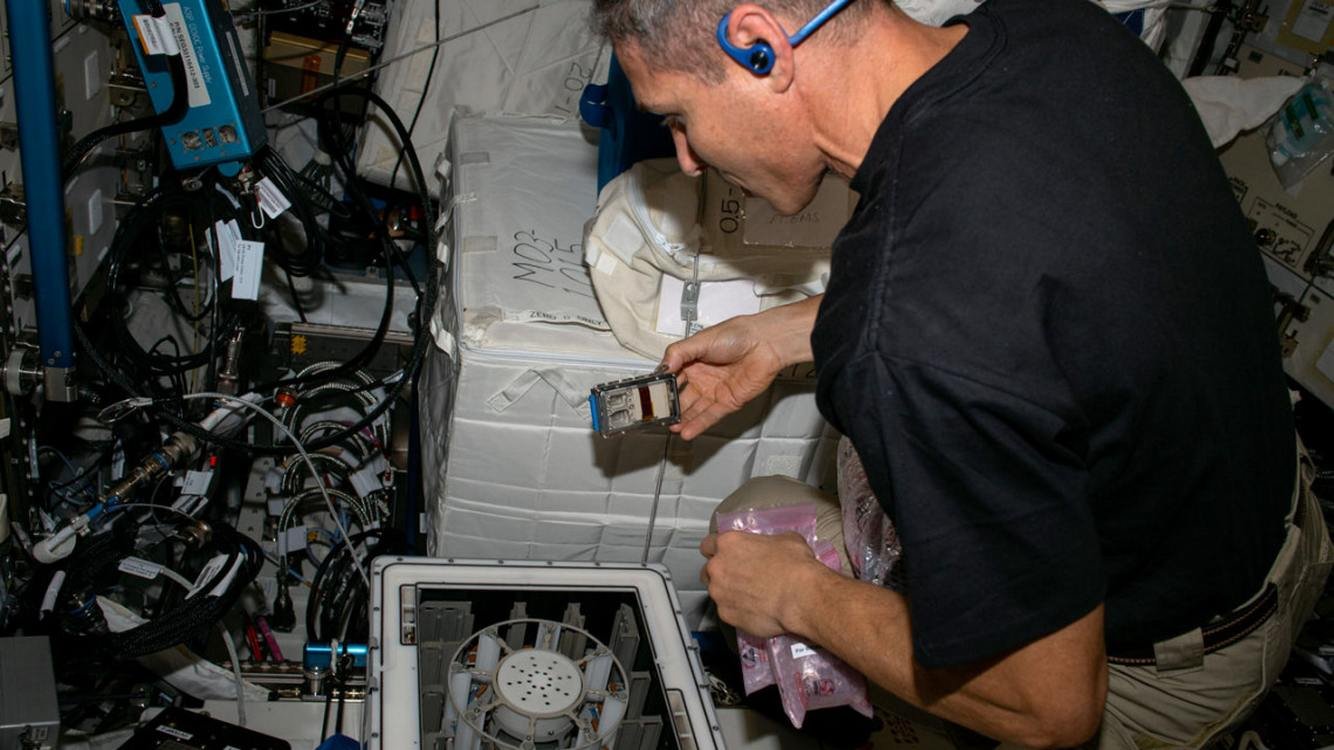
    NASA Astronaut Michael Hopkins performing an asteroid mining experiment on board the ISS – credit, NASA via Cornell University – released

    Last week, GNN reported that fungi were being trailed by scientists in Austria for their potential to extract valuable metals from electronic and industrial wastes.

    Now from the ISS comes a very similar story where, rather than ‘mushroom mining,’ scientists were able to extract platinum and palladium with ‘microbe mining.’

    It’s actually ‘microbe meteorite mining,’ as the scientist in question, NASA astronaut Michael Scott Hopkins, conducted the tests on L-chondrite meteorite samples which has long been theorized as a valuable source of minerals of all kinds.

    All elements we know of are made inside stars, and are embedded inside planets when they explode. This process is the same for asteroids, and at a time when humans are spending more and more time in space, scientists are interested in figuring out how to harvest materials from meteorites and moon dust, as it would likely be cheaper than flying them up from the Earth.

    A team of researchers from Cornell and Edinburgh universities recently published a paper in which they performed the same experiment in tandem with Hopkins.’ Both used a bacterium and a fungus to successfully harvest two precious metals with demand for space technology and hardware: platinum and palladium, from asteroids.

    The organisms achieve this by producing carboxylic acids which attach themselves to these minerals on the asteroids. Once placed in a liquid solution, the acids slough away and bring the minerals with them.

    By comparison to the Cornell experiment, the one aboard the ISS found that microgravity enhanced the fugus Penicillium simplicissimum’s ability to uptake and release palladium and platinum, showing that “bioleaching,” the technical term behind microbe mining, is for one reason or many, more effective in space than on Earth.

    MORE STORIES LIKE THIS: China’s New Moon Rock Samples Contain Beautiful Crystal New to Geology

    In direct contrast, nonbiological leaching—in which a solution without microbes is used to pull out the elements—was less effective in microgravity than on Earth.

    “Another complex but very interesting result, I think, is the fact that the extraction rate changes a lot depending on the metal that you are considering, and also depending on the microbe and the gravity condition,” Rosa Santomartino, Cornell professor and first author for the study, said in a statement to Cornell Chronicle.

    OPERATING LONG-TERM IN SPACE: Lava Tubes and Water Frost Found on Mars Offer Double Opportunity in Search for Life

    Several companies are already developing solutions to mine asteroids in space, among which is TransAstra. This firm, which had originally attempted to develop a series of autonomous mining probes, has shifted focus to asteroid mining technologies, including a system for reflecting the light of the Sun to melt and recover valuable elements from asteroids, and a capture bag that can be used to collect passing micrometeorites or space debris for later processing.

    SHARE This Impressive Demonstration For A Possible Future In Space…

    International Metals Meteorites Precious Scientists Space Station Successfully
    TECH
    • Website

    Related Posts

    3 Daily Habits that Often Drain 90 Percent of Our Potential in Life

    May 24, 2026

    Good News This Week: May 23, 2026

    May 24, 2026

    Animal DNA Samples Can Pinpoint Hotspots of Illegal Wildlife Trade Routes

    May 24, 2026
    Leave A Reply Cancel Reply

    Don't Miss
    Awareness

    We teach algebra before emotional regulation and our students are paying the price 

    By TECHMay 24, 20260

    By Nakoda C. Jordan  In Washington, D.C., about one in five youth experience a mental…

    The Silent Killer of Entrepreneurial Dreams (And How to Make Sure It Never Takes Yours Down)

    May 24, 2026

    3 Daily Habits that Often Drain 90 Percent of Our Potential in Life

    May 24, 2026

    You don’t need ADHD to benefit from neurodiversity coaching

    May 24, 2026
    Stay In Touch
    • Facebook
    • Twitter
    • Pinterest
    • Instagram
    • YouTube
    • Vimeo
    Our Picks

    We teach algebra before emotional regulation and our students are paying the price 

    May 24, 2026

    The Silent Killer of Entrepreneurial Dreams (And How to Make Sure It Never Takes Yours Down)

    May 24, 2026

    3 Daily Habits that Often Drain 90 Percent of Our Potential in Life

    May 24, 2026

    You don’t need ADHD to benefit from neurodiversity coaching

    May 24, 2026

    Subscribe to Updates

    Get the latest creative news from SmartMag about art & design.

    About Us

    At Moving Mountains, we believe that every individual has strength, value, and purpose—regardless of mental health challenges or physical disabilities. This platform was created to inspire hope, promote understanding, and empower people to live meaningful and confident lives beyond limitations.

    Latest Post

    We teach algebra before emotional regulation and our students are paying the price 

    May 24, 2026

    The Silent Killer of Entrepreneurial Dreams (And How to Make Sure It Never Takes Yours Down)

    May 24, 2026

    3 Daily Habits that Often Drain 90 Percent of Our Potential in Life

    May 24, 2026
    Recent Posts
    • We teach algebra before emotional regulation and our students are paying the price 
    • The Silent Killer of Entrepreneurial Dreams (And How to Make Sure It Never Takes Yours Down)
    • 3 Daily Habits that Often Drain 90 Percent of Our Potential in Life
    • You don’t need ADHD to benefit from neurodiversity coaching
    • 25 Free Ocean Coloring Pages for Adults
    Facebook X (Twitter) Instagram Pinterest
    • About Us
    • Contact Us
    • Privacy Policy
    • Terms & Conditions
    • Disclaimer
    © 2026 movingmountains. Designed by Pro.

    Type above and press Enter to search. Press Esc to cancel.