


Written by: Rhea Srivastava, Moitrayee Das
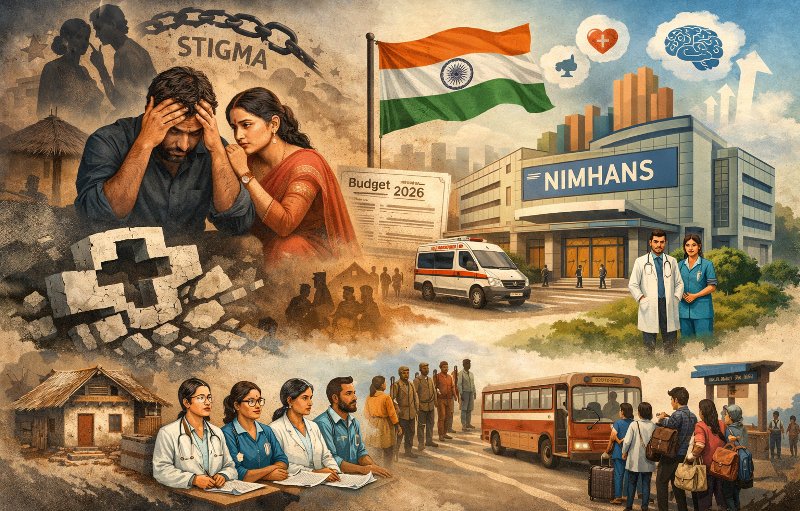
In a country where the treatment gap for almost all mental disorders is over 60% (Gururaj et al., 2016), the setting up of another NIMHANS means much more than just a new mental health institute in Northern India. It signals that India is beginning to prioritize mental healthcare like never before. The Union Budget of 2026–27 has finally begun to recognize citizens’ need for more accessible and quality mental healthcare.
This major step begins to give mental healthcare the attention that has long been overdue. Despite the longstanding need for better systems, the Union Budget has rarely, if ever, explicitly addressed mental health. Post-COVID-19, the effects of the lockdown included an increase in symptoms of depression, anxiety, and other mental health issues (Kumar & Nayar, 2020). Yet, the only notable mention of mental health in the Union Budget of 2022 was the initiation of the National Tele Mental Health Programme (Sitharaman, 2022).
The mere mention of mental health as an important milestone toward Viksit Bharat marks a significant shift from previous years. For example, the 2025–26 Union Budget made no explicit mention of mental health and only referred broadly to access to affordable, comprehensive healthcare. Alongside setting up a new NIMHANS, the government has planned to increase emergency and trauma care centres by 50%, upgrade National Mental Health Institutes in Ranchi and Tezpur as Regional Apex Institutions, and increase the number of institutes for allied health professionals, with the aim of producing one lakh more allied health professionals over the next five years (Sitharaman, 2026).
The total mental health budget in 2025–26 was ?1,898 crore, which is around 1% of the total budget allocated to the Ministry of Health and Family Welfare. While figures for the exact mental health allocation for 2026–27 are not yet available, the Ministry of Health and Family Welfare has received a 10% increase compared to the previous year (Centre for Mental Health Law & Policy, 2025).
While these changes are certainly a step in the right direction, they may not be sufficient for several reasons.
So, what additional factors need to be considered?
In a country like India, where mental health remains highly stigmatized, there is a dire need to address not only accessibility for vulnerable populations but also the cultural factors contributing to hesitancy in seeking care. According to Sanghvi and Mehrotra (2021), barriers to help-seeking behaviour for mental health concerns include lack of awareness, social and self-stigma, apprehension about unnecessary treatment, and misconceptions, among others.
In Indian culture, marriage is given utmost importance, as it is viewed as a necessity across most religions. Arranged marriages remain a culturally dominant practice, with families of both parties actively involved in approving the match. In such a context, societal perceptions of individual characteristics significantly influence marriage prospects. Mental illness is often perceived as making a person unsuitable for marriage. Individuals are sometimes rejected solely because they have consulted a psychiatrist in the past. This, in turn, discourages families from seeking care due to fear of stigma, which could harm marriage prospects and social standing (Raghavan et al., 2022).
There is also a strong sense of shame associated with mental health issues. This includes attaching shame not only to individuals facing mental health challenges but also to their families (Raghavan et al., 2022), as well as internalized shame experienced by individuals themselves (Kushwah, 2025). People with mental health conditions are sometimes even blamed for bringing shame upon their families.
Differing perceptions about the causes of mental illness further impact help-seeking behaviour. In India, many believe such symptoms stem from religious or spiritual causes. For instance, mental illness may be attributed to bad karma, nazar, or possession by spirits. These beliefs can prevent caregivers from seeking help from healthcare professionals, as they may instead turn to religious leaders or traditional healers. This may result in delays in receiving appropriate diagnosis and treatment.
India also faces a significant shortage of infrastructure, in addition to having fewer mental health professionals than recommended for its population. “There are only 0.20 beds per 10,000 population, and 0.29 psychiatrists, 0.07 clinical psychologists, 0.8 psychiatric nurses, and 0.06 social workers per 100,000 population” (World Mental Health Atlas, 2017, as cited in Mathur et al., 2024).
In rural areas, this issue is further exacerbated due to limited infrastructure compared to urban areas. The bed-to-population ratio in rural areas is one-fifth that of urban areas (Mathur et al., 2024). Hence, while the government’s steps to expand infrastructure through the establishment of a new NIMHANS are commendable, a critical question remains: does it truly benefit everyone?
Caregivers must not only overcome societal and self-stigma to seek care but also bear the cost of regular transportation in addition to treatment expenses. Seeking treatment may require taking leave from employment, posing a significant financial and logistical burden.
Cultural barriers, infrastructural deficits, and difficulties in accessing care significantly affect people’s ability to receive treatment. According to a 2015 NIMHANS study, a substantial treatment gap exists across mental health concerns, ranging from 28% to 83% for mental disorders and reaching 86% for alcohol use disorders. This gap includes individuals who did not seek care, as well as those who sought care but did not receive adequate treatment. These findings underscore the urgent need to address not only infrastructural deficiencies but also systemic and cultural barriers. The challenges posed by stigma and societal norms cannot be resolved merely by establishing another NIMHANS.
This raises the question: Is building a new NIMHANS and upgrading existing institutes truly enough?
For mental healthcare to be genuinely accessible to all, there is an urgent need to establish affordable, high-quality institutions across the country. Mental health support should be as accessible as general medical care. To ensure that people genuinely benefit from these reforms, the government must address systemic barriers, including stigma and cultural misconceptions surrounding mental health.
While the recent upgrades to mental healthcare infrastructure represent a positive step forward, achieving the broader responsibility of ensuring equitable access to quality healthcare for vulnerable populations will require sustained efforts in multiple directions.
Rhea Srivastava is a third-year undergraduate student at FLAME University, and Moitrayee Das is an assistant professor of psychology at FLAME University.
Related
!function(f,b,e,v,n,t,s)
{if(f.fbq)return;n=f.fbq=function(){n.callMethod?
n.callMethod.apply(n,arguments):n.queue.push(arguments)};
if(!f._fbq)f._fbq=n;n.push=n;n.loaded=!0;n.version=’2.0′;
n.queue=[];t=b.createElement(e);t.async=!0;
t.src=v;s=b.getElementsByTagName(e)[0];
s.parentNode.insertBefore(t,s)}(window, document,’script’,
‘https://connect.facebook.net/en_US/fbevents.js’);
fbq(‘init’, ‘609578899588292’);
fbq(‘track’, ‘PageView’);
