


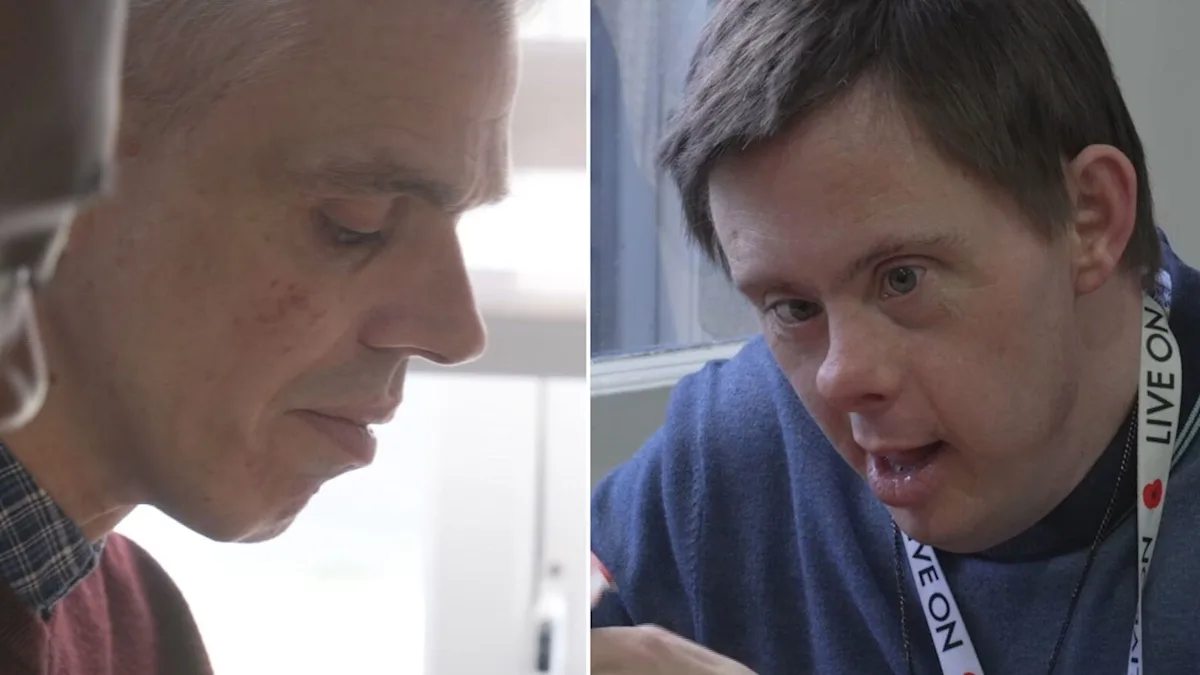
Dozens of learning disabled and autistic adults are facing “dangerous” cut backs to their care, ITV News has found.
Surrey County Council has been accused of carrying out “illegal” and “immoral” care assessments of vulnerable adults, and excluding their families, in a bid to save money by reducing their support.
Care provider Peak15 said 27 learning disabled adults in supported living are facing average cuts of almost 50% to their care hours.
In almost all of the cases, vital mental capacity assessments were not carried out to determine whether the reduction in their care hours was safe.
A mental capacity assessment establishes whether someone has the ability to make decisions about their own safety and wellbeing, and helps determine what support they may need.
It comes as the government is considering changing the law to give families the right to request a mental capacity assessment for a vulnerable loved one, following years of campaigning by Fiona Laskaris who believes this key legislative change could have saved her autistic son, Christopher, who was murdered in his own home.
Surrey County Council’s accounts make clear its intention to save £2.2 million on their spending on supported living for those with learning disabilities and autism in 2025/26.
Phillip showed ITV News Political Correspondent Romilly Weeks and the team proudly around his bedroom. Credit: ITV News
Peak15’s chairman David Holmes believes Surrey’s savings target played a role in the assessment process, which he describes as “flawed” and “negligent”.
Mental capacity assessments are a “really important step” in that process but they “by and large weren’t undertaken”, he told ITV News.
“And what that meant is that people’s families were excluded and that as a care provider we were excluded from that process,” David said, adding that 17 of the adults under his care have no family to advocate for them.
“It meant that the people that know those individuals well were excluded.
“And that’s tragic really because it means that this whole bank of knowledge that exists around that individual wasn’t accessed as part of that assessment process and as a consequence of that the assessment was necessarily and inevitably flawed.”
He added: “I think it was negligent on the part of the council and I definitely believe it to be illegal.”
‘There are others like us’: Government considers changing Mental Capacity Act
MPs call for change in mental capacity law after autistic man killed in own home
Apart from helping with the day-to-day basics, Peak15 also takes learning disabled adults to art classes, walking groups and even down to the pub. All of that, along with vital support with showering, cooking and cleaning, will likely disappear under the proposed cuts.
“We want to support people to live a life. We want people to be out there in the community, building relationships, getting jobs, finding love,” said David.
“None of that happens. Everything gets distilled back into the premises. And that’s kind of akin to a really old style of care and support.”That’s almost going back to long-stay institutions where we’re just warehousing people because it’s cheap.”
‘It’s dangerous’
That is a prospect facing Phillip Brown, who is autistic and has Down Syndrome. He loves the home he lives in, he tells us as he proudly shows us around his room adorned with his colourful artwork and family photographs.
He is settled and enjoys his routine – but that is now under threat with the council planning to cut his hours of support by three quarters. This means his one to one hours are being cut down from 40 a week to 11.
For mum Linda, it was a devastating discovery.
“I was just very, very tearful,” she said. “I mean I’ve had to battle for Phillip an awful lot in his life and for our family as a whole. And you just think, my God, where do I go from here?”
The decision was made after they reassessed his needs without his mother there to advocate for him because they failed to carry out a mental capacity assessment to determine whether he had the capacity to understand what was happening.
Linda was devastated when she discovered her son Phillip’s hours had been cut. Credit: ITV News
“If Phillip had been asked, ‘would you like your mum here?’ Phillip would have said yes, because Phillip knows I’m always here with him,” she said.
“He presents well, but his understanding is not particularly good, which is why we are always there. We understand him and we could have at least put it in a way that Phillip might understand.”
Asked how she felt when she discovered she’d been excluded from advocating for her son, she replied: “The way that the assessment has been carried out, I would say is illegal.”
It took Linda months of emails and telephone calls to get a copy of his assessment, she said, and that when she did, it was full of “glaringly obvious” inaccuracies.
“What Surrey are proposing is just not going to work, it’s dangerous,” she said.
Asked how she would start to tell him that the life he’s known and everything he relies on is being taken away, Linda said Phillip wouldn’t be able to comprehend what was happening.
“He would know people were disappearing from his life and ‘why are people no longer wanting to be with me and work with me and do things with me and take me out to the cinema and take me down to the pub once a week for a pint?’ All that would stop. Can you imagine?”
She said the majority of his life would just be confined to his room, having no meaningful interactions with others.
“None of us can live like that,” she added.
‘It was done behind our backs’
We then headed to the next supported living house on a leafy street, where Andrew Fairmaner greeted his brother Matthew, who had just returned from his food shop with his care manager.
Matthew, who is learning disabled and autistic, has lived in the house, which he shares with three other learning disabled men, for almost 30 years.
Andrew’s brother Michael has been receiving support from Peak15 for almost 30 years. Credit: ITV News
He arrived at the house, aged 19, at a time when he was so distressed he had stopped eating and drinking completely.
“He was really unhappy and quite disturbed,” Andrew explained. “He had a lot of eating disorders, he wouldn’t eat for long periods of time and he was fed through a peg in his stomach.
“It took the staff a long time to get him settled in. For a long period of time he would only stay in his room hiding in a wardrobe. It took a lot of patience and dedication to get him to come and mix with other people and eventually to start going out.”
Now, Matthew enjoys a full life going to weekly art classes, cooking classes and ramble groups, and is supported daily by care workers – but that could be under threat after Surrey reassessed him without his brother Andrew there.
“I don’t think his capacity was fully considered because he can’t read or write. He can’t really communicate his needs properly. So he needs more support at the meeting,” Andrew said.
“And I don’t know what happened to that assessment when it was written up because it wasn’t given to me and it wasn’t given to Peak 15. And it couldn’t have been given to Matthew because he couldn’t understand it.”So the decision to cut his hours was done really behind our backs and it wasn’t transparent at all.
“And I think it’s quite unfair and seems to just be to save money at the expense of some of the most vulnerable people in Surrey’s care.”
How a mother’s campaign after the murder of her autistic son could change law
PM will ‘look into’ changing Mental Capacity Act after murder of autistic man
Surrey County Council’s response
Sinead Mooney, Surrey County Council’s Cabinet Member for Adult Social Care, said: “We’re absolutely committed to making sure that people get the right support to meet their needs and build their independence – and far from cutting costs, we’re increasing investment in adult social care in Surrey, despite financial pressures facing local councils. We’ve just approved an adult social care budget increase of more than £27million.
“Care Act assessments are carried out by qualified professionals in line with our legal duties, with decisions based on evidence rather than targets, and we also consider bringing in others close to the individual.
“We won’t comment on individual cases, but if someone feels their assessment doesn’t fully reflect their situation, we encourage them to contact us directly and we’ll urgently consider if a reassessment is needed.
“Ensuring the care and support system is equitable and meets people’s assessed needs is essential. We’re working to build a strong and stable care market and have given financial assistance to some providers – including this one – to ensure continuity of care in a difficult climate.
“We’re also working to broaden the care and support options available in Surrey and remain committed to engaging with the people we support, their families and providers.”
What is the Mental Capacity Act and how could the law change?
The Mental Capacity Act was introduced in 2005 in a bid to minimise the number of vulnerable adults being detained unreasonably and indefinitely, and to give them more autonomy over their own care.
It states that as a starting point, everyone should be presumed to have the capacity to make their own decisions about their own safety and wellbeing, and that assessment should be carried out if their capacity is in doubt.
However, research has found that such assessments are either not carried out enough or are not carried out effectively – in particular on autistic people, adults with learning disabilities or those with severe mental health conditions, such as bipolar and schizophrenia.
‘Losing a child is the worst thing that can happen to anyone, but I think a preventable death is the very worst,’ Fiona Laskaris previously told ITV News following the murder of her autistic son Christopher.
Watch Romilly Weeks’ report produced by Elisa Menendez:
Their insistence that they can cope is often taken at face value without considering their past history and loved ones’ concerns. This means that – as in the case of 24-year-old Christopher Laskaris, an autistic man murdered in his own home in 2016 – they are left without the support they need.
His mother Fiona Laskaris and three MPs – the former health secretary Jeremy Hunt (Conservatives), Chris Coghlan (Lib Dems) and Jake Richards (Labour) – are calling for an amendment to the Mental Capacity Act to ensure family members’ views are taken into account when deciding if someone needs a mental capacity assessment.
They, along with the National Autistic Society, agree that the current system is failing autistic adults like Christopher, as well as other adults with learning disabilities and mental health illnesses, at times with catastrophic consequences.
They are concerned there are potentially hundreds of preventable deaths per year due to this issue, with recent research by King’s College London finding The Mental Capacity Act was not followed in a quarter of the deaths of autistic people and those with learning disabilities in 2022 alone.
A Department of Health and Social Care spokesperson said: “This government is determined to support SEND families and those with learning disabilities to get the care they need. That’s why, we are working closely with Fiona Laskaris to examine what further action we can take to prevent further tragedies, following the tragic death of her son.
“We will be consulting on liberty protection safeguards this year, which will include an updated Code of Practice for the Mental Capacity Act, and welcome Fiona’s feedback as part of that process”
Have you heard our podcast Talking Politics? Tom and Robert dig into the biggest issues dominating the political agenda in every episode…
If you have been affected by any of the issues raised in this article, help and support is available:
Samaritans is an organisation offering confidential support for people experiencing feelings of distress or despair. Phone 116 123 (a free 24-hour helpline).
The National Autistic Society offers free help and guidance for autistic people or anyone supporting someone who is autistic. Anyone who needs urgent support can find information here.
Bipolar UK offers free support to anyone affected by bipolar. If you need urgent help, phone their helpline on 0333 323 3880.
Access Social Care provides free legal advice and information for people with social care needs and helps them to achieve a better quality of life.
