


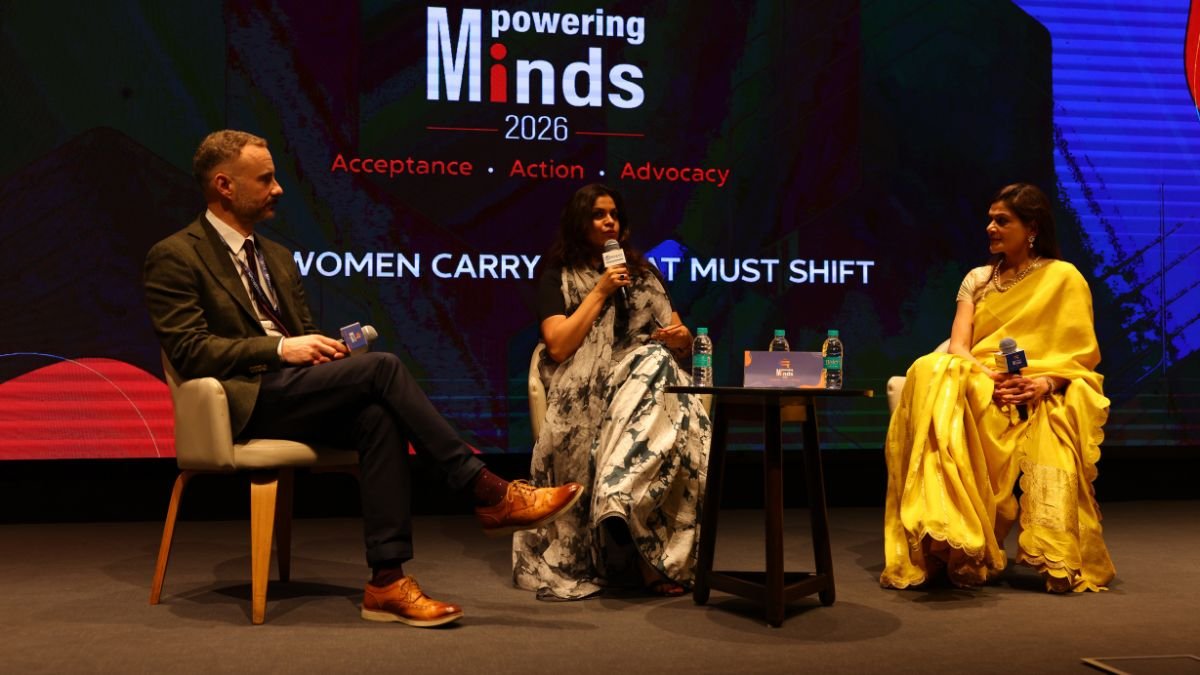
Mental health experts, policymakers and practitioners gathered at the second edition of the 2026 Mpowering Minds Women’s Mental Health Summit in Bengaluru in the last week of February, to examine how gender shapes mental health experiences across life stages.
Discussions repeatedly returned to the idea that women’s mental health is often mediated by structural pressures, family expectations, caregiving roles, workplace discrimination, and stigma around seeking help.
Speakers emphasised that while awareness around mental health has improved in India over the past decade, women still face unique barriers in accessing care.
Post the lighting of the lamp, Lakshmi Hebbalkar, the Minister of Women and Child Development, Disabled and Senior-Citizens Empowerment of Karnataka, said that mental health is not a side issue; it is a life issue. “Many smiles hide stress. Many strong women carry unseen battles. Silent struggles are still real struggles. From a young girl facing academic pressure to a woman balancing career and home. To a mother navigating life and changes…To an elderly woman facing loneliness…Every stage brings a new challenge,” said Hebbalkar.
In a keynote address delivered by Eamon McCrory, chief executive of mental health charity Anna Freud and professor of developmental neuroscience and psychopathology at the University College London, he spoke about the decades he spent studying how adversity and trauma shape the developing brain and what can be done to interrupt cycles of pain passed from one generation to the next.
His address, titled ‘Intergenerational Trauma: The Invisible Inheritance’, put a sharp focus on a pattern that has perhaps not been discussed widely in mainstream discourse: trauma does not end with the person who first experiences it. It ripples outward, shaping how parents relate to their children, how children learn to regulate their emotions, and how entire families navigate the world.
“Trauma really operates through its impact on relationships,” he said. “And that also means that recovery and healing happen through relationships.”
Several experts highlighted the silent burden of caregiving carried by women and they also pointed out how, across centuries, with the brutality of sati, the social exile of widows, the ritualisation of women’s suffering, distress has been inherited by Indian women silently down generations.
During a session on the ‘silent distress of young women,’ with panellists such as Jasmine Kalha, co-director and senior research fellow at the Centre for Mental Health Law & Policy, ILS, Pune, Meenakshi Kirtane, founder and director of Maanas The Inside Story and founding president, Indian Psychodrama Association and Dr Shyam Bhat, psychiatrist and founder of the Nirvikalpa Foundation, moderator Dr Zirak Marker who is a child, adolescent and family psychiatrist sparked a conversation around resilience among young women today.
“Something unprecedented is happening among women today, where they have to balance being assertive, competitive and strong with being gentle, soft and nourishing. Young women have taken up more than previous generations,” said Bhat.
Experts noted that women are frequently expected to hold families together emotionally while neglecting their own well-being. This invisible labour, caring for children, elderly parents, and managing households, can translate into chronic stress, burnout and depression.
“Women can have it all, but they have to stagger it,” said Masaba. “I think it really depends on what your support system is,” said fashion designer Masaba Gupta in a fireside chat with Shweta Punj, economic policy editor, Moneycontrol.
In the chat, titled, ‘Carrying Hope Forward: Rebuilding from Within’, Gupta spoke about a culture that tends to celebrate success while obscuring the struggle behind it. “I think we do the world and the people around us a great service when we are ourselves because then we allow them to be themselves. That’s what I believe in. That you should show as your best version. No matter how… challenging your situation is.” That approach, she said, has only served her. “So, being vulnerable, I think, is a superpower. I know a lot of people see it as a weakness. But, I don’t. I see it as a very very big strength. And that is my biggest strength.”
Psychiatrists and counsellors pointed out that women often seek help only when symptoms have escalated, largely because prioritising their own mental health is seen as selfish or secondary.
Neerja Birla, founder & chairperson, Aditya Birla Education Trust, spoke about how “India needs three decisive shifts: Mandatory mental health education in schools, sustained public investment with accountability and large-scale public-private partnerships that strengthen public systems without privatising access. Alongside this, we need workforce reform, real-time mental health data and gender-responsive service design.”
Workplace challenges were another recurring theme. Speakers discussed how professional women often navigate a double burden, managing demanding careers alongside traditional expectations at home.
While corporate India has begun to introduce mental health support systems, panellists argued that workplace policies still fail to adequately account for caregiving responsibilities, maternity transitions, and the emotional toll of gender discrimination.
Mental health practitioners called for gender-sensitive workplace policies that integrate counselling access, flexible work environments, and leadership accountability.
Another major focus was the mental health of adolescent girls and young women. Experts warned that social media pressures, academic competition, and body image anxieties are increasingly shaping psychological distress among young people. Psychologists stressed the importance of early mental health education in schools and open conversations within families.
Speakers also drew attention to the gaps in India’s mental healthcare infrastructure. Despite growing awareness, access to trained mental health professionals remains uneven, especially outside major urban centres. Panellists argued that community-based models, digital counselling platforms, and school mental health programmes could help bridge these gaps and make support more accessible to women across socioeconomic backgrounds.
The summit ultimately underscored the need to move beyond awareness campaigns toward systemic change.
Experts emphasised that improving women’s mental health requires interventions at multiple levels, from families and workplaces to public policy and healthcare systems.
Addressing stigma, expanding access to care, and recognising the emotional labour women perform in society were identified as critical steps in building a more supportive mental health ecosystem.
