


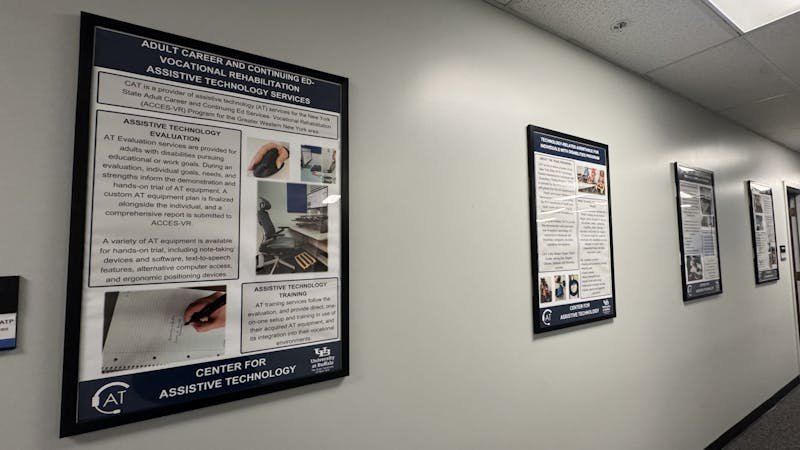
Located so close to North Campus that it’s considered part of the campus on UB’s official map, on North John Glenn Drive is the Center for Assistive Technology (CAT).
Assistive technology is vital for the disability community, ranging from a pencil grip for individuals who struggle with fine motor skills to a speech-generating device used by individuals with Amyotrophic lateral sclerosis (ALS). Assistive technology is significant in making the lives of disabled individuals easier, from low-tech to high-tech services.
Founded in 1988, for much of its early history, the organization was funded by the Administration for Community Living, a federal organization under the authority of the Department of Health and Human Services.
CAT was founded as a Rehabilitation Engineering Research Center, a federal program. Its initial goal was spearheaded by its former director, Joe Lane, who retired this month, for the purpose of assisting businesses in producing products that are accessible to individuals with disabilities and making them available on the market.
As the years went on, Lane noticed a growing need for community-based assistive technology services. Although research is still conducted, the primary goal of the center has shifted to working with clients to ensure they receive these technologies.
Although CAT is a part of UB, its services aren’t restricted to students, as it works with individuals of all ages throughout Western New York, stretching to rural areas such as Genesee County.
CAT works directly with UB students by working with the Accessibility Resources (AR) office to provide services such as note-taking and computer access.
“Any students that come through UB AR and there’s even a suspected need for assistive technology, then they’re set up with scheduling an appointment with one of us,” says Laura Mack, an occupational therapy assistant who serves as the assistant director of client services.
There has been media coverage of a surge in students receiving disability-related accommodations at their colleges and universities. This has increased CAT’s clientele and workload exponentially.
“When I first started taking over the Accessibility Resources tech, this was 2018. One of us was available one day a week. We’re now available somewhere between three and four days a week,” says Erin Bruenelle, a licensed occupational therapist who is the director of client services. One of the most popular services provided by AR via CAT is note-taking assistance.
Bruenelle says that increased funding to AR has contributed to that; but, “post-COVID, I think that a lot of need arose especially for digital learning, and with the growing student body receiving accommodations.”
The Americans with Disabilities Act was passed in 1990. Due to the massive growth in technology over the past two decades, Title II has since been amended to require that public universities make digital technology more accessible. So CAT is now working with AR to improve digital accessibility.
Bruenelle stresses the importance of CAT in providing everyday services to students at UB: “I don’t know how much the student body … are conscious of what’s happening because it’s faculty working on these things but all faculty and really everything within UB is currently undergoing a process of verifying, considering, resolving these digital accessibility barriers.” Bruenelle serves on the Title II task force. CAT and other UB entities are working tirelessly because there is an April deadline to ensure digital accessibility.
Bruenelle says that she thinks UB is “considerably more accessible than other institutions. UB has been planning this a long time, and it’s an incredibly hard thing to do … if you think about things like math or music, those are things that are really challenging to make accessible.” When one considers just how much material UB, a large public research university, holds, the task becomes more daunting.
“It’s a huge undertaking, and it’s a lot to ask our very busy faculty and staff. I would say in general, UB’s doing a good job but it’s certainly not a small feat by any means,” Bruenelle said.
The staff at CAT love their job. Mack, in particular, enjoys the daily novelty: “Every day is different. That’s the beauty of it. Typically, we have fairly long client appointments. A typical day would be: We come in at 8:30. If we have a morning client scheduled, we work with them for the entire morning.”
CAT plays a major role in working with employers by ensuring that the workplace is adequate to serve the employee’s unique needs. This requires a lot of traveling, such as traveling to where clients work, so CAT staff are on the road frequently.They also provide home-based services, sometimes driving long distances throughout Western New York, mostly to work with clients who work from home, partly as a result of the increase in the proportion of the labor force that works remotely over the past few years.
A significant proportion of those who receive services through CAT are blind or have some form of vision-related disability.
In addition to working with the Commission for the Blind, CAT works with ACCES-VR, which broadens its clientele to individuals with learning and developmental disabilities, as well as individuals who have been rendered physically disabled in some form.
“Sometimes we see clients that have some severe physical disabilities, and are in motorized wheelchairs. So quite the gamut,” Mack says.
Bruenelle concurs: “We may see someone come in with a baby who is a year old, and has developmental delays and needs switch toys or needs supportive seating and positioning; or we may see a college student is looking for information or text to speech tools; or we may see a caregiver who’s caring for their aging parent, who needs things for home safety. We meet every and any assistive tech need through our center.”
CAT works with some students out of Syracuse, Elmira and towns all the way out to the Vermont border.
In addition to directly working with clients, CAT serves as the state loan program through the Assistive Technology Act of 2004.
Bruenelle sees CAT’s services as vital to the disability community at UB and in Western New York. “We tend to be kind of a hidden gem. We’re a community resource that people can borrow things from us whether they are UB students or not. And we’re a resource that’s been around for a long time, and we still find people that don’t know about us.”
The Center for Assistive Technology can be reached by email at cat-traid@buffalo.edu or by phone at 716-836-1168.
Jacob Wojtowicz is the senior features editor and can be reached at jacob.wojtowicz@ubspectrum.com
Photo: Courtesy of Sevda Abdavinejad
