


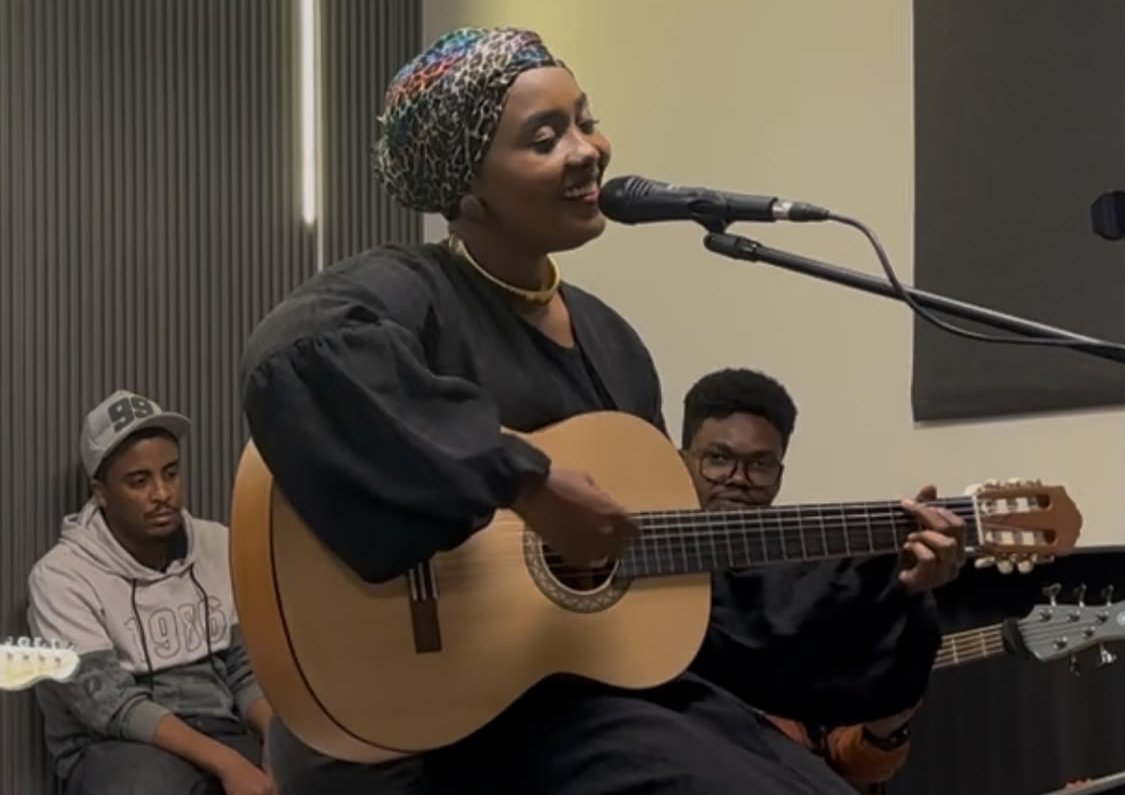
The contrast between a special needs educator’s experience of working in her native Sudan and what she found after moving to the UAE reflects the wider position for people with disabilities in Africa and globally. While they are poorly served in one instance, they receive the best possible care in another. By Nicholas Mokua.
The fate of children with special needs in most of Africa often depends entirely on whether or not the parents have sufficient funds to cover the essential expenses. It also depends on the facilities available locally and, increasingly, on political stability (or lack of it) in the areas concerned.
Wela Elmahi, a Sudanese special needs educator and music therapist now based in Dubai, has seen the situation from both sides of the divide – as a young professional trying to build a career in a Sudanese system with few resources, and later as a practitioner in one of the world’s more heavily resourced systems in the United Arab Emirates.
Her story, and the widening chasm she describes between the two countries, illustrates a theme central to ECA’s health financing work: that inclusive, well-financed care and education systems are not a luxury add-on but a foundation for whether children with disabilities get to participate in society at all.
Elmahi’s route into special needs work began with an undergraduate degree in psychology followed by a master’s in international education and development. Her father, a musician and music therapist himself, was a formative influence. Wela went on to specialise in music therapy herself, moving away from hospital-based clinical work towards children, which she found far more meaningful.
She relocated to the UAE in 2019 after finishing her Master’s, but the transition was not smooth. Music therapy roles specifically were scarce, and she spent time working in unrelated sectors including call centres and sales agencies before a brief return to Sudan and a subsequent move to Turkey. When war broke out in Sudan in 2023, she returned to the UAE and secured a school-based position within two months, launching the career she has built since.
Contrasting the special needs education in the UAE and Sudan, Elmahi notes that Sudan has no shortage of skilled educators. What it lacks is infrastructure and financing. In the UAE, she points to superior facilities, better-resourced educational departments, higher salaries and far greater access to professional development, new techniques, and evolving theories.
Empowering the disabled
That gap reflects deliberate policy choices. The UAE has built a legal and institutional architecture around what it calls ‘People of Determination’, anchored in the Federal Law of 2006. The National Policy for Empowering People of Determination rests on six pillars, including health and rehabilitation, education and social protection.
Government schools are required to adapt to accommodate students with disabilities, dedicated support centres provide diagnosis and family guidance, and a designated Service Officer for the Determined Ones sits inside government institutions to coordinate services.
Dubai has gone further still, with its own 2022 law on the rights of People of Determination and a dedicated committee overseeing implementation.
Families in Sudan face a starkly different reality, including high costs for therapy and medication, a near-total absence of specialised departments within mainstream schools and heavy reliance on expensive private clinics that most families simply cannot afford. Without financial resources, many parents are forced to keep children at home, without professional guidance of any kind, not because they lack the will to help their children, but because the system offers them almost nothing to work with.
The conflict in Sudan, now well into its third year, has deepened this crisis considerably. Recent humanitarian assessments put the number of people in need of assistance across the country at 33.7m for 2026 (over half of them children), with more than 9m people displaced and essential health, water and education infrastructure badly damaged.
Roughly two-thirds of Sudan’s population lacks access to essential healthcare, and children with disabilities are among those facing the highest risks amid displacement, family separation and collapsing services.
Elmahi has experienced this firsthand among the families she stays connected to. Many children carry visible trauma from the conflict. Some families have managed to flee to neighbouring countries like Egypt, but a majority remain trapped in rural areas, where support for children with special needs, which was already thin before the war, has effectively disappeared.
Even from Dubai, she continues to advise Sudanese families remotely on managing behavioural challenges: encouraging calm home environments, educating people around special needs children to prevent bullying, and introducing sensory tools to help children cope with overwhelming situations.
It is, by her own account, a limited substitute for in-person, systemic support, but one she offers because so little else is available.
Her longer-term ambition is to open a music therapy centre in Sudan for underprivileged families. For now, competing financial obligations to her own family and losses sustained during the war make self-funding impossible – a reminder that even skilled, motivated practitioners cannot close a financing gap using personal resources alone.
She is emphatic that government intervention is essential, and that officials need direct exposure to the realities faced by people with special needs if national priorities are to shift meaningfully toward inclusion.
Financing models
Despite the obstacles, Elmahi finds real grounds for hope in her work. This includes children with severe autism who, after a year of consistent intervention, can express their needs and emotions for the first time.
Her contribution was recognised when she was named Best Teacher of the Year across the whole of the UAE. She is now looking to pursue a PhD in special education, to eventually bring her knowledge of advocacy and intervention models to Africa.
Elmahi’s account maps closely onto what global health financing evidence shows more broadly. An estimated 1.3bn people live with a disability worldwide, and inequities in their access to care are driven substantially by how health systems are funded.
In Africa, governments finance less than 41% of total health expenditure on average, and unpredictable donor funding leaves the rest of the gap to be filled largely by out-of-pocket payments, which push over 150m people into poverty every year.
That burden lands hardest on households already carrying the cost of disability-related care, where narrow benefit packages and budgets that ignore the cost of accessibility and reasonable accommodation compound the exclusion Elmahi describes.
The Economic Commission for Africa (ECA) argues that closing this gap requires repositioning health financing from a residual social expense into a macroeconomic stabilisation and growth instrument, embedded in fiscal frameworks, public financial management systems and regional integration strategies rather than left dependent on volatile donor flows.
Its ‘Transforming Health Financing in Africa’ initiative, running across 25 countries from 2026 to 2030, is built on this premise, and explicitly recognises innovative financing instruments, alongside digital governance, primary health care modernisation, regional public goods, and institutional capacity building as necessary tools for building health systems that can reach populations current models leave behind.
That agenda points towards the kind of structural choices Elmahi’s story calls for: financing strategies shaped through direct consultation with persons living with disabilities that target their specific needs within care packages, and use disability-disaggregated data to guide resource allocation.
This contrast between service provision in the UAE and Sudan illustrates what happens when inclusion is a funded government priority, rather than something left to families, private clinics and the goodwill of individual practitioners working across borders.
As Sudan eventually moves toward recovery and reconstruction, an adequately financed system for children with special needs will need to be part of the agenda from the outset, not an afterthought. It is an area Africa needs to tackle as it confronts the financing gaps created by reduced development financing.
