


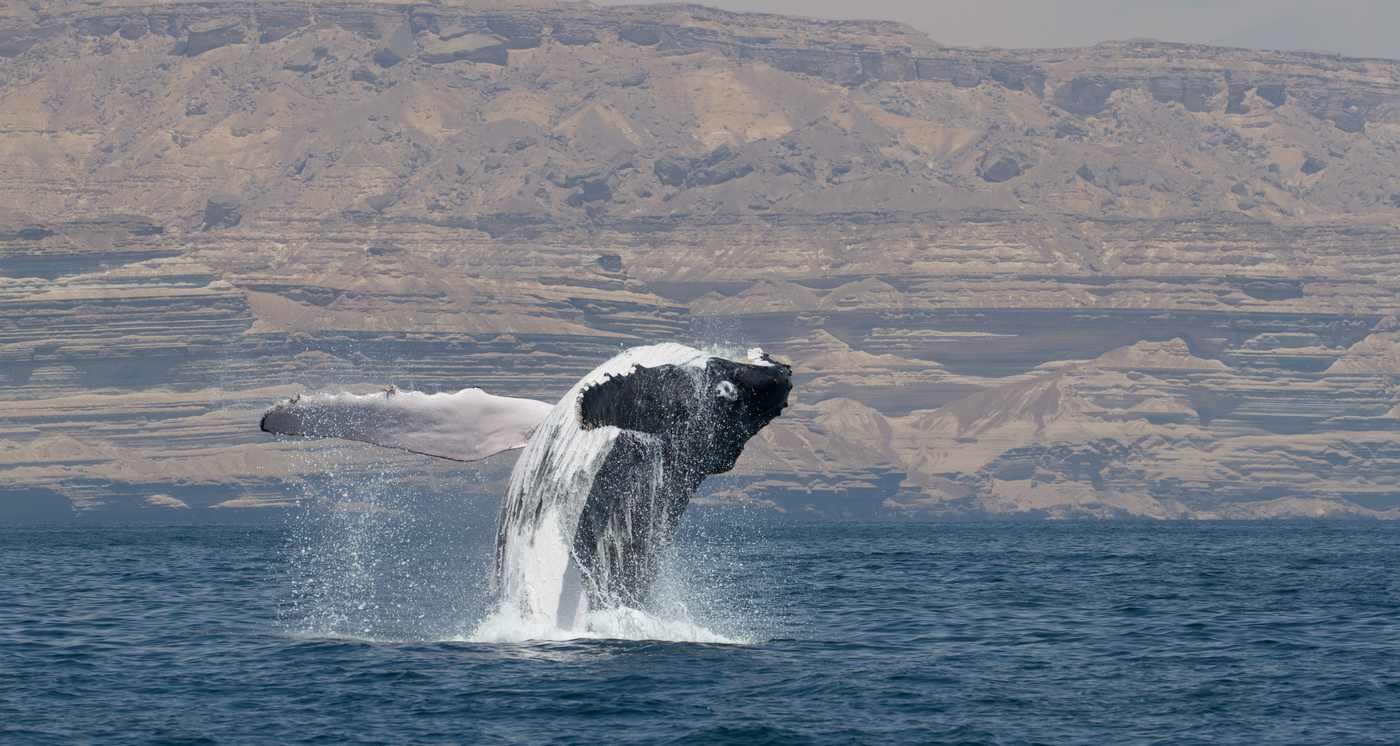
An Arabian Sea humpback whale breaches following interaction with another whale in Hallaniyat Bay, Oman – credit, Darryl MacDonald ©
This breathtaking photograph is of an Arabian Sea humpback whale—the subject of a new genetic analysis that seems to confirm beyond a shadow of a doubt that it’s a totally different subspecies compared to its cousins in the Pacific or Atlantic.
Existing with a remarkably unique ecology, it’s been clear to anyone with experience that Arabian Sea humpbacks are just different, but until recently it was uncertain whether this was a recent or prehistoric development.
Published in Frontiers in Marine Science, a study leveraging more than 25 years of whale research in Oman supports the recognition of a 4th subspecies of humpback.
Led by the Wildlife Conservation Society (WCS) in close collaboration with Omani environmental authorities and other key local and international partners, the study compared genetic samples from Arabian Sea humpback whales with populations from across the world’s oceans, including mitochondrial DNA from 2,285 animals.
Results revealed high levels of genetic differentiation between the Arabian Sea population and the 3 currently-recognized humpback whale subspecies of the North Atlantic, North Pacific, and Southern Hemisphere, indicating very limited gene flow between them.
The Arabian Sea population also showed the lowest genetic diversity among the ocean regions examined. The findings support the potential recognition of the Arabian Sea population as Megaptera novaeangliae indica, named for the type species in Iraq.
“Arabian Sea humpback whales have long been an enigma to the scientific community. Their ecology is unlike that of any other known humpback whale population, and this new genetic work represents an important milestone in understanding how that uniqueness developed,” said the study’s lead author Dr. Rita Amaral with the WCS.
“The results clearly indicate the Arabian humpback whales have followed their own evolutionary trajectory for tens of thousands of years and support their recognition as a distinct subspecies.”
Arabian humpbacks are the only group in their race which neither migrate to breed nor feed. They remain in the seas off Oman all year round, and are even genetically distinct from whales as close by as the Indian Ocean. What explains this strange, sedentary lifestyle?
The authors, citing research conducted over the decades, detail that seasonal upwelling of deep oceanic nutrients, driven by the southwest monsoon, creates hyper-productive conditions more typical of those found in temperate climates where whales would typically migrate to feed.
Other humpbacks who’ve thusly migrated to cooler waters then return to the tropics to breed, but that unique upwelling allows the Arabian sea humpbacks to feed at tropical latitudes normally associated with breeding activities.
A study published for the International Whaling Commission in 2018 reviewed Arabian Sea humpback whale singing and found that it too is unique among the species. All males within a population share the same song patterns, which also tend to change progressively over time. Populations that do not overlap or exchange individuals have distinctly different songs, the study wrote, whereas populations in contact share some, or all patterns.
This provides more evidence for a theory on a separate Arabian subspecies, because while overlapping populations of Arabian humpbacks share song patterns, the IWC study found zero overlap between Arabian humpback and Indian Ocean humpback singing, strongly indicating populational isolation.
SUBSPECIES TO GET EXCITED ABOUT: Amur Tigers Are Back From the Brink in China – Thanks to Government Policies
Now, this new study presents genetic analyses that shows the Arabian Sea whale lineages diverged between 43,000 and 113,000 years ago, depending on the group.
The study emphasized that the population’s isolation also makes it especially vulnerable. Arabian Sea humpback whales face threats from entanglement in fishing gear, vessel strikes, underwater noise, and pollution, as well as natural stressors such as disease.
Climate-driven changes to monsoons and ocean upwelling may also affect the availability of sardines and other prey. The paper notes that the population is small, with no evidence of an increase over the past two decades, and warns that they are at risk of extirpation without concerted efforts to manage known threats.
WHALE OF A STORY: Humpback Whale Watching Surges in Brazil Where Population Has Grown 27-fold Since Whaling Ended
“The growing body of research on Arabian Sea humpback whales has given Oman an increasingly clear understanding of both the importance of this population and the pressures it faces,” said Aida Al Jabri from the Environment Authority of Oman, which contributed to the research, in a statement.
“This evidence is now helping us move from scientific understanding towards practical conservation action, including regional cooperation through the International Whaling Commission and Oman’s work to explore greater protection for important marine habitats through international mechanisms such as the International Maritime Organization’s special protection provided by Particularly Sensitive Sea Areas.”
SHARE This Very Exciting Development In Whale Science With Your Friends…
