


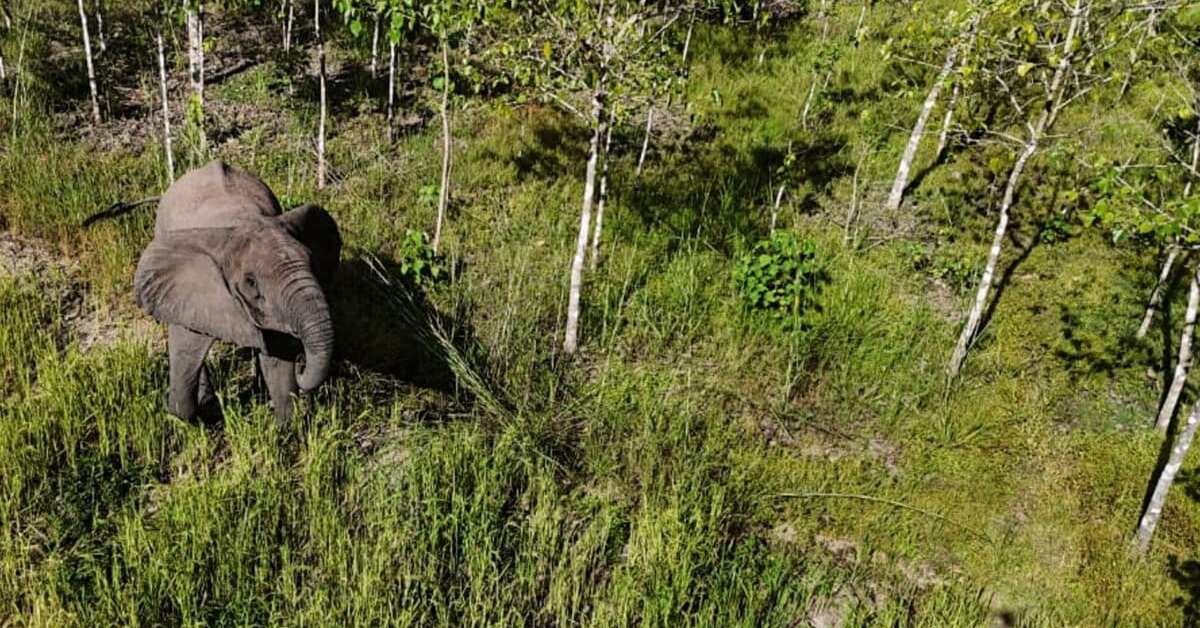
- African savanna elephants are using a narrow strip of land across the densely populated Kilombero Valley in southern Tanzania to migrate.
- It’s Tanzania’s first officially designated wildlife corridor, linking Nyerere National Park’s open savanna woodlands with the high-altitude rainforests of the Udzungwa Mountains National Park.
- Local landowners have designated parts of their farms for the corridor and co-manage it with the government.
- Experts note that vigilance is needed to prevent some planned development, which could negatively impact the corridor.
African savanna elephants in southern Tanzania have an unusual habit: They climb mountains. Up to 1,000 of the pachyderms spend part of their time in the Udzungwa Mountains, clambering up and down steep slopes that are clad in lush, closed-canopy rainforest.
“They go everywhere,” said Trevor Jones, director of strategy and development at the Southern Tanzania Elephant Program (STEP), a conservation group. “They can negotiate really quite surprisingly steep gradients that you wouldn’t expect, even to the point [of] occasionally, in the rainy season, sliding down on their bums when a particular slope is too steep.”
But some also migrate from the mountains to more typical savanna elephant (Loxodonta africana) habitat that lies to the east, across the Kilombero Valley, in Nyerere National Park.
A satellite image of the corridor traversing the Kilombero Valley, from the Magombera Forest Reserve in the east to the Udzungwa Mountains in the west. Darker green dots inside the corridor are signs of maturing forest trees planted since 2023. Image courtesy Reforest Africa/Google Earth
Researchers like Jones have been trying to understand why these herds have historically used such different parts of the landscape.
“It’s a very adaptive population that’s using that mosaic of habitats and resources, from montane forest to lowland forest, and then miombo woodland and open bush in Nyerere,” Jones told Mongabay. “I’m sure some of [the habitats] are crucial for different time periods or different circumstances; in drought, for example, they might have to move to the [mountains] where there would be enough food left when other areas get too dry.”
That food includes native bamboo, which grows in stands around 2,000 meters (more than 6,500 feet) above sea level.
Fifty years ago, this land was connected by unbroken lowland rainforest, but since then, the forest has been cut down and the valley converted to farmland. This created conflict between elephants and farmers when the pachyderms crossed the valley along their long-established migration routes.
The answer? Give some of the land back to the elephants. The process took seven years, but in April 2025, after seemingly endless preparatory work by STEP and its partners, and hundreds of meetings with officials and residents, the Tanzanian government designated the Nyerere-Udzungwa Wildlife Corridor (NUWC), the country’s the first wildlife corridor to be given official protection. It’s designed to keep elephants out of people’s crop fields.
Across Africa, both elephant species need protection. Massive poaching for their ivory tusks, combined with shrinking habitat, have decimated populations over the last 50 years, with numbers dropping by at least 60%. The African forest elephant (Loxodonta cyclotis) is critically endangered, according to IUCN, and the savanna elephant is endangered.
A camera trap captured this photo of an elephant moving through the wildlife corridor, which is being rewilded with native tree species. Courtesy of the Southern Tanzania Elephant Program.
Safe passage
Each day, elephants must consume massive amounts of forage — plant materials gathered by browsing and grazing — and water to survive. This requires them to move along ancestral routes to find resources; availability changes with the wet and dry seasons.
In 2006, Jones began studying elephant corridors in southern and central Tanzania and in 2009, he led a nationwide assessment that identified 33 of these pathways across the country. Years later, in 2018, he and colleagues began discussions with villagers and government officials to demarcate the most viable corridor across the Kilombero Valley.
The Nyerere-Udzungwa corridor is particularly important because it connects Tanzania’s southern and western elephant populations.
The corridor is just 200 m (656 ft) wide and extends for about 14 kilometers (around 8.7 miles) across the valley floor, from Nyerere National Park and the adjoining Magombera Nature Forest Reserve in the east to the Udzungwa Mountains National Park in the west.
The corridor’s route was chosen by local communities, and 368 landowners were compensated nearly 2.2 billion Tanzanian shillings ($880,000 at the time) for giving up 1,000-2,000 square meters (approximately 10,700-21,500 square feet) of their land to create it, according to STEP.
Current supporters include Fondazione Capellino, an Italian conservation NGO; the U.S.-based conservation organization Saving Nature; and the Hempel Foundation in Denmark.
Making the corridor viable includes installing fencing to funnel the elephants into it as they move between habitats.
Part of the process is assessing the success of the corridor — and documenting which animals use it. STEP has partnered with organizations including Lion Landscapes, an NGO that fosters coexistence with lions, to install 59 cameras at 500 m (1,640 ft) intervals across the corridor in November 2023. Images captured revealed that in 15 months, at least 1,440 mammals used the corridor, 529 of which were elephants, according to STEP.
Others included bushbuck (Tragelaphus scriptus), buffalo (Syncerus caffer), serval (Leptailurus serval), honey badgers (Mellivora capensis), Sykes’ monkeys (Cercopithecus mitis moloneyi), Harvey’s red duikers (Cephalophus harveyi) and even Cape clawless otters (Aonyx capensis).
A young bushbuck captured by a remote camera inside the wildlife corridor, with the mist-shrouded Udzungwa Mountains in the background. Courtesy of the Southern Tanzania Elephant Program.
“I’ll say that they [elephants] really need these [connected] areas for their survival,” said George Lohay, an ecologist and head scientist at the Grumeti Fund, a conservation nonprofit working along the western edge of Serengeti National Park in northern Tanzania.
“There are some areas that are used during the wet season; there are some which are used during the dry season,”Lohay told Mongabay.“But also, elephants are aware of [the location of] different resources, like salt licks.” These mineral deposits provide needed nutrients, he added.
Elephants can move over vast distances. Lohay, who is not involved with the corridor initiative, recalls that his Ph.D. work was evidence of this. He detected genetic similarities between elephants in the Tarangire National Park in northern Tanzania and those more than 700 km (435 mi) to the south, in Ruaha National Park.
“That was just an indication that these elephant populations were once one big population,” he said.
Rewilding the valley
The corridor linking Nyerere and Udzungwa not only helps to reconnect parts of the elephant’s historical range, but it also gives conservationists an opportunity to rewild the valley floor.
So far, villagers and one of STEP’s partners, Reforest Africa, have planted 100,000 native trees inside the corridor, featuring 30 different species raised in a nursery in Mang’ula village in the valley. Some areas are planted densely to resemble closed-canopy rainforest; others are left more open as woodland habitat. Another 50,000 trees will be planted.
Tree species were chosen to mimic the former landscape and to feed different animals. The fruit of sycamore figs (Ficus sycomorus) and wild mangos (Cordyla africana), for instance, is popular with Sykes’ monkeys and trumpeter hornbills (Bycanistes bucinator). Fruit-eating animals then disperse the seeds and aid natural reforestation, said Robin Loveridge, chief executive of Reforest Africa.
Some sites within the corridor remain unplanted so that the team can watch and learn how restoration unfolds. “These different habitats provide a home for different species,” he said. “The corridor aims to maximize biodiversity.”
Advocates for nature
The project hasn’t been without setbacks. Elephants using the corridor have avoided an underpass built especially for them beneath the main road that hugs the southeastern edge of Udzungwa.
Tarred three years ago, the road is busy. Onlookers sometimes stop their vehicles, and crowds gather when elephants emerge from the forest or come along the corridor, causing the herd to turn back, Jones said.
Screens will need to be placed near the underpass to give the elephants some privacy.
A new petrol station is under construction a few hundred meters from the corridor, being built without an environmental impact assessment, Jones said. A hotel and bus station are also planned for sites alongside, which, if they go ahead, could further undermine its effectiveness.
Elephants using the wildlife corridor are yet to learn to use the underpass beneath the tarred road (in the background) that runs near the base of the Udzungwa Mountains. Courtesy of the Southern Tanzania Elephant Program.
Strong representation by villagers on the committee that manages the corridor together with the government offers the best hope for ensuring compatible land use near it, Jones said.
Astrid Matejcek, a cultural geographer at the University of Mainz, Germany, carried out research on wildlife corridors in the Kilombero Valley between 2018 and 202. The strongest force for sustainable elephant routes is the residents themselves, she told Mongabay, describing them as “advocates for nature.”
This was seen, for instance, in their demand for native tree species to be planted inside the corridors.
In 2018, she said, another environmental NGO working in Kilombero considered restoring corridors by connecting patches of land that farmers could still derive benefits from, such as timber from plantations of exotic Burmese teak or harvests from groves of cacao.
But many villagers told Matejcek that elephants would avoid teak plantations because they lack the ground covering of small plants and grasses that herbivores need, while both elephants and monkeys eat cacao pods, raising the potential for human-wildlife conflict.
“Entrusting [local people] with responsibility not only for their land but also for [tree] species selection and forest management offers hope for the sustainability of the corridors,” she said.
“The corridors will only have a chance if people, resources, and creativity continue to be mobilized in their support.”
Lohay, the Serengeti scientist, said he’d like to see something similar done to secure connections between major ecosystems in northern Tanzania.
Elephants there use corridors linking Tarangire National Park to the Serengeti ecosystem, and between Tarangire and Ngorongoro Conservation Area. But in some places, corridors are threatened as farmers settle nearby.
“The window of opportunity to officially demarcate them is closing,”Lohay said. “We are not too late, it’s just that if we don’t act within, like, 10 years from now, things will definitely change.”
Meanwhile, back in the Kilombero Valley, Reforest Africa’s Loveridge said trees planted in late 2023 are already above head height. They’re starting to resemble a forest, and the dark green is now visible in space satellite images.
His favorite memory of the reforestation work was planting trees with his young son and imagining how wild the corridor will be once he’s grown up. “That’s what all this is really for,” he said. “Safeguarding the planet for the next generation.”
Featured Image: A tuskless bull elephant inside the Nyerere-Udzungwa Wildlife Corridor. Courtesy of Udzungwa Mountains National Park.
Written by Ryan Truscott. This article was originally published by Mongabay.
