


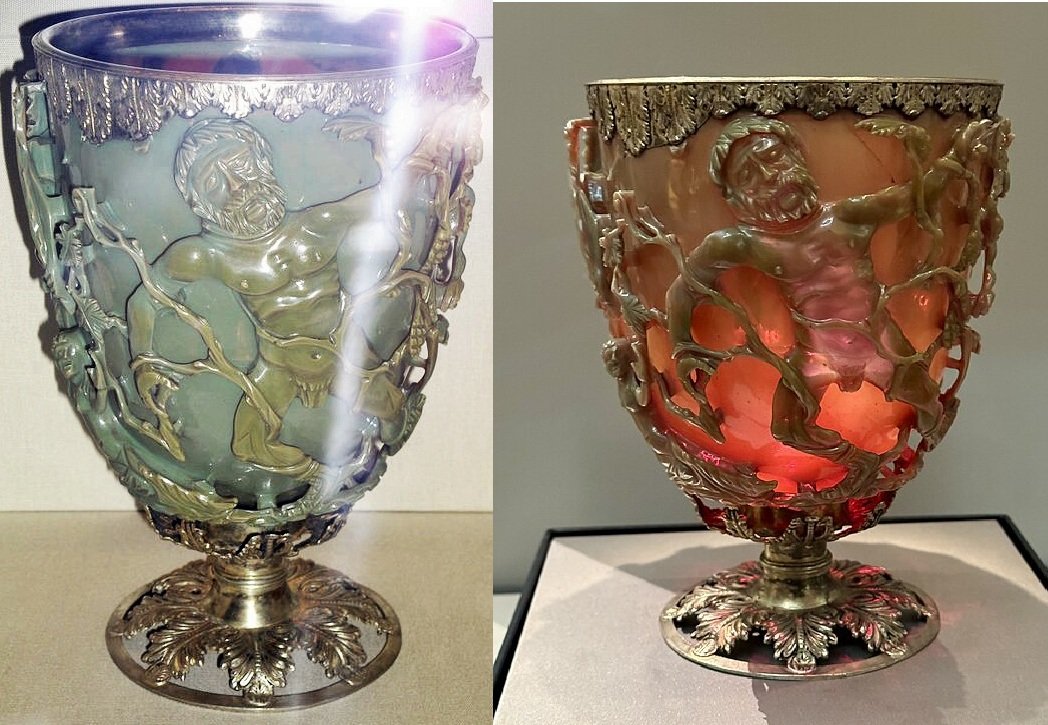
The Lycurgus Cup, located in the British Museum – credits, (left) Johnbod CC 3.0. SA – (right) Chappsnet CC 4.0. BY
The Romans were incredible materials scientists, having famously invented self-healing concrete that allowed their structures to stand for millennia.
Yet for some, it’s the glass that forms this one—yes, one—goblet that marks the undisputed pinnacle of Roman science.
It’s made of what’s called dichroic glass, and its party trick is changing color depending on which angle light is shone upon it. The goblet in question is known as the Lycurgus Cup, named for the king of the Thracians in Homer’s Iliad who insulted the god Dionysus.
Though scientists know how to make dichroic glass, how exactly the Romans managed it with 4th-century CE tools and materials is less understood. Its craftsmen embedded nanoparticles of gold and silver into the glass which then distort incoming light.
Essentially, it may be the world’s first instance of nanotechnology use, as the precious metals inside are smaller even than the wavelengths of light they’re distorting.
Lisa Hollands, a glass technical specialist at the University of Sheffield, led a thorough investigation and reproduction effort into the glass of the Lycurgus Cup, and spoke with the Guardian about what it is that makes the artifact so unique—saying how it seems more or less like “magic.”
“For this glass, if light is shone through it, the gold and silver particles block blue and green light, only allowing reds and oranges to pass through,” Hollands tells the Guardian. “If light is reflected off the surface, the particles have the effect of scattering the light, giving the opaque green color we see.”
The first step towards Hollands reproducing the glass in the Lycurgus Cup was making glass the way the Romans did. Using materials that would have been available at the time, this was achieved. What came next was longer and more arduous—a process of experimentation with different oxygen levels, furnace temperatures, and more.
One of Hollands’ team members explained that the color of the glass seemed to be highly dependent on its position within the furnace, such that it became almost uncontrollable.
ALSO CHECK OUT: This Ancient Man’s Piercing Hazel Eyes Drew Almost $1 Million in ‘Mummy Portrait’ Auction
“The fact that the color is so sensitive to the position in the furnace suggests that it would have been very difficult for the Romans to control the color,” said Ian Freestone, an emeritus archeological materials scholar at University College London. “It makes me think that, with the Lycurgus glass, they hit the jackpot.”
Though dichroic glass was manufactured in the 1960s—by NASA—the version produced by Freestone and Hollands is far more faithful to the Lycurgus Cup. Once they had grasped all the steps, the team turned the final touch over the glass artist Elliot Walker.
THE GENIUS OF THE ROMANS: 1,800-year-old Roman Water Pipe Made from Hollow Tree Trunks Found Under a Street in Belgium
His ultimate creation was an homage to both the Lycurgus Cup and a famous sculpture of Atlas carrying the world on his back. In his work, Walker replaced the world with a cup—that shines just as the one held in the British Museum today.
Smithsonian Magazine shared that it will be exhibited permanently at the University of Sheffield’s Turner Museum of Glass.
WATCH a short presentation on the project below…
SHARE These Ancient Secrets Manifested Anew With Your Friends On Social Media…
