


Although retiring to the warm climate of Phoenix, Arizona might sound like a dream, the state’s seniors are one of the fastest-growing populations experiencing homelessness.
In fact, adults aged 55 and older regularly occupy about 40% of emergency shelter beds at Central Arizona Shelter Services, the largest shelter provider in the region. A new project hopes to help ease the issue.
In March, a brand new development called Senior Bridge opened in Phoenix, with 40 independent studio units available to those 55 and older who are transitioning out of homelessness.
Officials gather at the opening of Senior Bridge. @greaterphx/Instagram
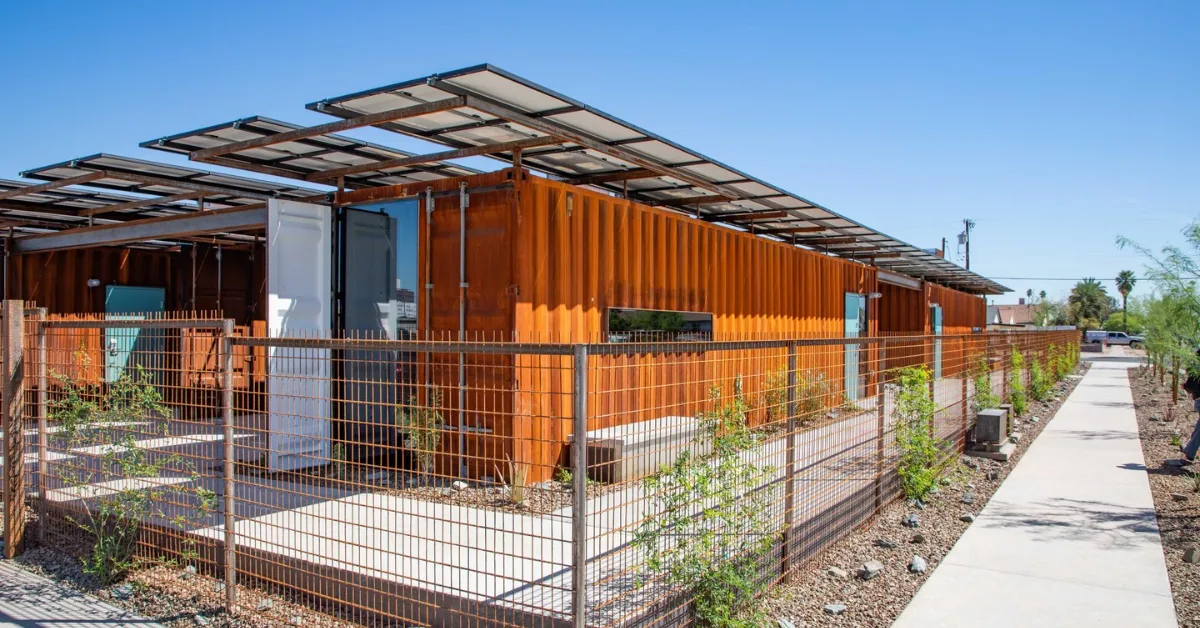
The buildings are made from shipping containers and tout major sustainability features, including off-grid power. During the day, the units are powered by solar panels. At night, lithium batteries take over.
“By doing this, completely energy independent, it reduces one of the largest costs for an operator, and then for the permanent housing, it reduces the cost of your air conditioning bill,” Brian Stark, co-founder of Senior Bridge and CEO of Steel and Spark, which manufactured these repurposed containers, told KJZZ Phoenix.
Senior Bridge is operated by housing nonprofit Mercy House, and Phase 1 is now open to residents. Each 160-square-foot unit includes a twin bed, bathroom with sinks, toilets, and showers, a mini-fridge, and a microwave.
@greaterphx/Instagram
Each resident is paired with a case manager who will help them access services like health care, nutrition support, and community engagement. Mercy House chief program officer Timothy Huynh told Axios Phoenix that there is no set time for how long residents are allotted, but that they will ideally move on to more permanent housing within about 90 days.
And, once Phase 2 is completed, 54 permanent supportive apartments will be available on the same campus, so those seniors can fully maintain their progress as they end their journey with homelessness. Once here, they will pay an affordable rent but no additional power bills.
It’s an intentional model out of Mercy House, which ensures that social services exist in the same place as housing support.
“We have this mistaken idea that shelters exist in isolation,” Mercy House CEO Larry Haynes told KJZZ Phoenix. “You know, the effectiveness of a shelter depends upon the outreach teams that bring books to us, and the amount of permanent housing stock to which we can then connect people to.”
Vice Mayor Kesha Hodge Washington speaks at the opening of Senior Bridge. @greaterphx/Instagram
The communal element of the program is what Haynes believes will be central to solving senior homelessness.
“We will not solve homelessness if we’re working against each other,” Haynes said. “We will only solve homelessness if we’re all working together. Because the things that our local businesses want to turn a modest profit, the things that our neighborhoods want to have a decent place to live, are virtuous, are reasonable.”
The permanent apartments are already under construction and are expected to be move-in ready by the end of 2026, Axios Phoenix reported.
Phoenix Vice Mayor Kesha Hodge Washington spoke at the Phase 1 ribbon-cutting event earlier this year.
“We are creating a model that centers dignity while delivering results,” she said.
You may also like: Startup matches college students in need of housing with boomer homeowners who have rooms to spare
Featured Image: @greaterphx/Instagram
