

Close Menu

    Subscribe to Updates

    Get the latest creative news from FooBar about art, design and business.

    What's Hot

    Researchers find honey bee hives have their own ‘immune system’

    October 28, 2026

    Weleda x Maggie’s Wellness Collection launches, with £10 per sale going to the charity

    October 28, 2026

    25 Cute Kawaii Thanksgiving Coloring Pages

    October 28, 2026
    Facebook X (Twitter) Instagram
    Trending
    • Researchers find honey bee hives have their own ‘immune system’
    • Weleda x Maggie’s Wellness Collection launches, with £10 per sale going to the charity
    • 25 Cute Kawaii Thanksgiving Coloring Pages
    • What is the Same and What is Different in Customer Harassment Countermeasures? A Labor and Social Security Attorney Organizes the Details Based on MHLW Materials|柴田久志|障害福祉の労務を専門とする社労士
    • Nnaabagereka Nagginda Raises Concern Over Children’s Mental Health, Calls for Parental Support
    • 23 Exercises & Activities to Practice Daily Self-Improvement
    • These 5 Principles Changed My Life and Made Me Happier
    • Hana Financial Opens Digital Career Classroom for Students With Developmental Disabilities
    Moving MountainsMoving Mountains
    Facebook X (Twitter) Instagram
    Wednesday, October 28
    • Home
    • Mental Health
    • Life Skills
    • Self-Care
    • Well-Being
    • Awareness
    • Inspiration
    • Workers Comp
    • Social Security
      • Injuries
      • Disability Support
      • Community
    Moving MountainsMoving Mountains
    Home » Researchers find honey bee hives have their own ‘immune system’
    Community

    Researchers find honey bee hives have their own ‘immune system’

    TECHBy TECHOctober 28, 2026No Comments4 Mins Read
    Facebook Twitter Pinterest LinkedIn Tumblr Reddit WhatsApp Email
    Search
    Share
    Facebook Twitter LinkedIn Pinterest WhatsApp Email

    Open a honey bee hive on a warm afternoon and the first thing you’ll notice is movement.

    Thousands of bees stream across the frames, tending brood, processing nectar and pollen, building wax, and maintaining the colony. A constant hum of activity and the smell of honey fill the air.

    But this bustling environment is also home to something much smaller: a vast community of bacteria and fungi.

    Some are harmless. Some are essential. Others can cause serious disease.

    For honey bees, living together in such dense numbers creates an obvious problem. An infection that enters a colony has tens of thousands of potential hosts. Yet healthy honey bee colonies are remarkably good at keeping harmful microbes under control. How do they do it?

    Our new research, published in ISME Communications, suggests that part of the answer lies in the way the hive is organized.

    ‍

    Mapping the hive’s defences

    To understand how a colony keeps microbes under control, we first need to look at the hive as a whole.

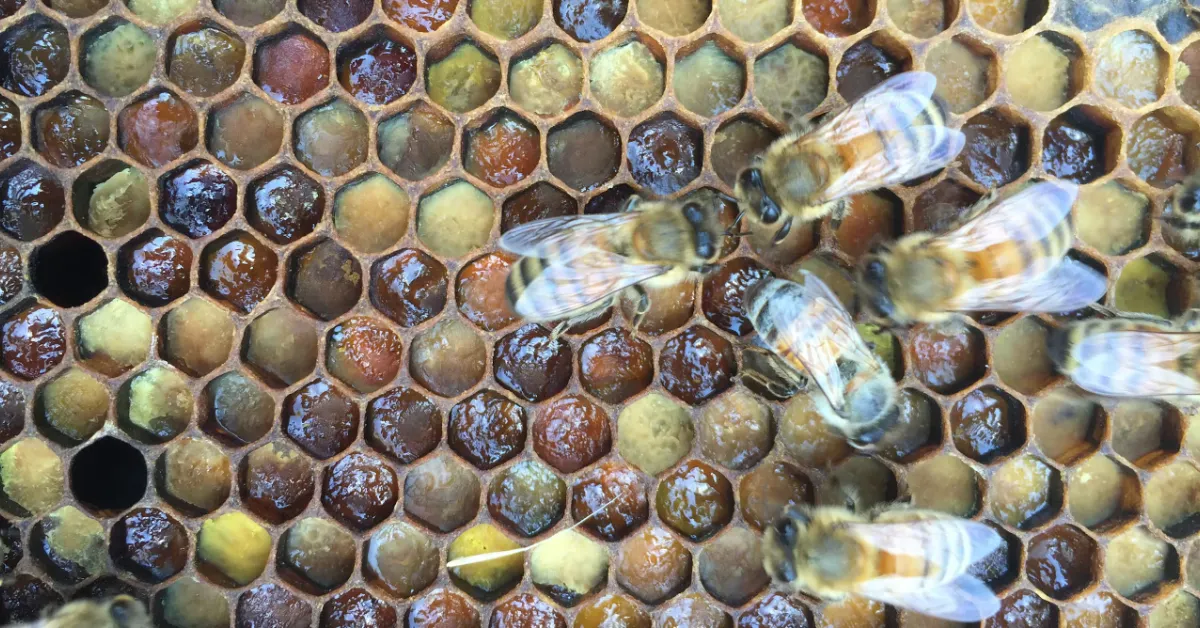
    The hive is not one place. Thousands of hexagonal wax cells are packed into combs, serving as nurseries, pantries, and storerooms.

    At the center is the brood, tended by nurse bees. Beyond it are the food stores, and at the edge is the entrance, where foragers come and go. Bees modify these spaces with materials they collect and produce.

    Plant resins are turned into propolis, a sticky antimicrobial glue used to seal cracks and line parts of the hive. Nectar becomes honey, and pollen is fermented into “bee bread”.

    Each of these materials has been studied before, but we wanted to know whether they work together as part of a coordinated defense system.

    So we sampled 24 colonies from five apiaries in New South Wales, collecting honey, propolis, pollen, wax, and nurse and forager bees.

    We used DNA sequencing to map bacterial and fungal communities, tested the ability of hive materials to inhibit microorganisms, and used nuclear magnetic resonance spectroscopy (a chemical fingerprinting technique) to investigate their composition.

    This allowed us to look at the hive as one connected system.

    ‍

    A floor plan for fighting disease

    What we found was striking.

    A healthy hive is not a sterile one. Many of the microorganisms living in and around a colony are harmless or beneficial, so eliminating them all would be neither possible nor desirable.

    Instead, the colony uses different kinds of defense in different places: selective protection around the vulnerable brood and broader antimicrobial activity in more exposed parts of the hive.

    Different materials also have different antimicrobial chemistry. For example, honey relies heavily on hydrogen peroxide — the same molecule in a bottle of antiseptic.

    Propolis leans on flavonoids, the same class of plant compounds that give red wine and green tea their antioxidant kick.

    Pollen’s defences look more like fermented food, rich in the short-chain acids produced by fermentation.

    Rather than relying on one all-purpose disinfectant, the colony combines multiple types of antimicrobial activity across different parts of the hive. In effect, the hive has a chemical floor plan for disease defense.

    Researchers sampled 24 bee colonies from five apiaries in New South Wales, collecting honey, propolis, pollen, wax, and nurse and forager bees. / Kenya Fernandes

    ‍

    The landscape becomes part of the defense system

    Perhaps the most important finding emerged when we looked beyond the hive.

    The strongest predictor of the chemical potency of hive materials wasn’t disease history or health status. It was which apiary the hive came from.

    This points to the surrounding landscape. Bees typically forage only a few kilometres from home, so local plants determine not only what they eat, but also the raw materials available for their chemical defences.

    A colony surrounded by diverse flowering plants may therefore have access to a broader chemical toolkit than one foraging in a simplified landscape dominated by a single crop.

    In other words, much of a colony’s chemical defences are built from what is growing outside its front door.

    ‍

    A broader view of bee health

    We often think about threats to bee health in direct terms: the varroa mite, pesticides, and pathogens.

    But our findings suggest that the ecological complexity of the landscape around a hive may also shape its ability to cope with disease.

    As native vegetation is cleared and flowering resources become less diverse, bees lose access to a wider range of plants and the resources they provide. Maintaining diverse habitat around bee colonies could therefore be an important part of supporting healthy colonies.

    And this idea may extend beyond honey bees. Ants, termites and stingless bees also use antimicrobial compounds to protect their colonies, often drawing on materials collected from their surroundings.

    For these animals, the landscape may provide more than food and shelter.

    It may provide part of their medicine cabinet.

    ‍

    This article by Kenya Fernandes from University of Sydney was originally published by The Conversation

    Bee Find hives honey immune researchers System
    TECH
    • Website

    Related Posts

    The Interview – Yuval Abraham and Rachel Szor: There’s a vacuum in Israeli media

    October 28, 2026

    4 Foundational Ways to Start Letting Go Before Life Gets Any Harder

    October 28, 2026

    Etsy Cracks Down on AI-Generated Content to Protect Buyers from Barrage of Slop

    October 28, 2026
    Leave A Reply Cancel Reply

    Don't Miss
    Community

    Researchers find honey bee hives have their own ‘immune system’

    By TECHOctober 28, 20260

    Open a honey bee hive on a warm afternoon and the first thing you’ll notice…

    Weleda x Maggie’s Wellness Collection launches, with £10 per sale going to the charity

    October 28, 2026

    25 Cute Kawaii Thanksgiving Coloring Pages

    October 28, 2026

    What is the Same and What is Different in Customer Harassment Countermeasures? A Labor and Social Security Attorney Organizes the Details Based on MHLW Materials|柴田久志|障害福祉の労務を専門とする社労士

    October 28, 2026
    Stay In Touch
    • Facebook
    • Twitter
    • Pinterest
    • Instagram
    • YouTube
    • Vimeo
    Our Picks

    Researchers find honey bee hives have their own ‘immune system’

    October 28, 2026

    Weleda x Maggie’s Wellness Collection launches, with £10 per sale going to the charity

    October 28, 2026

    25 Cute Kawaii Thanksgiving Coloring Pages

    October 28, 2026

    What is the Same and What is Different in Customer Harassment Countermeasures? A Labor and Social Security Attorney Organizes the Details Based on MHLW Materials|柴田久志|障害福祉の労務を専門とする社労士

    October 28, 2026

    Subscribe to Updates

    Get the latest creative news from SmartMag about art & design.

    About Us

    At Moving Mountains, we believe that every individual has strength, value, and purpose—regardless of mental health challenges or physical disabilities. This platform was created to inspire hope, promote understanding, and empower people to live meaningful and confident lives beyond limitations.

    Latest Post

    Researchers find honey bee hives have their own ‘immune system’

    October 28, 2026

    Weleda x Maggie’s Wellness Collection launches, with £10 per sale going to the charity

    October 28, 2026

    25 Cute Kawaii Thanksgiving Coloring Pages

    October 28, 2026
    Recent Posts
    • Researchers find honey bee hives have their own ‘immune system’
    • Weleda x Maggie’s Wellness Collection launches, with £10 per sale going to the charity
    • 25 Cute Kawaii Thanksgiving Coloring Pages
    • What is the Same and What is Different in Customer Harassment Countermeasures? A Labor and Social Security Attorney Organizes the Details Based on MHLW Materials|柴田久志|障害福祉の労務を専門とする社労士
    • Nnaabagereka Nagginda Raises Concern Over Children’s Mental Health, Calls for Parental Support
    Facebook X (Twitter) Instagram Pinterest
    • About Us
    • Contact Us
    • Privacy Policy
    • Terms & Conditions
    • Disclaimer
    © 2026 movingmountains. Designed by Pro.

    Type above and press Enter to search. Press Esc to cancel.