


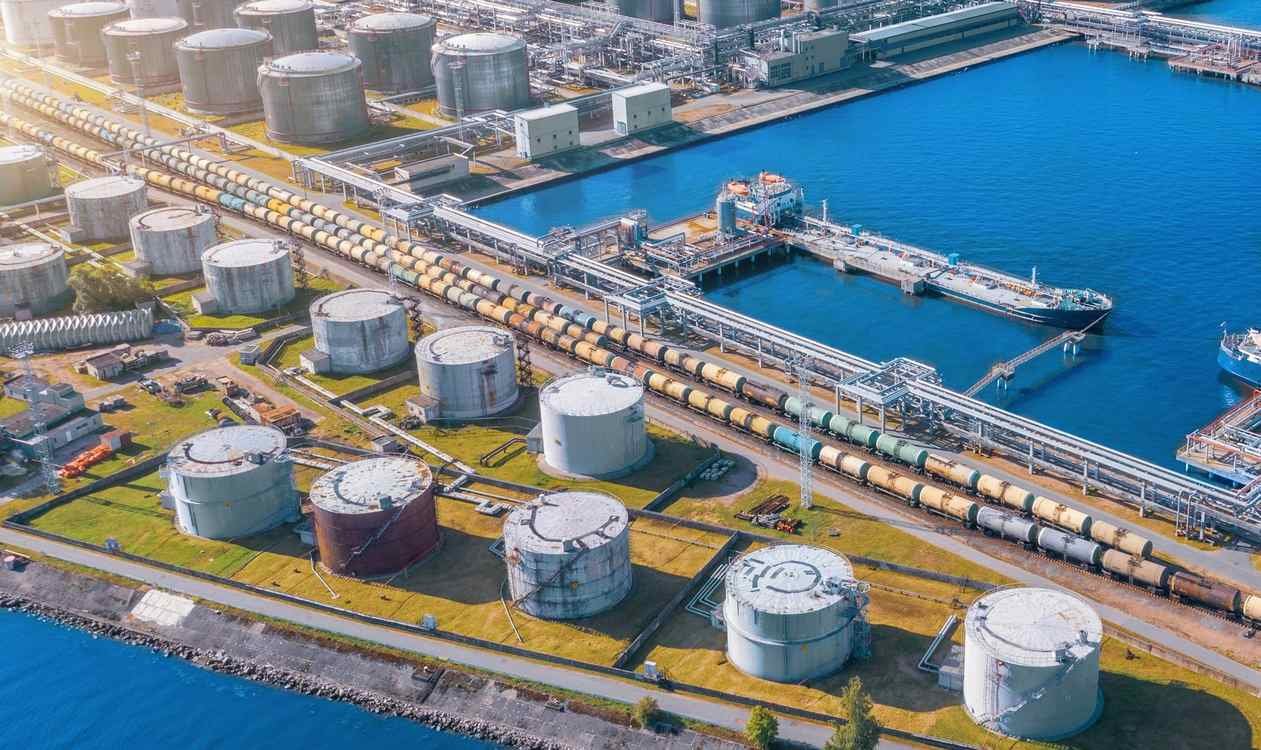
– credit – Getty Images for Unsplash +
Rather than bringing crude oil to boiling point over and over again as is done in traditional distillation refining, Chinese scientists have found a way to separate the mixture molecule by molecule at room temperature, cutting energy use by 90%.
The groundbreaking discovery was done in the lab, and so it can’t be said for certain to be scalable to the global petroleum products industry. If it could, though, it would dramatically reduce the cost and emissions from producing gasoline, diesel, or plastics.
Crude oil and its refined derivates are direct manufacturing inputs for thousands of common, high and low order goods—a fact widely circulated in the aftermath of the closure of the Strait of Hormuz through which one-fifth of the world’s crude is moved.
Researchers in northern China’s Dalian Institute of Chemical Physics have pioneered a method for turning crude oil into refined petroleum called “molecular refining,” which uses a chemical membrane to separate the different molecules found in crude oil and shunts them into different containers.
This is a critical change from the standard distillation method which leverages the slight variations in boiling points between the various chemicals in crude oil to separate them. It requires that crude oil be boiled many times over, requiring huge amounts of heat, and therefore huge amounts of energy.
Each of the scientists’ chemical membranes are specially designed like sieves to allow certain crude oil ingredients to pass through while the rest are filtered out. For example, straight-chain and single-branched alkanes that are used to produce the product ethylene can fit through one sieve because these have a different size from the multi-branched alkanes and cycloalkanes used to make gasoline.
These two separate membranes needed a fair amount of continual tweaking to get right, as the difference in size between these two groups of molecules is only about one-one hundredth of a nanometer. The researchers managed it, however, and then tested the two members with a light sweet crude mixture containing 15 different chemicals.
HEAVY INDUSTRY LIGHTENING UP:
In the lab, it was separated into 3 groups of high-value products with a recovery rate of between 85 and 90%, the authors reported in a study, published in National Science Review.
And because nothing needed to be boiled, vaporized, or condensed, the process used 91% less energy.
A 2021 estimate placed oil refining as the 3rd largest stationary contributor to global CO2 emissions, amounting to around 1.3 gigatons of CO2 per year, reaching at its highest level about 4% of global human-related CO2 emissions. That trumps contributions from large transportation like maritime shipping or aviation, and brings into context how valuable molecular refining could be if established at scale.
REFINE Your Friends’ Social Media Feeds By Sharing This Good Breakthrough…
