


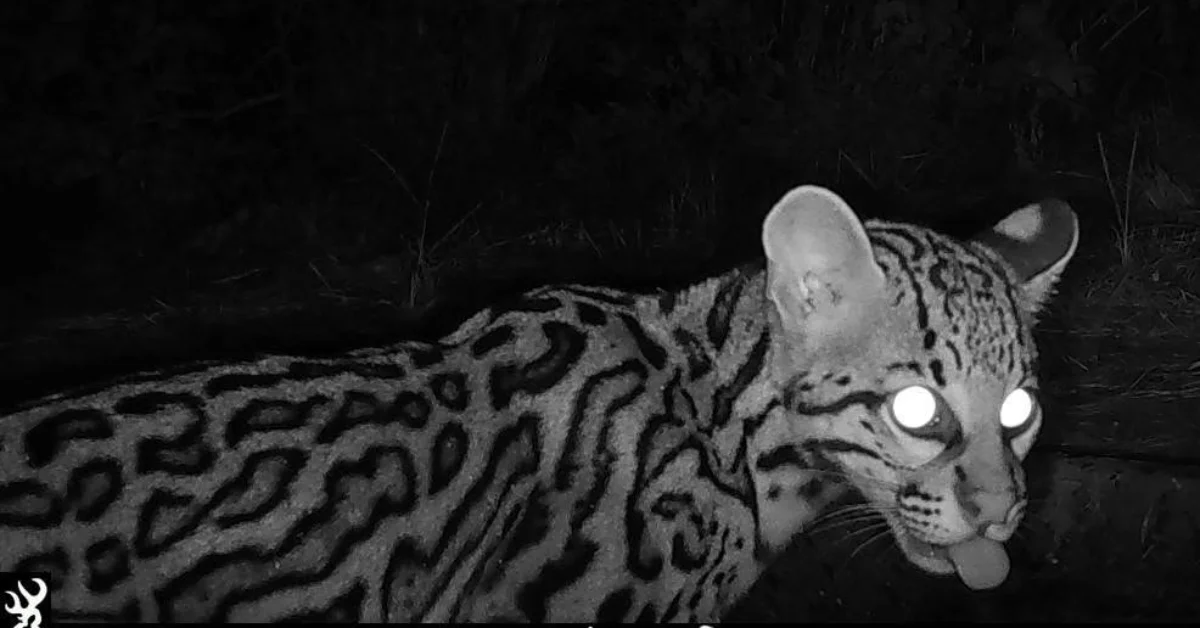
The ocelot, a spotted, medium-sized wild cat, used to be prominent along the American Southwest. But now, fewer than 100 individual wild ocelots remain in the United States.
Habitat loss and fragmentation due to industrial development, agriculture, and roads have become the most nefarious threats facing the ocelot population.
Though their stronghold remains in Laguna Atascosa National Wildlife Refuge in the Lower Rio Grande Valley in Texas, the 120,000-acre refuge still required the cats to cross a busy road to access the dense habitat they need to thrive in the wild.
Martinus Scriblerus/Flickr (CC BY 2.0)
Fortunately, in 2013, Texas began development on eight wildlife underpasses on FM 106, including on a road that runs through and adjacent to the wildlife refuge.
Construction finally began in November 2015, and all the underpasses in the project were completed in the summer of 2019. But it wasn’t until a few months later that ocelots began making their appearance.
Using remote trail cameras, the state’s Fish and Wildlife Service and Department of Transportation have monitored the species that use the wildlife crossings.
On January 25, 2020, the cameras captured the first sighting of an ocelot, a key species the underpasses were built to protect.
The ocelot was identified as OM331, a 5-year-old ocelot wearing a tracking collar as part of a study that used tracking collars to follow five ocelots between 2013 and 2021.
“OM331 … crossed beneath the FM106 roadway, perhaps starting the dispersal process or maybe just exploring his range’s boundaries,” a press release from the U.S. Fish and Wildlife Service reported.
“Photographed approaching the same underpass on January 17, he took more than a week to actually use the underpass to travel to the other side of the road — without ever needing to cross the road surface.”
Courtesy of TxDOT/USFWS/TxDOT
According to a 2024 study on wildlife crossing structures, animals may take years to acclimate to the presence of a crossing structure, “suggesting that the use of these structures may increase over time.”
Even seeing one ocelot so quickly after the crossing was installed is cause for celebration — and future improvements.
“Additional fencing could further help limit high-risk road encounters by ocelots in this region,” the study concluded.
An estimated 40% of ocelot deaths are caused by vehicle collisions, so the use of underpasses and other crossing structures is “crucial” to reducing any further population decline, USFWS said.
After seeing proof of concept at these initial underpass crossings, the Texas DOT applied for grant funding from the Federal Highway Administration’s Wildlife Crossings Pilot Program in 2023.
The state was rewarded with $1.8 million to build more wildlife crossings, particularly to reduce collisions with ocelots. The funding came through former President Joe Biden’s Bipartisan Infrastructure Law, which set aside $350 million for wildlife crossing projects nationwide.
Caesar Kleberg Wildlife Research Institute/USFWS
Laguna Atascosa was one of the first 19 projects to receive funding in the first round of grants.
“We are pleased to announce the first round of grants under the Wildlife Crossings Pilot Program to projects that will significantly reduce the number of collisions between motorists and wildlife,” former Federal Highway Administrator Shailen Bhatt said in a press release.
“These roadway safety investments will ensure that motorists and wildlife in Texas get to their destinations safely and are a win-win for safety and the environment.”
To date, the Texas Department of Transportation has built 32 animal crossings across the state, and at 21 locations in South Texas specifically to protect ocelots. As the Laguna Atascosa remains home to one of the last breeding populations remaining in the U.S., these wildlife crossings have proven to be a means of avoiding extinction — at least for now.
And it’s not just ocelots that have benefited.
“TxDOT has been monitoring results and found that the crossings are successful in allowing multiple wildlife species to cross our roads,” TxDOT environmental specialist John Young Jr. said in a statement.
“As many as 26 different species have been documented using TxDOT wildlife crossings, including mountain lion, alligator, ocelot, bobcat, coyote, Texas indigo snake, striped skunk, raccoon, beaver, bridled weasel, to name a few.”
You may also like: Since 2018, over 9,000 animals have crossed this wildlife bridge in Washington. Trail cameras just spotted its first bear
Featured Image: Caesar Kleberg Wildlife Research Institute/USFWS
