


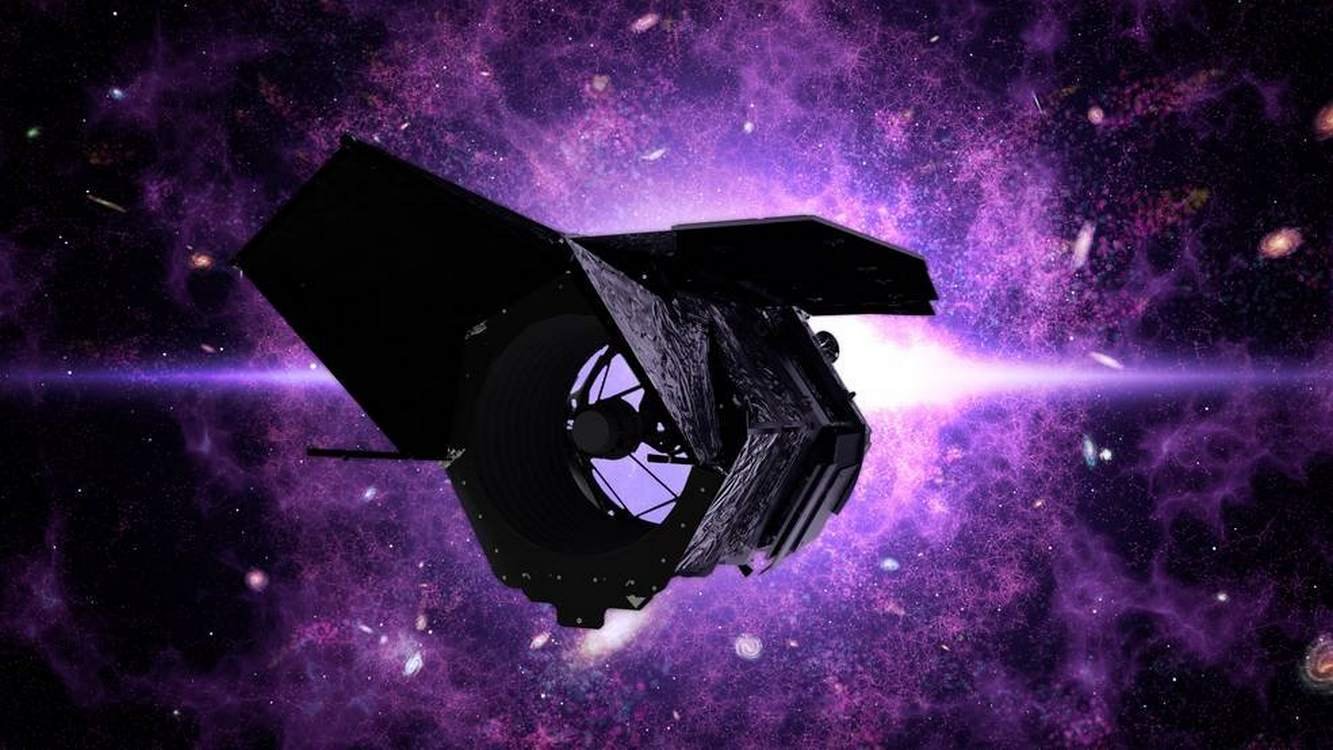
A high-resolution illustration of the Nancy Grace Roman Space Telescope against a starry background – credit, NASA’s Goddard Spaceflight Center
Reprinted with permission from World at Large.
9 months ahead of schedule, and surviving attempts in both Trump Administrations to cut its budget in half, the Nancy Grace Roman Space Telescope soared into space on Sunday afternoon aboard a SpaceX Falcon Heavy rocket launched from Cape Canaveral.
Designed to compliment NASA’s existing James Webb and Hubble space telescopes by acting as a wide angle field of view, it will have a mission life of between 5 and 10 years depending on its fuel.
“I have no doubt that Roman will become a household name alongside those great instruments of discovery,” NASA Administrator Jared Isaacman told reporters after the launch, referring to Webb and Hubble.
“It feels like I’m on the edge of a precipice, and we’re just about to set a foot off into the unknown,” Julie McEnery, Roman telescope senior project scientist, told reporters at a post-launch news conference.
Named after American astronomy pioneer Nancy Grace Roman, this new first-rate observatory has a different set of tools for a different sort of job.
Rather than using infrared vision to pinpoint moments or objects from the earliest periods of the universe, or dazzling the public with images of nebulae, the NGR will look to another secretive aspect of space: dark matter and dark energy, strange material that makes up about 95% of all the matter in the universe. And while Webb can show us the atmospheres of exoplanets in extreme detail, Roman will be the master of finding them, thanks to the inclusion of a first-of-its-kind “active coronagraph” instrument.
“The combination of sensitivity, angular resolution, and speed, those are the key things that differentiate Roman from all the other observatories that NASA currently and in the future would have,” says Dominic Benford, Program Scientist for NGRST and who oversees the entire Roman project from science, through to materials and collaborations.
“The unique capabilities that Roman will bring to bear are a combination of being able to cover a relatively wide field of view, at a very high angular resolution, with the kind of sensitivity that telescopes in space are able to provide, and be able to do this relatively quickly,” he told WaL in an exclusive interview.
It could survey the entire Milky Way galaxy in about a month, compared to a century needed by Hubble.
The interview with Benford occurred in 2022, and is reproduced below.
Why are the galaxies pictured here in JWST’s deep field view positioned where they are? It could be because the mysterious forces of dark matter and dark energy are pushing and pulling them around. To get a better understanding, Roman will produce images like this in a fraction of the time, to allow astronomers to map the progressive movements of galaxies, and better discover dark matter and dark energy’s effects – credit, NASA/JPL Caltech
The dark side of the forces
The NGR arose from NASA’s 2010 “decadal survey” which is a questionnaire conducted with astronomers and physicists every 10 years that seeks to organize the space agency’s goals around what the scientific community is most interested in studying.
In 2010 that was, and today remains, and will continue to be, the desire to study dark energy and dark matter, two unique and polarized forces in the universe that cannot be seen.
“Dark matter is roughly a quarter of the universe, and it acts like regular matter gravitationally in that it pulls things together, it helps build structures,” explains Benford, who holds a PhD in infrared instrumentation and building space telescopes to observe stars and galaxies.
“It helps coalesce galaxies, bringing dwarf galaxies that then merge to form larger and larger galaxies. So you see the effects of dark matter by how quickly over cosmic time all these galaxies pull together to form the very largest structures in the universe”.
“Dark energy is if anything a little bit harder to figure out,” he adds. “It acts as a repulsive force. It pushes things apart. To some extent it counteracts the activity of dark matter. Major surveys necessary for dark matter and dark energy measurements require a variety of different techniques, but all require large datasets taken uniformly over much more sky and much more time than has been possible for any other space telescope”.
One way in which to study how these two forces act in the universe is to measure the positions of galaxies now, and compare them to where they were 1 billion years ago, and then maybe 3 billion years ago. Measuring the characteristics of the galaxies’ movements allows scientists to draw hypothetical dark matter/energy structures in a game of connect the dots in which the lines connecting them are invisible, and the placement of the dots is merely inferred.
The gradual slowing of the expansion of the universe after the Big Bang is thought to have been a result of dark matter’s gravitational pull gathering much of the visible matter together again, but the increase in the expansion rate is thought to be a result of dark energy pushing it away again.
“One of the long-term questions Roman is supposed to address is what the influence of dark energy has been across cosmic time,” says Dr. Benford. “So we can look forward and extrapolate which of these two is really going to dominate in the universe: does dark energy essentially win out and push the universe apart faster and faster, or does dark matter perhaps win and cause the universe to slow down, or is it in perfect balance?
It’s a big question, and Roman is the first real tool that will be able to come close to answering it.
The other capability unique to Roman comes from the observatory’s namesake.
“In 1959, Nancy Grace Roman, the woman, wrote a paper predicting that it would be possible to make direct measurements of the reflected light from planets around other stars by using what she thought was a razor’s edge to block the light of the star and let the light of the planet pass by,” says Benford.
When the NGR goes up, this “razor’s edge” will take the form of a “coronagraph,” similar to a tool of the same name that has allowed ground-based telescopes to capture information about our Sun’s corona. A system of masks, prisms, detectors, and even self-flexing mirrors make up the tool that will allow Roman to create an image that places an artificial eclipse around a distant star to reveal the planets in orbit around it, just as Roman the woman predicted.
“This hasn’t been done before. And we have an excellent design and it has been working very well in a lab, but because we’re doing this for the first time in space in an observatory that has real moving parts, we don’t know exactly how well it’s going to work,” Benford admits.
This was made by “passive” coronagraphs, on earth, which Benford explains can manage to detect the subtle light signatures of orbiting exoplanets to the degree of around 1 part per million. But they have a flaw.
“They don’t compensate for all the distortions and motions of the telescope,” he said. “With a space-based telescope, using an active coronagraph, we can get to the [1] part per billion level”.
At this extreme sensitivity, we should be able to see Jupiter-size planets around other stars. If the technology is successful, Whenever Roman’s successor goes up into space, it should have a next-generation coronagraph that could detect the light signatures from Earth or Mars-sized planets.
The coronagraph is equipped with a spectroscopy instrument as well, allowing us to not only see exo-Jupiters, but detect the molecular makeup of their atmospheres.
Hubble’s ultra-deep field is the small square in the middle of an area capable of being surveyed with the same definition by Roman – credit, NASA’s Goddard Spaceflight Center
It bears asking, between Hubble, Webb, and the SphereX surveyor that maps the entire universe every 6 months, why is another space telescope being built. What can it do that the others can’t? Well as Phil Korngut, Instrument Scientist at the California Technical Institute team that built SphereX told WaL, and to which Benford agreed, these are extremely complimentary beasts.
SphereX takes a picture of the entire sky over 6 months, while JWST can take extremely high-resolution images in infrared of individual objects.
One might say that Roman sits in a “Goldilocks zone” of wide yet detailed view, in infrared, that compliments both.
“So with something like JWST which is very good at focusing on a single object or a small number of objects and studying them in great detail, Roman will be a way that you can find those most distant galaxies, or the clusters of galaxies that need great study,” reasons Benford.
“For something like SphereX which is a survey mode instrument that occurs at much longer wavelengths, it has a relatively wide field of view, but it’s a shallower image, and it’s not as sharp, so the interesting areas you might see in a SphereX survey can be seen in great detail in the Roman survey of the same area”.
“If you want to do something like the Hubble Deep Field, Roman can do this hundreds of times, to a thousand of times faster. So you can contemplate doing in a month what would have taken Hubble a century”.
It remains flexible. A quarter of total use time will be set aside to help answer questions that arise from the astrophysics community after NGR comes into operation. An example could be star formation in our own galaxy.
With infrared, and the wide field of vision, NGR offers a unique opportunity to look at massive stars on the other side of the Milky Way, without all the gas, dust, and light that can get in the way.
NGR will need 90 days to perform pre-operation checks and tests before the public will be able to get a sample of what will no doubt be its incredible capabilities.
ROCKET This News Over To Your Friends On Social Media…
