


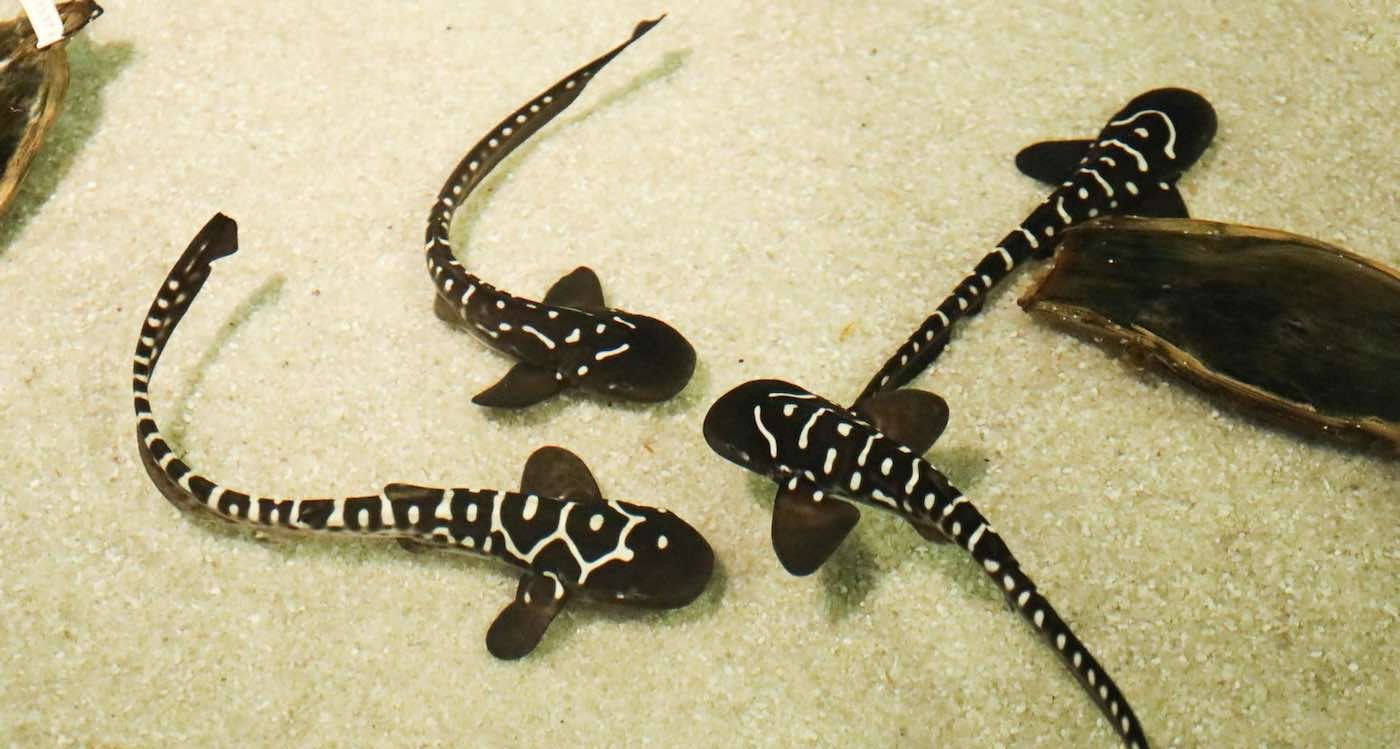
Released by Reshark.org / © Georgia Aquarium
Out in the wild waters of Indonesia, zebra sharks are extremely rare. Overhunted, these striped bottom dwellers were at risk of going extinct.
After 3 years of foundational work, an international consortium of 60 aquariums in 15 countries that banded together to create a huge captive-breeding-and-release program is seeing the fruits of their labor—nothing less than the first rewilded sharks in the world.
Such an effort has never been undertaken before, and rewilding is typically reserved for mammals and other terrestrial species, but the zebra shark, also known as the Indo-Pacific leopard shark, is ideally suited since it lays eggs.
Since GNN first reported on ReShark’s efforts on the Indonesian island of Raja Ampat, 82 shark pups reared in captivity have been transported to the island and released into a 46,000 square-kilometer (17,760 square-mile) shark and manta ray sanctuary.
Satellite tagged, ReShark has been able to gather critical proof-of-concept data about what a captive-bred shark, released into an enclosed nursery, and then into the open water, would do with that freedom. They’re foraging well, and staying within the boundaries of the marine sanctuary, meaning that with any luck they’ll be protected from the illegal fishermen that saw the zebra shark listed as “Endangered” by the IUCN.
“Back in 2019, in Raja Ampat, we estimated that there were about 20 individual adult sharks remaining,” Mark Erdmann, executive director of ReShark, told CNN in an interview.
“Most conservation activities for sharks usually revolve around either setting up marine protected areas or doing fisheries management. In our case, our niche is we’re doing active recovery.”
INDONESIAN NEWS: Marsupials Previously Thought Extinct for 6,000 Years Discovered: ‘A once-in-a-lifetime discovery’
The program got its start when Erdmann visited the SEA Aquarium in Singapore, and staff told him that the zebra sharks in their captivity were overwhelming the tank with viable eggs. Pups would hatch and there would be just too many to handle.
Now dozens of aquariums are shipping viable eggs in special containers to ReShark’s two nurseries in Raja Ampat and Phuket, Thailand. There, the eggs hatch, and the baby zebra sharks are reared in protected nurseries by “shark nannies,” which despite the name are actually rigorously trained aquatic animal husbandry specialists.
At 1 meter in length, just over 3 feet, the animals are released into the sanctuary, where they will need between 5 and 12 years to reach sexual maturity. It’s then the true test of this never-before-deployed method of marine conservation will take place: will these sharks reproduce in the wild. ReShark will see the results by 2028 at the earliest.
PROTECTING MARINE PROTECTED AREAS: Locals Succeed in Tripling Protected Seascapes Along 300 Miles of Turkiye’s Breathtaking Coastline
One of the major contributors to the zebra shark’s decline was Thai and Indonesian locals overharvesting them for their fins. ReShark’s other chief operation is getting these islanders and fishermen involved in the project so they can understand the vulnerability of the shark and its importance in the ecosystem.
43% of sharks lay eggs, so if the effort is successful, it could be an important milestone in shark conservation that may be replicable in other climes with other sharks.
Give Your Friends A BITE Of This Shark Story By Sharing It On Social Media…
