


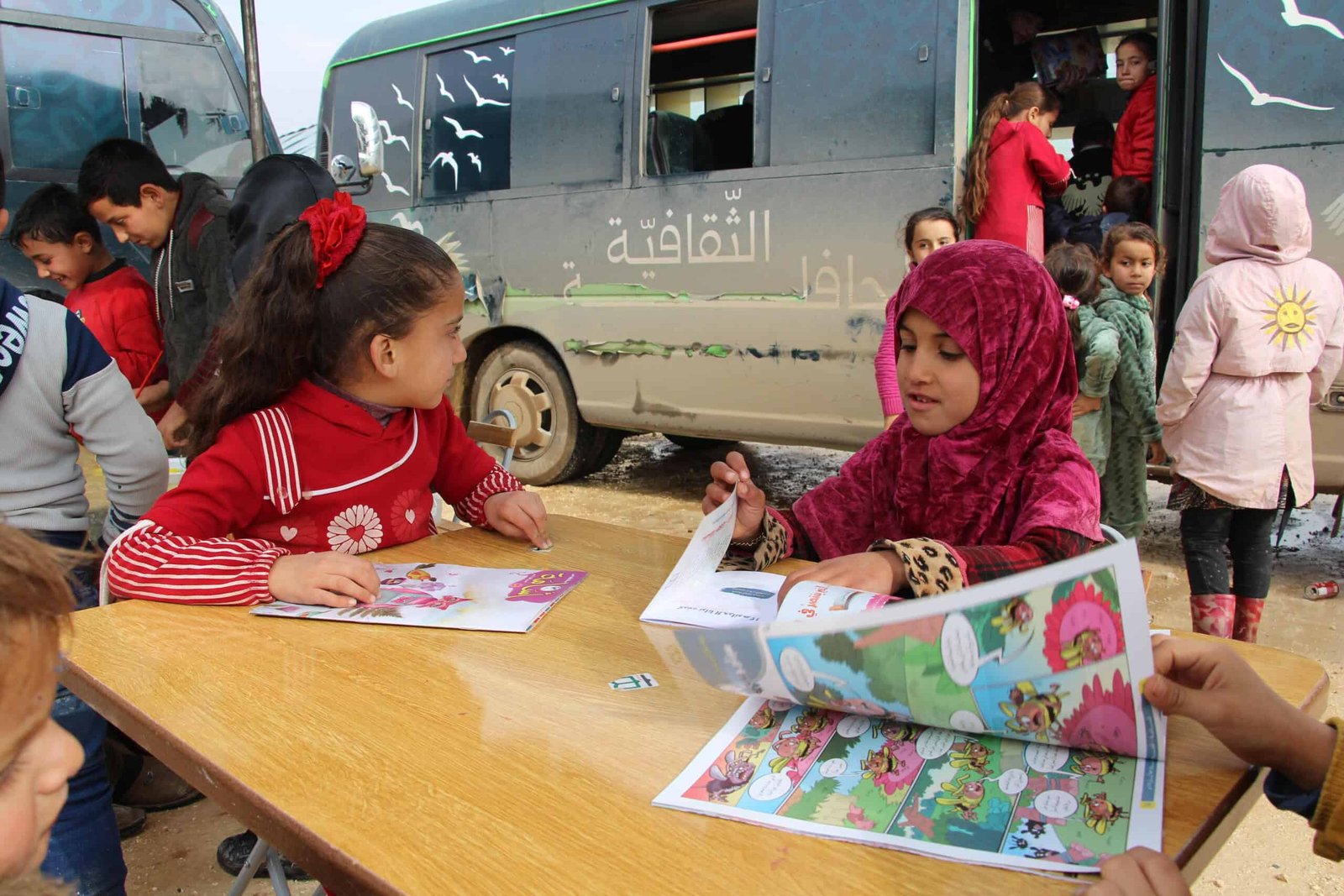
In camps and rural communities across Syria, a brightly painted bus is bringing books, puppets and art workshops to children who have grown up with war
In a dusty clearing inside Kafr Lusin camp, in the rural reaches of northern Idlib in Syria, a brightly coloured bus pulls up with books and cartoon characters painted across its sides.
Within minutes, children begin moving towards it, curious at first, then excited, gathering around the doors as they open to reveal shelves of books, boxes of art supplies and a small puppet theatre.
Soon, a performance begins, and the space around the bus fills with the laughter of children who have had little chance to experience anything like this. For a few hours, there are stories to listen to, pictures to draw, games to play and characters to cheer. In a place where childhood has too often been shaped by displacement, fear and waiting, the arrival of a bus can feel like a small festival.
The project is known as the Mobile Cultural Bus, an initiative launched by Syria’s Ministry of Culture with support from a group of volunteers. Its aim is simple enough: to take books, art and cultural activities to children and families in areas that have little or no access to libraries, community centres or safe creative spaces.
Solutions every Saturday
Uplift your inbox with our weekly newsletter. Positive News editors select the week’s top stories of progress, bringing you the essential briefing about what’s going right.
Sign up
For the children who run to meet it, however, the bus is more than a travelling library. It is a break in the day, a doorway into stories and, for some, the first time they have been invited to make something, imagine something or hold a book of their own.
Syria’s long years of conflict have torn through the country’s education and cultural life. Schools have been damaged or destroyed, community centres have closed, and families have been uprooted again and again. In rural areas and camps, where daily life can be reduced to the search for safety, food, water and work, cultural activities are often treated as a luxury.
Mohammad Murad, the project director, says that is exactly why the bus was created. “We realised that many children had never stepped foot inside a library,” he says. “Our thinking was simple: if they cannot go to culture, we must bring culture to them.”
For a few hours, there are stories to listen to, pictures to draw, games to play and characters to cheer
The initiative began with an old bus donated by a supporter. Volunteers cleaned it, repaired it and repainted it in bright colours before turning it into a mobile educational space. Today, it carries novels and short stories for both children and adults, alongside learning materials, drawing equipment and craft supplies.
When the bus arrives in a village, town or camp, the team usually spends several hours with the children. A visit might begin with a group storytelling session, followed by drawing, handicrafts or reading, before ending with a puppet show or educational games. The format is deliberately simple, but the response can be immediate.
“For these children, the arrival of the bus is an extraordinary event,” says Sarah al-Khatib, a volunteer teacher with the project. “Many have spent years living in a state of tension and fear because of the war and the shelling of their towns by the former Syrian regime. But when we arrive, we see the atmosphere shift completely; laughter and joy reclaim the space.”
Al-Khatib says the volunteers are not pretending that a book or a puppet show can undo what the children have lived through. What they can do is offer attention, routine and a brief return to something that looks and feels like childhood.
“Seeing the happiness on their faces is what makes us forget our exhaustion,”she says. “We may not be able to offer a lot, but we can offer our time and expertise. Sometimes, a simple story or an activity can leave a profound impact.”
That impact is often felt most clearly by children who would otherwise have almost no access to books. Among them is 12-year-old Walid al-Samahi, from the town of Al-Qutayfah in rural Damascus, who loves science fiction but can’t afford books. For him, the mobile library’s visit is one of the few chances he has to enter a world beyond his daily life.
When we arrive, we see the atmosphere shift completely; laughter and joy reclaim the space
“I find so much joy in reading these stories, and I am always eager for a new book,” he tells Positive News. “This is the first time I’ve held a book filled with so many pictures and tales. When I grow up, I want to become a teacher so I can give children books like these, so they don’t have to feel as lonely as I did.” As he speaks, he hugs the small book and breaks into a wide smile, as if he has found somewhere to live for a while inside its pages.
So far, the Mobile Cultural Bus has visited dozens of villages and neighbourhoods, reaching thousands of children. According to the project team, its first phase covered 39 areas in Damascus and its surrounds before expanding to other provinces, with Homs among its more recent stops. The project currently operates with two buses, which means the volunteers still have far more requests than they can answer.
The need is enormous. Unicef’s 2026 humanitarian appeal for Syria says that more than 2.5 million children are out of school, while nearly 8,000 schools need urgent rehabilitation. Overcrowded classrooms, damaged buildings, a shortage of learning materials and the displacement of families continue to make education difficult for many children.
Against that backdrop, a bus filled with books cannot solve the education crisis. It cannot rebuild a school or replace the teachers Syria has lost. But it can reach children who are cut off from learning and culture, and it can remind them that they are allowed to ask questions, make things, laugh loudly and imagine a future that is not defined only by loss.
For Murad and the volunteers, the bus is not just delivering stories; it is treating culture as something children in camps and rural communities are entitled to, rather than something reserved for those living in city centres or more stable places.
In a country trying to recover from years of devastation, the sight of children gathering around a brightly painted bus may look modest. But for those waiting on the roadside, it brings a rare window of joy and learning, and perhaps the start of a new dream.
Images provided by Sonia al-Ali
Be part of the solution
At Positive News, we’re not chasing clicks or profits for media moguls – we’re here to serve you and have a positive social impact. We can’t do this unless enough people like you choose to support our journalism.
Give once from just £1, or join 1,800+ others who contribute an average of £3 or more per month. Together, we can build a healthier form of media – one that focuses on solutions, progress and possibilities, and empowers people to create positive change.
Support Positive News
