


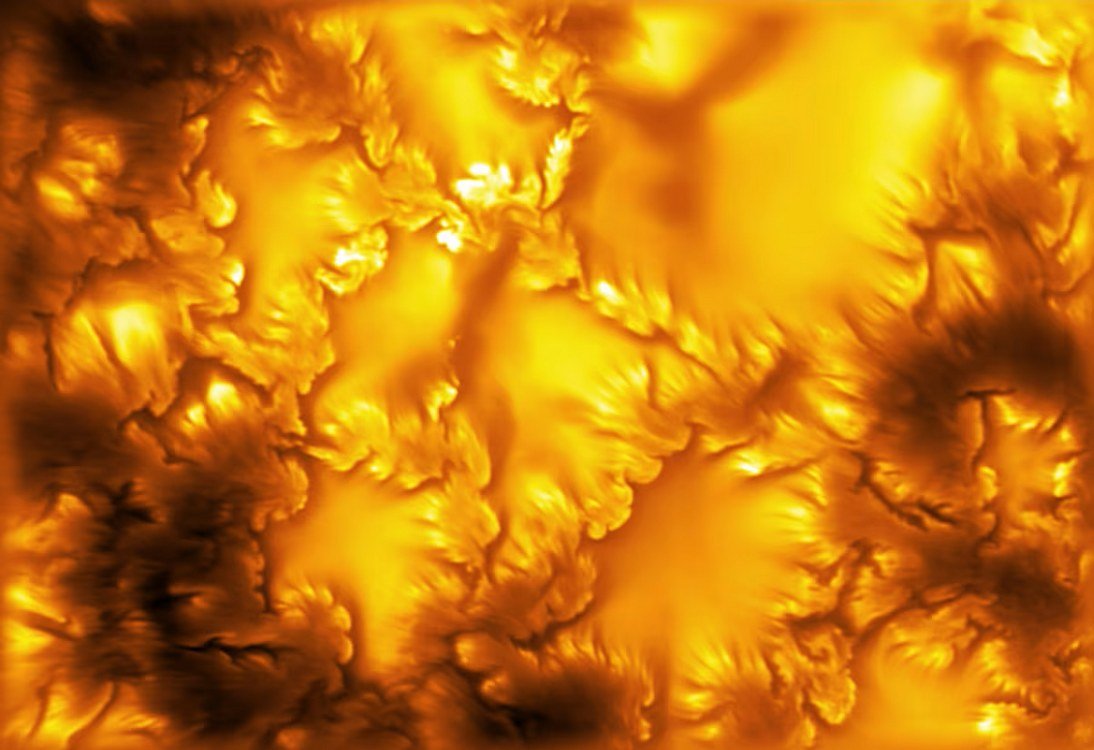
Little plasma whirlpools on the Sun’s surface – credit, NSF/NSO/AURA/MPS
Scientists using Earth’s most powerful solar telescope have snapped a picture of the Sun’s surface that helped explain—for the first time—foundational physics about our dear star.
Situated atop the summit of Haleakalā, a volcano on the island of Maui, the Daniel Inouye Solar Telescope peered down onto the surface of the Sun. Captured in the data is proof that the plasma thereupon is subjected to the same physical force that causes waves to break and whirlpools to form down on Earth’s seas, or among Jupiter’s clouds.
Published in the journal Nature, the authors of a paper on the discovery said it carries “far-reaching implications for our understanding of the creation and dissipation of magnetic fields,” on the Sun’s photosphere.
“The vortex formation on the Sun has long been a central question in solar physics. For the first time, we have identified both their origin and their driving mechanism,” lead study author Dr. David Kuridze, assistant astronomer at the National Solar Observatory in Boulder, Colorado, wrote to CNN in an email.
The phenomenon is known as Kelvin-Helmholtz Instability.
“Although theoretical models had suggested that the right conditions for Kelvin-Helmholtz Instability could exist in the photosphere, seeing these structures widespread across the surface was still a huge surprise.”
The discovery promises a wealth of further information on the mechanics of solar flares and coronal mass ejections, phenomena which, when occurring in the direction of Earth, can interfere with satellite communications and power grids, cause the Northern and Southern lights, and even destroy electrical equipment.
It also could help scientists understand why the Sun’s outer atmosphere is hotter than its surface.
Kelvin-Helmholtz Instability occurs when two fluids moving at different speeds pass each other in different directions. The perturbations caused by the interaction form vortices. The images from the Inouye telescope mark the first time the phenomenon has been seen on the Sun.
NEW TELESCOPES: Greatest Spectroscope Ever Built Can Tell What 2,400 Cosmic Objects Are Made of Every 20 Mins.
Kuridze later told CNN to think of the vortices as small engines that drive magnetism, energy, and heat up from the surface to the Sun’s outer atmosphere. This occurs, in part, through flux braiding, another potential signature of the vortices.
The vortices have the power to intertwine lines of a magnetic field, which generate heat when they snap and reform. For their research, the scientists pointed the Inouye Telescope at a magnetically-active area next to a large Sunspot.
MORE SOLAR PHYSICS: This Stunning Perspective of the Sun and Moon Comes from New NASA Mission Set to Study Solar Wind
CNN reported that the general consensus in solar physics is that these small solar whirlpools are far more relevant to the formation and expression of massive and rare solar events than other signs in the lead up to those events.
The ultimate reward of this work would be the ability to interpret the formation and movements of the vortices as signs of future, larger events that could potentially affect Earth.
WATCH the whole video below…
SHARE This Incredible Science With Your Friends…
