


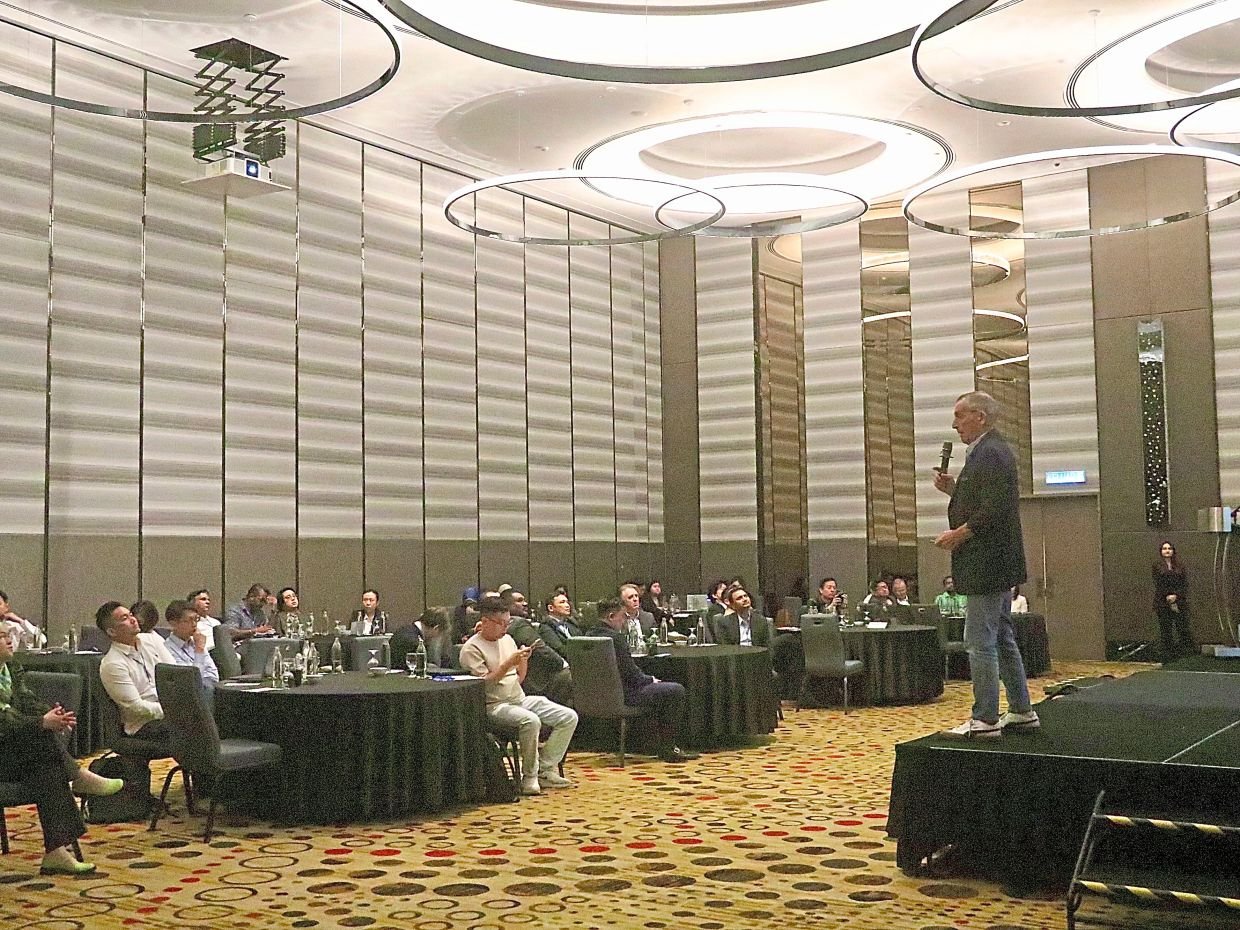
From housing above highways to digital twins, industry experts gathered at “Future Cities: Infrastructure Ready Cities 2026” to explore strategies for smarter, resilient cities.
The two-day event, organised by Star Media Group, discussed topics such as transit-oriented development, smart and resilient infrastructure, infrastructure financing and public-private partnerships (PPPs), urban planning and local governance, urban proptech, as well as net-zero ecosystems and ESG compliance.
O2 Design Atelier founder and principal architect Edric Choo captured the audience’s attention with his proposal to address housing issues in the Klang Valley with residential blocks above highways or train stations.
“Because of land price and construction costs, people move to the suburbs and travel two to three hours in the traffic to get to work, and then back home. That is crazy.”
Equipped with features such as courtyards, jogging tracks and greenery, Choo envisioned this to be attractive living spaces while keeping people close to the city.
He also shared a futuristic concept of flying capsule homes that can plug in and out of towers built above the ground, eliminating the need to clear forests for development.
Later, in a panel discussion on “Internal Infrastructure: Integrating Smart Interior Systems into the Urban Fabric”, Jalex Group of Companies executive director Janet Lee, who is also the past president of Malaysian Interior Industry Partners Association, shared that Malaysian builders are often asked to bring down their budget, compress buildings and replacing materials with local alternatives.
Commercial viability must be addressed right from the beginning of projects, she said, instead of telling the builders and suppliers to make changes towards the end.
The project objectives risk being compromised, leading to delays, cost overruns and systems that cannot integrate effectively, she added.
Lee said builders and suppliers should see themselves as long-term solution partners, rather than at the bottom of the value chain.
“As buildings become more complex within a short time frame, we have to invest in information technology. We have to be technology driven, which means we have to invest in softwares which can assist us in our planning and the critical part, delivery,” she said.
In addition, the local workforce has to be trained and upskilled, while suppliers have to modernise the manufacturing chain to incorporate modular systems, shorten production and use ESG-compliant materials, she added.
In his plenary session on “CIDB Digital as an Enabler of Smart Infrastructure: Bridging Policy, BIM and Digital Construction Management”, CIDB Digital Sdn Bhd chief executive officer Nazir Muhamad Nor said the construction industry must become more connected, data-driven and digitally enabled to build infrastructure-ready cities.
He said construction activities contribute about 4% to Malaysia’s gross domestic product and has a multiplier effect of 2.03, with some economists estimating it could reach as high as six or seven.
As project value, volume and complexity continue to grow, Nazir said manual processes lead to delay, rework and cost inefficiency.
Many projects still face fragmented information, inefficient workflow and incomplete digital adoption, with project information scattered across different platforms, spreadsheets and systems.
The industry must shift from traditional to smart infrastructure that is connected, monitored and managed intelligently, he said.
“Smart infrastructure moves us towards connected assets, real time data, predictive maintenance, integrated information and lifecycle-based delivery,” he said.
He said CIDB Digital bridges policy and implementation through building information modelling (BIM) adoption, common data environment (CDE), digital construction management, digital reporting, asset information management and smart infrastructure.
In her plenary session titled “Urban, Resilient and Smart Infrastructure: Future-Ready Cities”, AECOM Hong Kong buildings and places vice president Shirley Chen said future cities should embody four qualities: human-centric, resilient and sustainable, innovation-driven, and inclusive and equitable.
Drawing on five case studies from mainland China and Hong Kong, she shared how the company has implemented urban and smart infrastructure in the real world.
Zooming in on digital governance, Chen shared that the Hong Kong government has been pursuing its smart city vision since 2017 through initiatives like adopting BIM, developing a common spatial data infrastructure and creating a citywide 3D map.
The BIM data and the 3D map, she added, are publicly accessible, accelerating Hong Kong’s digital transformation.
“We also helped the Hong Kong Lands Department to develop an underground utility information system. It was very complicated, but we harmonised all utility data for the whole city.”
A successful future city is not defined by new infrastructure or the latest technologies alone, said Green Building Index chief executive officer Sarly Adre Sarkum.
“By rushing through the process of providing infrastructure, we may be exacerbating environmental problems because, at the end of the day, we are not looking far enough ahead,” he said in a session titled “Infrastructure is Not Enough: Why Future Cities Must Be Regenerative, Resilient and Human”.
A truly successful city, he added, is one where infrastructure and supporting systems are planned to promote environmental regeneration, which in turn would drive economic prosperity, social inclusion, climate resilience and health and well-being.
“The ultimate goal is to have a higher quality of life, stronger economy, lower emissions, greater resilience and greater social cohesion.”
According to Sarly, future cities should be built on three key foundations: resilience against climate-related disasters, human well-being and regeneration.
Rather than degrading nature, development should restore and enhance the environment, leaving it better than before. Achieving this requires a long-term approach to the development of cities, he added.
During the panel on “Future-Proofing Our Cities: Climate Resilience, Disaster Preparedness and Next-Generation Urban Utilities”, panellists said fragmented data, unclear communication and weak execution are among the biggest obstacles to future-proofing cities.
Climate Governance Malaysia council chair Dr Gary William Theseira said the challenge lies partly in the fragmentation of data, such as hydrograph data from rivers, temperature readings and wind speed measurements.
“All of these things are already contributing to the huge amount of information that we have regarding what’s headed our way in the next 24 hours, in the next seven days, in the next month,” he said.
He added that the issue is not prediction, but the ability to act on what is already foreseeable.
Reinforcing the importance of turning data into action, Blue Stone Management Malaysia director Dr Joshua Netto said the cost of responding to climate impacts far outweighs the cost of preparing for them, citing financial losses, reputational damage and the disruption of lives and livelihoods.
Offering another perspective, he said the challenge of future-proofing cities often lies in delivery and execution, which can weaken over time as projects are altered.
“The delivery and the execution are often where we fail because things change over time and we start to optimise, value engineering, remove elements and in the end, we end up in a state where we don’t know how we got there,” he said.
Building on this, International Islamic University Malaysia assistant professor Dr Mohd Farid Jaafar Sidek said uncertainty is another major hurdle, especially when national plans are not clearly translated for those implementing them on the ground.
