


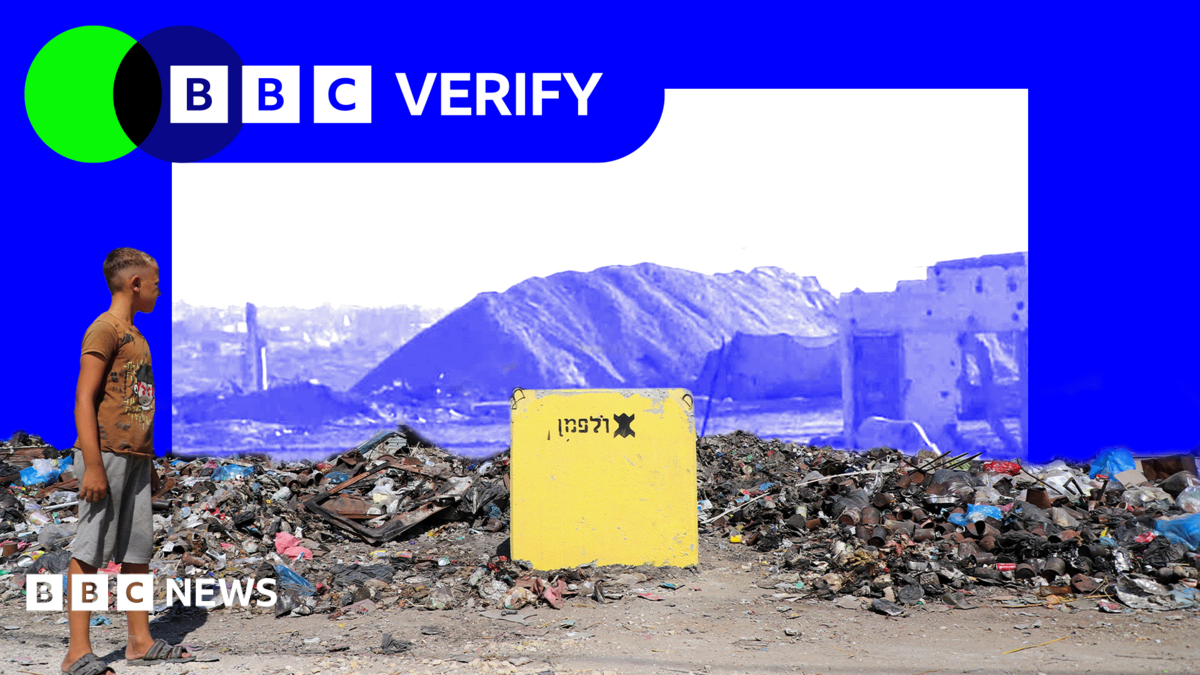
“We’ve been displaced from place to place, and now we have nowhere left to go,” says Umm Mohammed al-Shawish.
She is desperately searching for somewhere to live after Israel moved yellow concrete blocks that mark out where it controls in the Gaza Strip.
Families living in al-Tuffah in northern Gaza woke on Monday to find the blocks had been moved westwards into the centre of Salah al-Din road, a key north-south route through Gaza.
Nearby, an Israeli flag was flying on top of an earth barrier around 3m (10ft) tall.
The al-Shawish family home was destroyed during the war. On Sunday, they had to flee again after the Israeli military called to warn of an attack on a nearby building. Their only shelter was a tent, which was torn apart by the strike.
“We are going to die here,” Mohammed al-Shawish said. “Death is better than humiliation. No-one is standing with us.”
Under the terms of the US-brokered ceasefire deal between Israel and Hamas last October, Israel agreed to withdraw its forces from across Gaza to a designated demarcation – the Yellow Line.
The deal was meant to leave Israel in temporary control of the area behind the Yellow Line – equating to 53% of Gaza’s territory. However, the Israeli Prime Minister Benjamin Netanyahu recently said the Israel Defense Forces (IDF) controlled more than 60%. In May, he said publicly that his “directive” was to move to 70%.
Hamas accuses Israel of violating the October ceasefire agreement by moving the Yellow Line westwards. A senior Israeli government official said Israel rejected Hamas’s claims outright. The BBC was told: “IDF deployments and security lines are operational measures taken to protect Israeli citizens and prevent Hamas from rebuilding its terror army. Israel will continue to act against any ceasefire violations.”
The Israeli military initially marked the Yellow Line with concrete blocks, before moving some markers further into Gaza. But Israel has now constructed a network of barriers, having started soon after the ceasefire. The barriers now stretch more than 42km (26 miles) and cover 85% of Israel’s Yellow Line, with the longest section already 13.8km (8.5 miles).
Experts have told the BBC that the earthworks suggest Israel is planning for a long occupation of the strip. In some areas the earth barrier effectively moves the de facto “border” – the Yellow Line – deeper into Gaza, further increasing the deadly no-go zone for Gazans.
One section of the embankment near the al-Mawasi camp is more than 1.5km beyond where the Yellow Line was originally mapped. Another section in Khan Younis is positioned more than 500m over it.
