


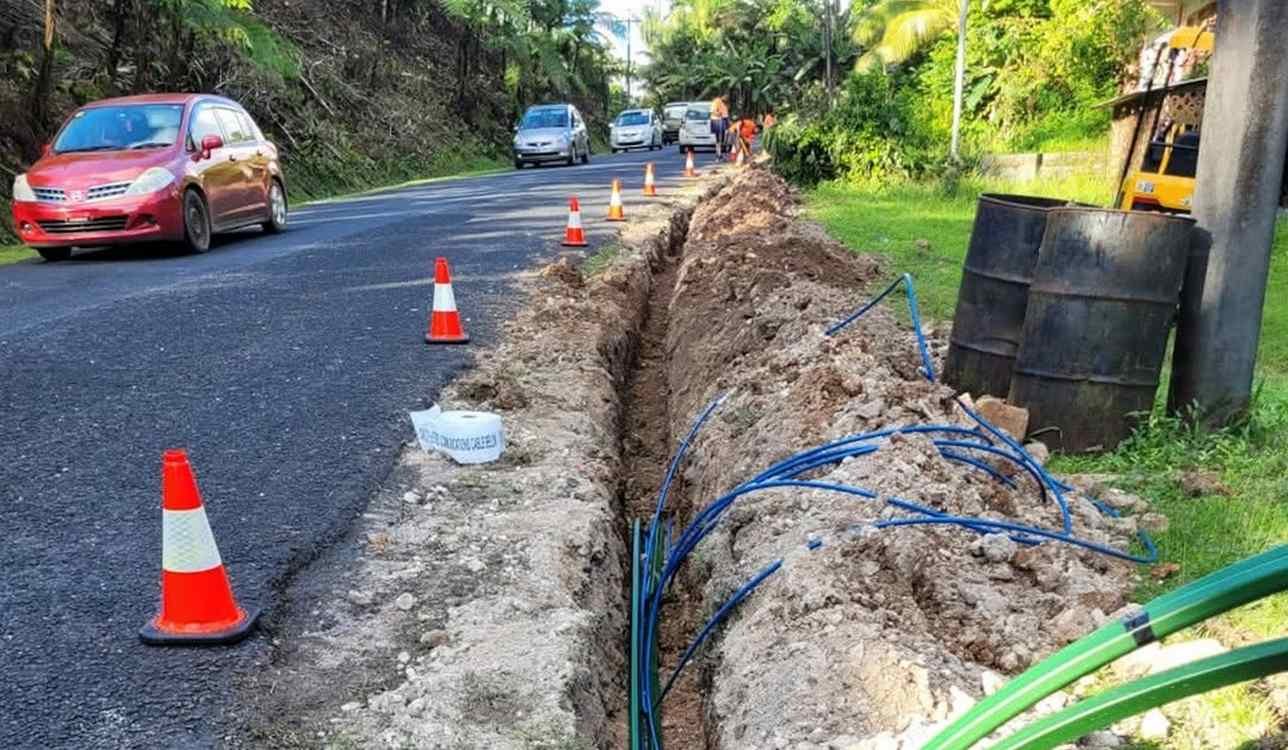
Fiber optic cables being installed in FSM – credit, Digital FSM Project / The World Bank Group
Internet access has increased 20-fold and broadband costs have fallen by 99% on the archipelago of Micronesia thanks to the ending of government monopoly in the sector.
Market liberalization has dropped the cost of internet to $65.00 per Mbps per month to just 78 cents, while more than 1,500 kilometers of undersea fiber optic cables have been laid, and advanced satellite dish networks have sprung up on the most outlying islands.
Made up of more than 600 small islands spread across 2.9 million km² of ocean, telecommunications is both complicated and absolutely necessary on the Federated States of Micronesia (FSM).
For decades, FSM had had but one single telecom provider: FSM Telecommunications Corporation, a government-granted monopoly established in 1984 to provide fixed-line, mobile, and internet across the islands. Its board members were appointed by the head of state and state governors.
In 2014, at the urging of the World Bank Group, the Telecommunications Act ended FSMTC’s monopoly, and since then internet access has increased 2,000%, reaching 88% of the whole population, as competition over the market share brought Kacific, Starlink Pacific, iSolutions Micronesia LTD, and iBoom into the country to offer new telecom products and services.
Satellite technology, which had been largely undeveloped or retarded under FSMTC’s monopoly, has now provided vital and instantaneous communications solutions for the most remote islands in the archipelago, an absolute necessity for digital government services in health care, digital ID, and voting.
LIFE ON THE ISLANDS:
It used to cost $705 per megabyte-per-second to use mobile internet data. A rate like that would translate to several hundred dollars every month for basic speeds.
It now costs just $30, while private planning in FSM has seen the archipelago become a landing point for the East Micronesia Cable system, benefiting people across FSM but also neighboring Kiribati and Nauru.
The World Bank has contributed funding and support to a next-level integration of telecom technology across FSM through its Digital FSM Project, which launched in 2020.
ARE You Reading From FSM? Leave Us A Comment Below About Your Experience…
