


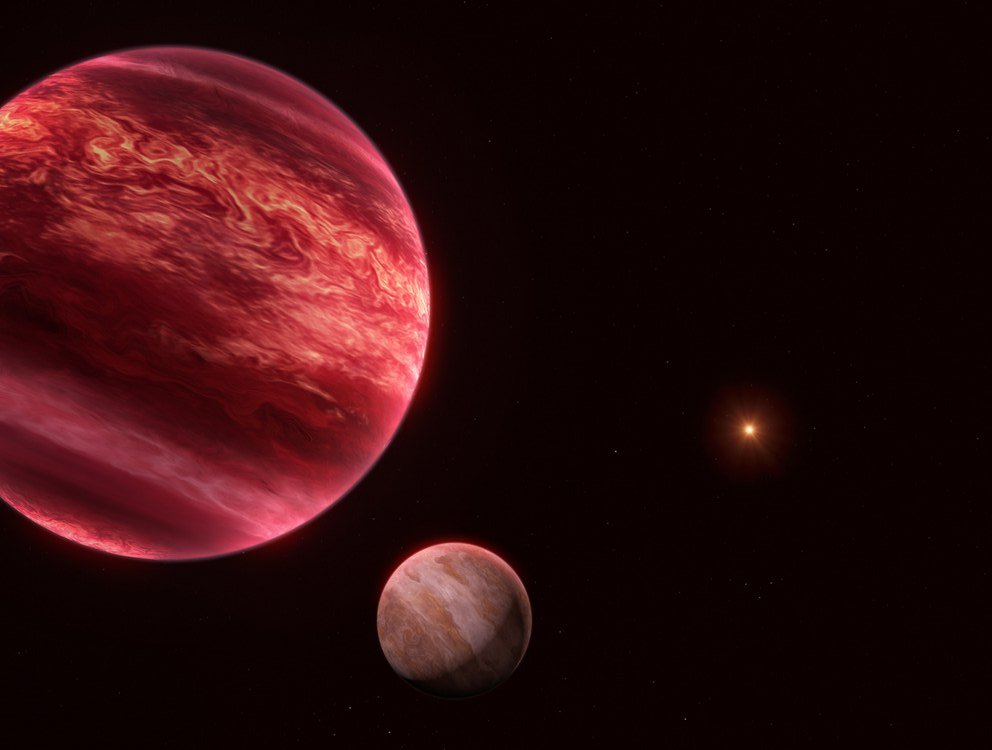
Artist’s impression of the CD-35 2722 system – credit, ESO/M. Kornmesser
As soon as Aleksander Wolszczan confirmed the observation of the first planet outside of our solar system, he immediately reasoned that thousands more would be discovered in the coming decades.
On that prediction the astronomer, now 80, was eminently correct, and the trend has expanded to the point that recent observation seems to include the first recorded moon outside our solar system.
The presented evidence for a moon-like object in the CD-35 2722 star system, however, raises questions about what the word “moon” even means. That’s because unlike moons in our solar system, the newly-found object does not orbit a planet, but a star; and it is a heck of a lot larger than any moon in our neighborhood.
Nevertheless, European Southern Observatory’s Very Large Telescope (ESO’s VLT) found what is the first confirmed “three-tiered system,” of a star with a body orbiting it, and a third, smaller body orbiting that.
Kevin Hoy, an ESO student in Chile and lead author of the study published in Nature, describes the system he spent months analyzing as “super weird” compared to our own.
The biggest object in this young system is the star CD-35 2722, which has about half the mass of the Sun. The star is being orbited by a brown dwarf, an object too massive to be a planet but too small to be a star. This brown dwarf has a satellite, which we usually call a moon, but in this case it’s about as big as Jupiter.
“This system is somewhat hard to define using Solar-System-based words like ‘planet’ and ‘moon,’” states Hoy, who is also affiliated with the Universidad Diego Portales and YEMS, a multidisciplinary research center focused on detecting exoplanets and exomoons.
Hoy and his co-authors have settled on the most technical terminology available, and called the third-order object an “exosatellite.”
“The exosatellite is clearly massive enough to be a planet, but it does not orbit a star, though it orbits an object that orbits a star,” says Hoy. “Being the third wheel in this system makes us want to call it a moon, even if it’s nothing like the small, rocky moons we have in our system.”
“We have a clear delineation between the planets and the Sun in the Solar System, so defining things like moons is simple,” adds Alice Zurlo, YEMS Director and collaborator on the study.
“In the CD-35 2722 system, where we are blurring the lines between stars, planets, and moons, the whole thing becomes more complicated to describe.”
MORE FIRSTS IN SPACE:
Regardless of what to call this object, astronomers have been trying to detect satellites outside our Solar System for years, but none has yet been confidently detected. Therefore, despite the over 6,000 exoplanets discovered to date, only a few exomoon candidates have been spotted and the evidence to support them is limited.
For the CD-35 2722 observations, Hoy, Zurlo, and their team used the CRIRES+ instrument on the VLT, employing the method that was used to find the first exoplanet around a Sun-like star.
They applied this radial velocity method to detect small wobbles on the brown dwarf caused by the gravity of the object orbiting it, finding what the team believe to be strong evidence for this ‘moon.’
“This system is truly unique and represents a breakthrough: the first plausible detection of an exosatellite,” says Zurlo confidently.
Like Wolszczan’s, the detection could herald a rapid acceleration in the identification of exosatellites/moons. 6 of the 8 planets in our solar system have natural moons, so they should be fairly common in the universe. The issue is that they’re small. Our Moon is quite small compared to Earth, but Phobos, the largest satellite of Mars, is just 7 miles across.
SHARE This Brilliant Science And The Breakthrough It Portends In Moonspotting…
