


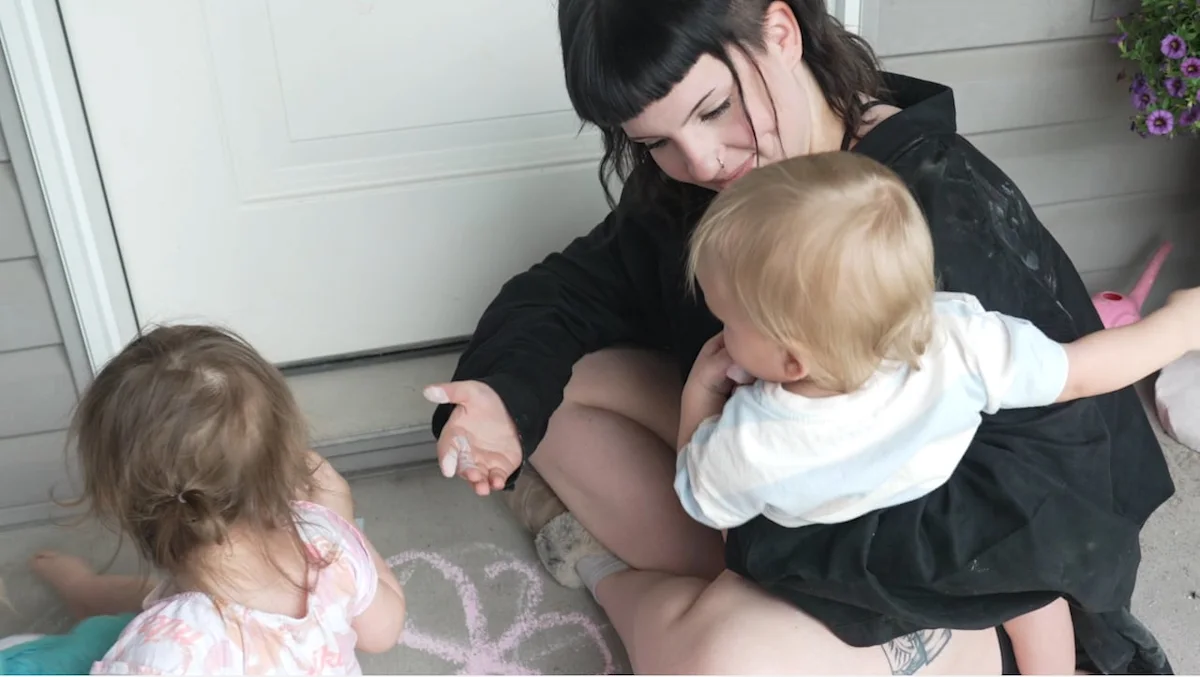
Reese Dyck wants to make sure no other moms feel alone. That’s why the 22-year-old is opening a centre focused on supporting parents postpartum in southeastern Manitoba.
The Southeast Postpartum Centre is expected to open in Steinbach this fall, and will provide space for moms to rest, connect with others and find support.
Dyck’s children, SJ and Sonny, were born 11 months apart. She struggled with postpartum anxiety and depression after giving birth, and even considered taking her life.
“I did not know how I was going to get through it,” Dyck said at her home in Île-des-Chênes, about 25 kilometres southeast of Winnipeg.
“I did, obviously, but no mom deserves to feel that way. No mother who’s doing such important work, in such a vulnerable and important time of their lives, deserves to feel like they’re alone.”
Dyck says her own experiences revealed gaps in care. She wants her new centre to be a one-stop-shop for moms adjusting to their new normal.
Services will include therapy, massage therapy, on-site child care and support groups. Dyck also wants spaces where moms can rest and connect with other moms.
She intends to offer services for free, and expects to have the centre registered as a non-profit in August. It will then be able to accept donations and apply for grants. She hopes to have the centre open by the end of October.
Dyck is working to open the Southeast Postpartum Centre in Steinbach this fall to support parents adjusting to their new normal. (Jura McIlraith/CBC)
She also feels it’s important to include support for men navigating the postpartum period and looking for ways to better support their partners.
Dyck, who grew up in Prince George, B.C., moved to southeastern Manitoba when she was 17 to be with her partner.
“We live in a community where, for a lot of factors, women tend to have a lot of babies back to back,” Dyck said.
“It’s a huge contributing factor to postpartum depression, and I find in our society, in our community in particular, there is a lot of stigma around mental health to begin with.”
That’s why she feels it’s important to create a space for mothers to feel safe and receive support without judgment.
‘You’re just thrown into it’
Dyck is also partnering with Charlyse Litke, a birth and postpartum doula working in the area. Litke says postpartum depression is not talked about enough.
“You’re just thrown into it,” and “because it’s not a commonly talked about thing, if you get postpartum depression, there’s the shame and you feel like you can’t talk to anyone about it,” Litke said.
“You internalize it, and then it gets worse and bad things can happen.”
Charlyse Litke works as a birth and postpartum doula in the southeast. She’s partnering with Dyck to start the Southeast Postpartum Centre. (Jura McIlraith/CBC)
Litke wants moms to know it’s OK to reach out for help.
In her work as a doula, she helps support new mothers by doing things like doing laundry or looking after the baby while the mom gets to sleep.
Litke also hosts an expo, Bump2Baby, where people can learn about child care and women’s health. There’s been strong interest for the event in the community, she said.
That experience is helping her guide Dyck in opening the Southeast Postpartum Centre.
Litke says there isn’t enough postpartum support anywhere in North America, and one expert agrees.
Kristin Reynolds is a clinical psychologist and professor at the University of Manitoba who focuses on health care access needs for different groups, including pregnant and postpartum people. She wants to see a national strategy to support mental and physical health for perinatal care.
Kristin Reynolds, a clinical psychologist and professor at the University of Manitoba, says there aren’t enough supports for postpartum care. She’s excited the Southeast Postpartum Centre will be another resource for new parents. (Zoom)
Data from Statistics Canada released earlier this year indicates just under half of birthing parents experienced emotional or mental health challenges in 2024. Among those who reported challenges, 60 per cent said they began after childbirth, and 25 per cent said they started during pregnancy, according to Statistics Canada.
“The postpartum period just represents so many changes both for the birthing parents, for their lifestyle, for their hormonal changes, physical changes and caring for a new little one,” Reynolds said. “People are doing all of that while they’re not sleeping well.”
It’s important for communities to keep an eye on new moms and support them in finding the right resources, said Reynolds, and she’s excited to see a centre like the one in Steinbach open to serve the region.
Dyck said for her, success for the new centre “means that every mother that walks through our doors feels heard, feels understood and feels supported.”
“I want mothers to know while they’re struggling with such a gruelling time that they’re not alone.”
If you or someone you know is struggling, here’s where to look for help:
