


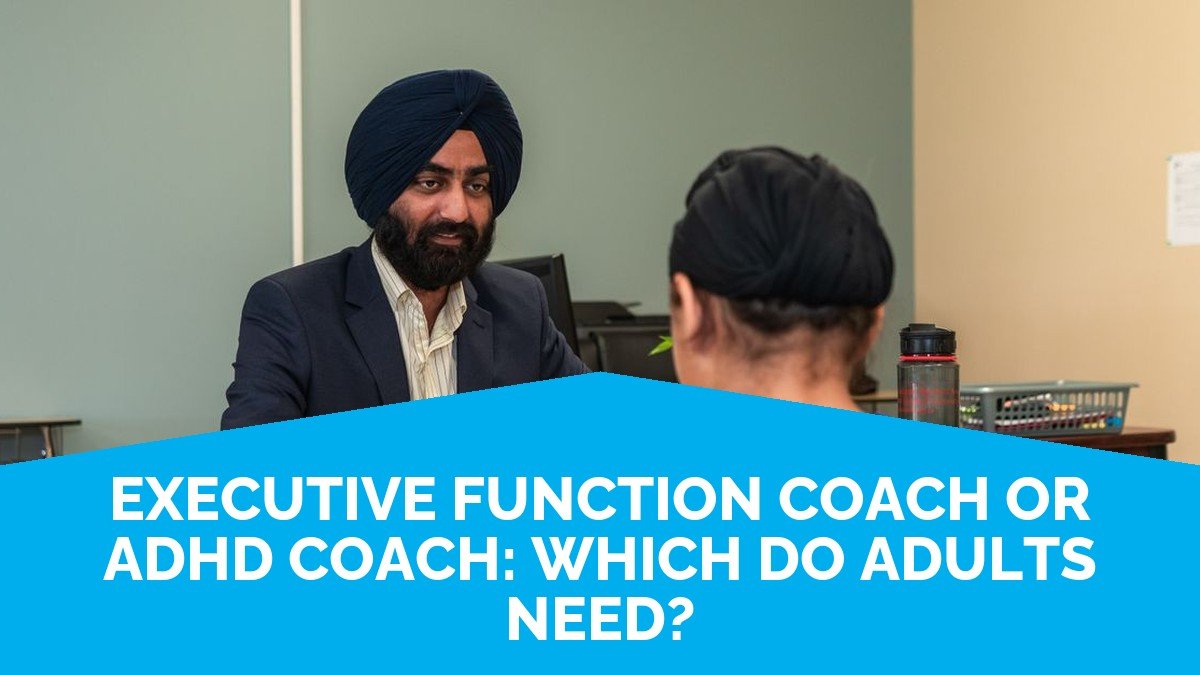
You have two browser tabs open. One coach calls herself an executive function coach. The other calls himself an ADHD coach. Same friendly headshots, same promise to help you get your life in order, same pricing you have to send an email to find out.
And you are stuck trying to guess which of those two words is the one that will get you unstuck.
If you are an adult with ADHD, or you think you might have it, and you are weighing an executive function coach vs ADHD coach, this is a more confusing choice than it should be. Most of the pages you land on make it worse.
So here is the short version, and it is a little annoying: an executive function coach and an ADHD coach are often the same person, doing the same work, with a different word on the website. Not always. But often enough that choosing by the label is the wrong move.
The question worth answering is which coach can do the work you need done. I run an executive function coaching practice and I have ADHD myself, so I will keep this straight with you: here is where the two labels blur, where they really differ, and how to choose the person instead of the word.
TL;DR
If you are stuck on executive function coach vs ADHD coach, this guide sorts out four things:
- Are an executive function coach and an ADHD coach really different services, or mostly the same work under two labels?
- Which one fits if your real problem is starting tasks, following through, or feeling buried?
- What should you ask a coach before you hand over any money?
- What does coaching cost, what happens in a session, and do you need a diagnosis first?
Coaching is skills-and-accountability support, not medical care or a diagnosis. If part of what you are carrying is anxiety, shame, or burnout, that points more toward therapy, and there is a link below to help you tell the difference.
Executive Function Coach vs ADHD Coach: Are They Even Different?
Start with the thing that clears up most of the confusion: neither “executive function coach” nor “ADHD coach” is a protected title. There is no license, no governing board, and no legal definition behind either phrase. Anyone can put either one on a homepage tomorrow, so the word on the website tells you less than you would hope.
It is the same reason “life coach” can mean almost anything. With no license behind the words, the label is a starting point for a conversation, not a promise about scope.
That sounds cynical. It is not meant to be. The ADHD Coaches Organization, the field’s own professional body, defines an ADHD coach as a trained coach who works from the International Coaching Federation model and has added specific ADHD training on top.
That is a real, useful description. It just is not a fence around the words, because a coach who never did that training can still use them.
Executive function coaching comes at the same work through a slightly different door. Executive function is the set of mental skills that run the show: planning, starting tasks, working memory, organization, and managing time and emotions.
Trouble with those skills is not unique to ADHD, so an executive function coach frames the work around the skill, not the label.
What each label tends to emphasize
The emphasis usually splits like this. An ADHD coach centers the ADHD experience: how your particular brain handles attention, motivation, and time. An executive function coach centers the skill itself, whatever is driving the trouble, which makes the frame broader and works for people across diagnoses, and people with none.
According to CHADD’s overview of ADHD coaching, an ADHD coach targets the core places ADHD trips people up: planning, time management, goal setting, organization, and problem solving. Read that list again. It is the same list an executive function coach would hand you.
That is not a coincidence. For most adults, the daily weight of ADHD basically is executive function difficulty, so the two roles keep landing on the same work.
Where they overlap (and why the line is blurry)
Both kinds of coach tend to use the same core tools: goal-setting, accountability, breaking big things into steps, and a bit of structure between sessions. Because the labels are unregulated, plenty of coaches hold both. The same person will describe herself as an ADHD coach on one page and an executive function coach on another, depending on who is searching.
This is where how executive dysfunction shows up day to day matters more than the title on the door. A coach who understands the mechanics of it, and can meet you on the day starting a task feels physically impossible, is worth more than one whose homepage happens to match your search term.
Question
Executive function coach
ADHD coach
Main focus
The executive function skill itself: planning, task initiation, organization
Living and working well with an ADHD brain
Best fit for
Anyone with executive function challenges, diagnosed or not
People with ADHD or strong ADHD-like patterns
Typical background
Coach training plus an executive function or special-education grounding
Coach training (often ICF-based) plus specific ADHD training
Diagnosis required?
No
No, though most clients are identified or suspect it
Which One Do You Need, an Executive Function Coach or an ADHD Coach?
Here is how I would decide it, once you set the labels aside for a second. The choice between an executive function coach and an ADHD coach comes down to your real, specific situation, not the phrase that ranked first in your search.
Find the line below that sounds most like you.
- Your main problem is structure and follow-through. You know what to do; you just cannot get started, stay on it, or keep a system running. Either coach can help here, so vet for whoever can genuinely coach executive function skills and do not overthink the label.
- You want someone who lives in the ADHD world. If half the battle is feeling understood by a person who gets rejection sensitivity, time blindness, and the shame spiral, an ADHD-labeled coach who can still coach the skills is a natural fit. Fluency in the experience matters.
- Your challenges reach past ADHD. Maybe there is autism in the mix, a learning difference, anxiety, or no diagnosis at all, just a brain that struggles to run the show. A skill-first executive function frame is built to include all of that instead of leaving the rest out.
- What is underneath is anxiety, shame, or burnout. When the thing in the way is more emotional than logistical, that is a therapy question before it is a coaching one. A good coach will tell you the same, and often you end up doing both.
- You genuinely cannot tell. Then stop trying to pick the right word and vet the person instead, or start by mapping which executive function skills are the weak ones so you know what you are shopping for.
That third and fourth line catch a lot of people. Plenty of adults arrive at coaching because everything feels like too much, and it turns out the pileup is part ADHD, part life, and part something worth taking to a therapist. Naming which is which is half the work.
If you land in that last spot, the free executive functioning assessment is a low-stakes place to begin. It shows you which executive function skills are giving you trouble, which is exactly what you want to know before you hire anyone.
These lines are rules of thumb, not a formula. Real people are messier than five bullet points, and plenty of good coaches blur the categories on purpose. Use them to get pointed in a direction, not to box yourself in.
How to Choose an Executive Function or ADHD Coach (What to Ask)
Once you stop shopping for a word, the real skill is vetting the person. Whether someone calls the work executive function coaching or ADHD coaching, the same handful of questions will tell you far more than the label ever could. Ask them on a first call or a trial session.
Here are the questions worth asking any coach before you commit:
- What is your training and background, and do you have specific ADHD or executive function training?
- Have you worked with people whose situation looks like mine? What happened?
- Do you have lived or close experience with ADHD or executive function challenges yourself?
- What does a typical engagement look like, how often do we meet, and for how long?
- What happens between sessions, and how do you handle a week where I get nothing done?
- Do you offer a trial session so we can see whether we click?
- What are your fees, and what am I committing to?
You will notice I did not put “what certifications do you have?” at the top. Credentials are worth knowing, and the certifications coaches hold can signal real training. But a certificate is a floor, not a ceiling.
Some of the best coaches I know came up through special education or their own hard-won experience, and some heavily credentialed folks turn out to be a poor fit for a given person. Ask about training, then judge the human in front of you.
That lived-experience question is the one readers tell me they care about most, and for good reason. The coaches I work with are all neurodivergent, and clients say the same thing constantly: it is easier to trust a plan from someone who has needed one too.
Cost, Sessions, and What to Expect
Coaching is almost always out of pocket. Therapy is a medical service and, as this breakdown of coaching versus therapy costs lays out, is often covered by insurance, while coaching is not. So you are paying directly, and that is the single biggest practical difference between “should I see a coach” and “should I see a therapist.”
Prices vary a lot.
One provider I looked at lists one-on-one packages in the range of $475 to $600 a month; others charge per session, and rates swing with experience and location. Treat any number you see as a starting point and check current pricing directly, because it moves. I dig into the fuller picture in a separate piece on what executive function coaching costs.
Sessions themselves are fairly consistent. A first meeting usually runs longer, an hour or two, to map where you are and what you want. After that, regular sessions tend to land around 30 to 60 minutes, focused on the past week, what got in the way, and a workable plan for the next one. If you want the full walkthrough of what executive function coaching involves, that is its own guide.
Do You Need an ADHD Diagnosis First?
No. You do not need an ADHD diagnosis to hire either an executive function coach or an ADHD coach. Coaching works on the skills and the follow-through, and neither role requires a piece of paper to get started.
That said, an evaluation can still be worth it. If you have been wondering whether ADHD is part of your picture, getting assessed can explain a lot and open doors to other supports, including medication if that is a path you want. Coaching and an evaluation are not either-or; plenty of people do both, in either order.
The bigger fork is not “coach or no coach,” it is “coach or therapist,” and that is a genuinely different question. If you are weighing skills support against mental health care, I wrote a separate guide on coaching, therapy, or tutoring and how to tell which one your situation calls for. Start there if the real answer is “I am not sure this is a coaching problem at all.”
Executive Function Coach vs ADHD Coach: The Facts Worth Quoting
Finding
What it means
Source
Coaching of either label is certification-based and unregulated, with no licensing requirement; a therapist is licensed.
In the executive function coach vs ADHD coach choice, the title on a website does not certify quality, so vet the coach, not the word.
CHADD
An ADHD coach is a trained coach who works from the ICF coaching model and adds specific ADHD training.
“ADHD coach” signals added ADHD expertise, not a separate profession from executive function coaching.
ADHD Coaches Organization
In the studies that exist, mostly on college students and adults, coaching improved executive functioning and self-determination skills.
Coaching can move real executive function skills, not just motivation, though the research base is still limited.
CHADD
Coaching is usually paid out of pocket; therapy is often covered by insurance.
Your budget expectation depends on the service type, not the coach’s label.
Therapy Center of NY
FAQ
Executive function coach vs ADHD coach: are they the same thing?
Mostly the same, with an asterisk. The two labels overlap heavily and are both unregulated, so the same coach can market as either one depending on who is searching. The more useful answer is that the word on the website matters less than the person behind it, which is unsatisfying but true.
Do I need an ADHD diagnosis to work with either kind of coach?
No. Neither role requires a diagnosis to get started. Plenty of clients are identified or suspect ADHD, but coaching works on the skills either way.
Is ADHD coaching worth the money?
It depends on two things, and only one of them is the coach. A skilled coach who genuinely fits you can be worth every dollar, and the limited research that exists points the same direction.
The other half is you. Coaching only works if you meet it halfway: showing up, trying things between sessions, and saying so out loud when a week falls apart. If you are ready for that back-and-forth, the return is real. If you are hoping to hand the problem off and have someone solve it for you, no coach at any price will pull that off.
I’m torn on executive function coach vs ADHD coach, what breaks the tie?
Stop trying to decode the label and vet the person instead. Book a trial call with one of each, ask all of them the same questions, and pay attention to who really understands your situation and who is running a rehearsed script. If you want a running start before those calls, map which executive function skills are giving you the most trouble first, so you walk in already knowing what you are shopping for.
Coach or therapist: which should I start with?
Start with whatever is most in the way. If the core problem is logistical, getting started, planning, following through, keeping systems alive, a coach is a reasonable first move. If the core problem is emotional, persistent anxiety, depression, trauma, or something that runs deeper than a missed to-do list, a therapist comes first, or at least at the same time.
The two are not competitors. Coaching is skills and accountability; therapy is mental health care. Plenty of people work with both at once, and a good coach will point you toward a therapist when that is what you need instead of pretending coaching covers everything. If you are genuinely unsure which door to walk through, my guide on coaching versus therapy walks through how to tell them apart.
Next Steps
If you came here trying to pick a word, here is the reframe to leave with: pick a person, and pick them for fit. A few concrete moves from here:
- Write down the one thing you most want a coach to help with, in a single sentence. That sentence becomes your filter for every call.
- Map your executive function skills. The free executive functioning assessment shows you where the real gaps are, so you are shopping with information instead of a vague feeling.
- Book two trial calls, one with an ADHD coach and one with an executive function coach, and ask the same questions. Notice who gets you.
- Want a skill-first team? A group that works skill-first and is neurodivergent to the core is what executive function coaching for adults at Life Skills Advocate is built around.
