


Discussion
In this study, we found that the majority (75%) of patients who were identified as medium to high risk of developing TIC according to the TIC-BN model did not receive TXA within 1 hour. Furthermore, approximately half of the patients who received major or massive blood transfusions, or died within 24 hours or 28 days, also did not receive TXA within 1 hour. Higher TIC-BN risk categories were related to younger age, male sex, blunt injuries, higher injury severity, more deranged physiology, transfusion requirements and mortality. Although the higher the TIC-BN risk, the larger the proportions of patients who received TXA, a large segment of patients in the medium-risk to high-risk groups still did not receive TXA. Early TXA administration was associated with clinical characteristics similar to TIC-BN risk predictions, apart from a prompter administration of TXA in penetrating injuries instead of blunt injuries.
TXA has been shown in multiple studies to improve outcomes when given during the resuscitation of patients with suspected or confirmed traumatic hemorrhage. TXA works by blocking the lysine binding site, preventing the conversion of inactivated plasminogen to activated plasmin. The CRASH-2 trial demonstrated that TXA safely reduces mortality due to bleeding and all-cause mortality in trauma patients.6 A further exploratory analysis showed that TXA conferred the greatest benefit in trauma patients when administered within 1 hour of injury, smaller benefit when administered between 1 and 3 hour of injury, but no benefit, if not harm, after 3 hour postinjury.2 The Study of Tranexamic Acid During Air and Ground Medical Prehospital Transport trial compared TXA versus placebo, given prehospital and within 2 hours of injury to patients with hypotension or tachycardia.4 It showed no significant difference in 30-day mortality (primary outcome), but a preplanned secondary analysis demonstrated reduced 30-day mortality in those who received TXA within 1 hour from the time of injury.4 5 A recent systematic review demonstrated significantly reduced mortality at 24 hours in patients given prehospital TXA (OR 0.6, 95% CI 0.37 to 0.99), and no change in venous thromboembolism risk (OR 1.49, 95% CI 0.90 to 2.46).3 The Prehospital Antifibrinolytics for Traumatic Coagulopathy and Hemorrhage (PATCH-Trauma) trial—an international, randomized, double-blind, placebo-controlled trial—randomized participants to prehospital TXA (n=657) or placebo (n=643) within 3 hour of severe trauma (1 g intravenous bolus followed by 1 g intravenous infusion over 8 hours).22 The primary outcome (survival with a favorable functional outcome, ≥5 Glasgow Outcome Score-Extended at 6 months) was similar between groups. However, there were fewer 24 hours and 28-day deaths and no difference in vascular occlusions in the TXA group compared with the placebo group.22 Despite this large body of evidence, many assert that the patient group that would benefit the most from TXA still remains unclear.13 Consequently, many trauma systems administer TXA only if indicated based on VHA results.
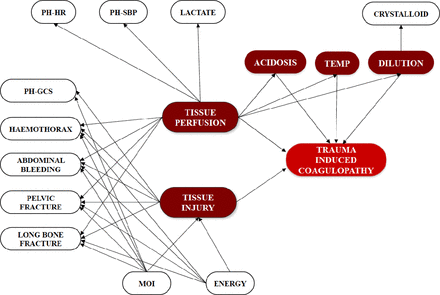
This study provides insight into how a ML model might perform to help trauma clinicians and prehospital providers identify individuals who are at high risk of developing TIC, before VHA results are available. This addresses the delay inherent in waiting for VHA results, as few systems use VHA devices in the prehospital environment. Although the TEG-6 (thromboelastography) and ROTEM-sigma (rotational thromboelastometry) machines are compact and portable enough to be used in the prehospital environment,23 training, uncontrolled environmental factors and cost make widespread adoption unlikely. Excessive artifact precludes their use during aeromedical transport.24 25 Therefore, the earliest TXA administration decision based on VHA results may be several minutes after hospital arrival. Whereas the earliest TXA administration decision based on the TIC-BN model could be prehospital. Prehospital administration of TXA is associated with a 50% reduction in time to administration.26 The TIC-BN model’s performance has been previously demonstrated.19 20 The present study illustrates the potential utility of the TIC-BN model in clinical practice, using a national data sample of trauma patients. Namely, as a system intervention, TIC-BN has the potential to improve the precision and speed of TXA administration. At present, clinicians’ decisions are either protocol-based or experience-based, or a combination of both. Both have the risk of over-treating or undertreating patients. TIC-BN could improve coagulopathy by ensuring those who are at the highest risk of coagulopathy are treated with TXA promptly (prehospital, prior to VHA results), to better achieve the window of greatest benefit (within 60 min of injury according to CRASH-2).6
There are several implications of these findings. First, there is clearly a knowledge gap among both prehospital and hospital providers to accurately and consistently identify patients for whom TXA is indicated. This is important given the body of literature, which shows survival benefit the earlier TXA is given to patients in whom it is indicated.2–6 This study demonstrates the potential impact of the TIC-BN model on a specific clinical practice decision, which is challenging for emergency medical service providers to make consistently. Second, though TIC-BN might not identify all patients who may benefit from TXA, using the model to prompt its administration may increase its use in those at high risk of coagulopathy and those with more severe bleeding. The added benefit of the TIC-BN model in clinical practice is that it could provide decision support, helping clinicians decide in uncertain cases. A high proportion of patients who did not receive TXA or received it late still had adverse outcomes and may have benefited from early TXA administration. Third, within each risk category, patients who received TXA within 1 hour were a more injured subgroup than those who did not receive TXA or received it after 1 hour. Furthermore, those who received TXA ≤1 hour had significantly higher mortality at 24 hours than those who received it late or not at all, in nearly all TIC-BN risk strata. The violin distribution plot demonstrates that a larger proportion of those who received TXA ≤1 hour had higher TIC risk, validating that the model predicts more severe patients, many of whom received the indicated treatment. Thus, that patients who received TXA ≤1 hour had higher mortality does not indicate that the treatment makes no difference, but rather that those who received the treatment early were those in whom it was indicated. Fourth, the TIC-BN could be implemented by choosing a threshold of the TIC-BN prediction, above which TXA should be administered. We suggest it could be moderate risk or higher, but a prehospital provider could set the threshold at high risk, thereby administering TXA to fewer patients but with greater certainty that it will be beneficial. This would need to be prospectively evaluated in a clinical study to ensure the safety of this approach.
There were some limitations to this study. First, its retrospective design may have led to a selection bias. For instance, because of the inclusion criteria of TARN, less-severely injured patients were excluded from this study.27 Second, there may have been multiple reasons why TXA was not or could not have been given within 1 hour when the patient was eligible, which are not captured in the data. For example, the data did not include who attended the patient; some attendees—such as an emergency medical technician, rather than a paramedic or prehospital physician—are not trained in TXA administration, in which case the earliest patients could have received TXA was on arrival to the hospital. There may also have been logistical factors that prevented patients from receiving TXA within 1 hour of injury that TIC-BN could not remedy. For example, the time from injury to first responders’ arrival on scene may already exceed 1 hour in rural areas, where lower population density leads to longer emergency response times. Third, this article did not evaluate the impact of TXA administration on outcomes, such as mortality or morbidity. Specifically, it does not address the outcomes in patients who did not receive TXA when it is indicated (undertreatment) or those who received TXA administration when it was not indicated (overtreatment). Rather, we describe the proportion of patients who received it or may have benefited from it, based on predicted TIC risk. The study should not be interpreted as an indicator of the potential impact of TXA administration for trauma patients. Fourth, the TIC-BN model was validated for TIC (defined by a combination of prothrombin ratio >1.2, an expectation-maximization algorithm, and expert review) and not specifically for hyperfibrinolysis.19 TIC is nuanced and is treated not only with an antifibrinolytic agent such as TXA but also with other modalities, including balanced blood transfusion (or whole blood), correction of acidaemia, hypothermia, and additional coagulopathies. Fifth, as a hypothetical impact study, using a previously validated model, one cannot assume that clinicians would act on the result of the prediction model in real-life circumstances, or even that clinicians could act, if the reason for delay is a set of logistic challenges that cannot be mitigated by a prediction model. Therefore, the implementation of such a tool would need to be studied prospectively to appreciate its impact on clinical decision-making regarding TXA administration and patient outcomes, as well as measure time-to-prediction, clinician acceptance, and usability. Sixth, though the validation dataset initially split TIC-BN risk strata into five equal groups, on this national dataset, these groups are not equal, having far fewer patients in the “very high” and “very low” strata compared with “low”, “medium” and “high” risk groups. This is most likely due to the development dataset comprising a particularly severely injured patient group. Seventh, data on blood products other than RBCs were not available in the dataset, which could undermine the validity of the results due to potential confounding factors. Eighth, the study’s outcome was not coagulopathy but whether and when TXA was given, so it should not be considered a validation study. Ninth, clinicians may be using information to inform decision-making that the model does not incorporate. If so, this provides impetus to allow the TIC-BN to learn from ongoing, prospective data, so that it can continue to learn and improve. This represents the main advantage of using ML methods compared with regression modeling, which produces static coefficient values.
In summary, an opportunity exists to improve early TXA delivery for patients by prehospital care providers, as four out of five patients for whom TXA is indicated do not receive it within 1 hour of injury, including three-quarters of those at medium-high TIC risk. Applying an ML model to identify patients at risk of TIC may allow more tailored and prompt treatment with TXA. Clinical implementation of such ML models may support clinician decision-making and reduce traumatic hemorrhage morbidity and mortality.
