


True inclusion begins with workplaces designed around people
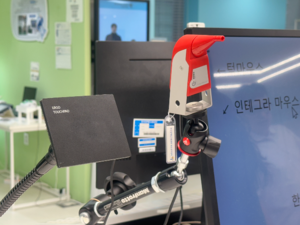
A phone can flash instead of ring. Glasses can turn speech into captions. A keyboard can work with foot pedals, and a mouse can be controlled by subtle lip movements and breathing.
These tools look familiar at first, but they are built for workers many offices were not designed to accommodate. Together, they show a changing approach to disability employment, one that focuses less on asking people with disabilities to adjust to workplaces built without them and more on redesigning work so they can do their jobs on equal terms.
The devices are displayed at an assistive technology center run by the Korea Employment Agency for Persons with Disabilities, where workers and employers can explore ways to remove barriers from the workplace.
A chin-operated mouse, left, and an IntegraMouse, right, allow people with cerebral palsy or other physical disabilities to control a computer using their chin or mouth. (Choi Jeong-yoon/The Korea Herald) An office telephone for employees with hearing impairments uses flashing lights instead of a ringtone, while the device on the right supports sign-language video calls and intranet access. (Choi Jeong-yoon/The Korea Herald) Foot pedals allow users to operate keyboard shortcuts using shift and control, helping people with limited hand mobility type and navigate a computer with one hand. (Choi Jeong-yoon/The Korea Herald) This one-handed keyboard helps workers with limited hand mobility type and operate a computer using one hand. (Choi Jeong-yoon/The Korea Herald)
The shift is becoming more important as South Korea moves beyond a long-standing focus on simply increasing the number of workers with disabilities. Private-sector employers met the country’s mandatory disability employment quota for the first time in 2025, but experts say hiring is only the beginning.
“The focus is gradually shifting from simply increasing employment to helping people continue working in jobs that match their abilities,” said Park Sang-do, general manager of the Assistive Technology Service Department at the agency.
The gap remains large. The employment rate among registered people with disabilities stood at 34 percent in the first half of this year, far below the national average. Many workers remain concentrated in lower-paying jobs or smaller businesses.
Experts say the biggest barriers are often not the disabilities themselves, but workplaces that were never designed with disability in mind.
Many employers assume that hiring workers with disabilities requires a major investment or lower productivity. Park said those assumptions often come from a lack of information.
“In many cases, employers simply do not know what kinds of support are available,” he said. “Sometimes only a small adjustment to the workplace or a single assistive device can allow someone to perform the job independently.”
The agency’s specialists begin not with a person’s disability, but with the job itself. They examine what a worker needs to do, identify where barriers exist and look for ways to remove them through assistive technology or workplace redesign.
When existing equipment is not enough, engineers at the center create customized devices.
“The technology itself is not the goal,” Park said. “The goal is creating an environment where a person can perform the work they were hired to do.”
For Kim Min-jung, a blind choir manager whose name has been changed, that meant being able to work with less dependence on her colleagues. She had long needed help reading sheet music, checking attendance and identifying performers during rehearsals.
After receiving AI-powered smart glasses through the agency, Kim said she could read documents, recognize people and manage rehearsals on her own.
“I no longer have to ask for help every time I need to check who’s arrived or read a document,” she said. “Now I can manage rehearsals and carry out my work much more independently.”
Disability employment is often discussed in terms of quotas, labor shortages or productivity. For workers and advocates, however, the issue is also about independence.
“Work is not simply about earning money,” said Kwon Yong-deok, a special education teacher who has spent nearly two decades helping students prepare for life after graduation. “For students with disabilities, work is the foundation for growth, independence and the right to live a dignified life.”
That is why experts say employment policy should not stop at job placement. For many people with disabilities, the harder transition begins after school, when daily structure, peer relationships and steady support suddenly become weaker.
Kim Kyung-mi, a professor of social welfare at Soongsil University, said disability employment policy should be viewed across a person’s lifetime, from school-to-work transitions to workplace adaptation, career changes and periods of unemployment.
“Employment should never be viewed as the end goal,” Kim said. “People with disabilities, like everyone else, aspire to live independently.”
Without stronger community-based support, experts say, employment alone may not be enough to sustain independence over time.
Kim Min-jung (pseudonym) reads sheet music using Envision Glasses provided by the Korea Employment Agency for Persons with Disabilities. (Korea Employment Agency for Persons with Disabilities)
jychoi@heraldcorp.com
