


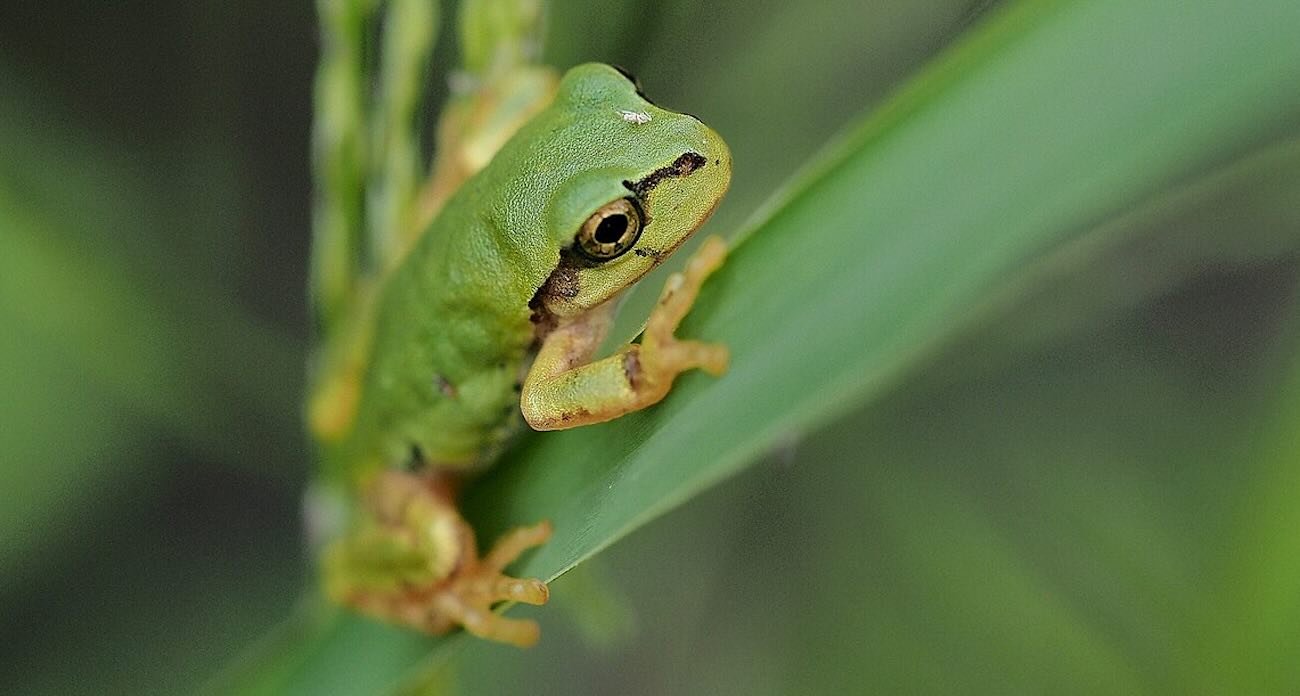
Japanese Tree Frog (Hyla japonica) by Greg Peterson – CC BY-SA 3.0
Japanese scientists have discovered a naturally-occurring bacteria in a frog species with remarkably-potent anticancer activity—in fact, it destroyed cancer tumors in one dose.
Led by Professor Eijiro Miyako, the team at Japan’s Advanced Institute of Science and Technology discovered that a natural bacteria from the intestines of a Japanese tree frog (Ewingella americana) achieved a 100% tumor elimination rate in mice with just a single intravenous.
Not only did the gut bacteria kill the cancer cells, it also engaged the animal’s immune system for “comprehensive tumor destruction”.
The team reported and published their findings in the journal Gut Microbes.
While the relationship between gut microbiota and cancer has attracted considerable attention in recent years, most approaches have focused on indirect methods. In contrast, this study takes a completely different approach: isolating, culturing, and directly administering individual bacterial strains intravenously to attack tumors.
The research team isolated a total of 45 bacterial strains from the intestines of Japanese tree frogs, fire belly newts (Cynops pyrrhogaster), and grass lizards (Takydromus tachydromoides). Through systematic screening, nine strains demonstrated anti-tumor effects, with E. americana exhibiting the most exceptional therapeutic efficacy.
In mice with colorectal cancer, a single intravenous administration of E. americana achieved complete tumor elimination with a 100% complete response rate—dramatically surpassing the efficacy of current standard therapies, including immune checkpoint inhibitors (anti-PD-L1 antibody) and liposomal doxorubicin (chemotherapy agents).
“These findings suggest that gut microbiomes of lower vertebrates harbor numerous uncharacterized bacterial species with exceptional therapeutic potential,” said the authors.
“Our study underscores the critical importance of microbial biodiversity in advancing cancer treatment strategies.”
The innovative therapy strategy also exhibited an excellent safety profile, according to a press release (wherein you can read more about how it works).
Safety profile of E. americana:
• Rapid blood clearance (half-life ~1.2 hours, completely undetectable at 24 hours)
• Zero bacterial colonization in normal organs including liver, spleen, lung, kidney, heart
• Only transient mild inflammatory responses, normalizing within 72 hours
• No chronic toxicity during 60-day extended observation
Future research and development will expand to other cancer types, evaluating the efficacy in breast cancer, pancreatic cancer, melanoma, and other malignancies.
MORE CANCER BREAKTHROUGHS:
• Cancer Vaccine Produces 49% Melanoma Reduction in Patients Five Years Later
• Scorpion Venom May Provide the Next Breast Cancer Breakthrough
The team will also focus on developing safer and more effective delivery approaches including dose fractionation and intra-tumoral injection. And they plan to investigate any synergistic effects with existing immunotherapy and chemotherapy.
The research demonstrates that unexplored biodiversity represents a treasure trove for novel medical technology development.
SHARE THE CANCER HOPE And Some Frog-Love on Social Media…
