


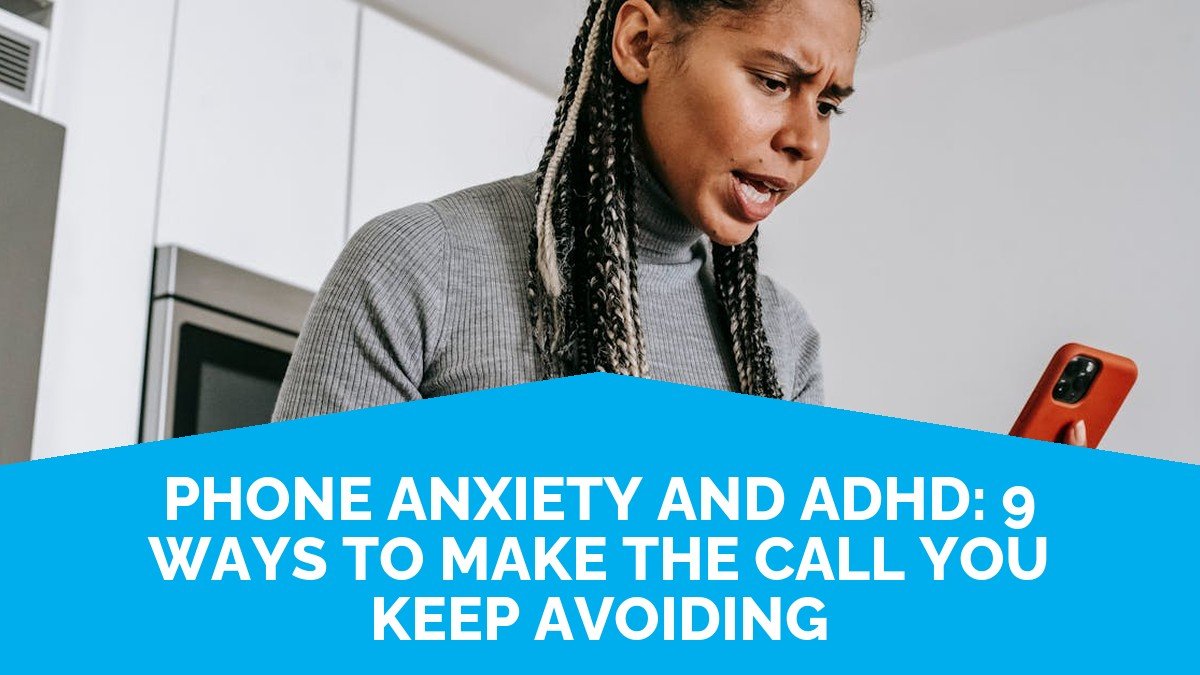
The phone is sitting right there on the counter. The call takes four minutes, tops. You have known about it for three days, maybe three weeks, and you still have not made it.
If that sounds familiar, you are in good company. Phone anxiety is one of the most common things we hear about from ADHD adults, and the advice they usually get misses the point. Relax. Stop being shy. Just push through.
None of that touches the actual problem.
For a lot of ADHD brains, dreading a phone call is not mainly a fear problem. It is a starting problem. A call is a cold-start task with a stack of small steps and no edit button, and the hardest part is usually getting yourself to begin. Once you see it that way, the fix changes. You stop trying to feel less anxious and start making the call easier to start.
TL;DR
If you have ever let a call sit in your head for days, phone anxiety is probably not about being bad at talking. It is that the call is hard to start. Here is the short version.
- For a lot of ADHD brains, this is a task-initiation problem before it is a fear problem. A call stacks several small steps and gives you no chance to pause or rewrite.
- The fix is to lower the cost of starting, not to force yourself to feel calmer on command.
- Nine concrete ways to make the call: write a point-form script, jot the facts first, body-double it, batch your calls, lower the stakes, shrink the call, schedule it like an appointment, give yourself a one-line opener, and plan a small reward for after.
- Sometimes it runs deeper than getting started, like rejection sensitivity or social anxiety. We cover how to tell the difference, and when it is worth talking with a professional.
This is educational executive function content, not medical or mental health advice. If phone anxiety is making everyday life hard, it is worth raising with a professional you trust.
Why Phone Calls Feel So Hard When You Have ADHD
Most advice about phone anxiety treats the dread as the root of the problem. For a lot of ADHD brains, the dread comes later: a call asks your executive function to do several hard things at once, with no warm-up and no way to take any of it back.
The dread is real, but it is not the root.
This is a recognized pattern, not a personal failing. In a 2024 study of medical students in India, about 42 percent reported real reluctance around phone calls, documented in this cross-sectional study on telephone phobia. ADDitude has covered the specific link between ADHD and phone-call avoidance, from dodging voicemails to spacing out mid-call.
The Micro-Step Stack
A phone call looks like one task. It is actually a stack: find the number, decide what to say, dial, wait through the rings, open with the right words, explain why you called, listen, hold onto the thing you actually needed, and close without fumbling. For a brain that struggles with getting started on multi-step tasks, that pile is the wall.
Getting started, not the talking, is the bottleneck.
So phone-call avoidance is not laziness. It is avoiding an effortful, ambiguous task, the same reason any of us put off the chores with identifiable root causes behind procrastination.
No Edit Button, No Face to Read
A text lets you draft, delete, and reread before anyone sees it. A call gives you none of that. It is real time, with no visual cues, so you cannot rehearse the next line, pause to think, or read the other person’s face to see how it is landing. The psychology of why phone calls feel so high-pressure comes down to this: no control, no rewind, no body language.
One reader on r/adhdwomen said it plainly: you cannot see the other person’s expression on a call, so you cannot anticipate their reaction and adjust.
Going Blank the Second They Say Hello
Then there is the blank. People describe dialing with a clear plan, hearing “hello,” and watching it evaporate. As one person on r/ADHD put it, once they say hello my mind goes blank and I have to remember why I called.
That blank is working memory under load.
Holding your reason for calling, the other person’s words, and your next sentence all at once is a heavy lift, and a jolt of nerves makes it heavier. You did not forget how to talk. The format just asks your memory to juggle more than it can, live, with no notes.
9 Ways to Make the Call You Keep Avoiding
None of these nine moves ask you to feel calmer about phone anxiety on command. Each does the same quiet job: it shrinks the gap between deciding to call and actually dialing. Pick the two or three that fit the call in front of you.
1. Write a Point-Form Script
Before you dial, write what you want to say in fragments, not sentences. One line on why you are calling. The two or three facts you will need. The single question you have to get answered. A closing line so you are not improvising the goodbye. This is the move a lot of ADHD folks invent on their own, and for good reason: when your mind goes blank, the words are already on the page.
2. Jot the Facts You’ll Need First
Pull the specifics together before the call, not during it. The account number, the dates, the spelling of a name, the reference buried in that email. Real-time recall is the exact thing that gets hard on a call, so do the digging up front, when there is no one waiting on the line.
3. Body-Double the Call
Have someone in the room while you dial. They do not have to do anything or even listen. Body-doubling, having another person present while you do a hard task, lowers the activation cost for many ADHD adults. A friend on the couch, a partner doing dishes, even a video call with someone working quietly all count.
4. Batch Your Calls
Stack the calls you owe into one block instead of spreading them across the week. The hardest call is the first one. Once you are warmed up, the next ones cost less, and you are not paying the start-up tax five separate times.
5. Lower the Stakes
Make the first rep an easy one. Call a number where the stakes are near zero, or leave a voicemail instead of waiting for a live pickup. A quick call to confirm a store’s hours is a different animal than calling about a bill, and one low-pressure win first can make the harder call feel reachable.
6. Shrink the Call
Some calls do not have to be calls. Where you can, route the task to email, an online form, a chat window, or an in-person visit.
None of that is cheating. It is reducing the number of calls you genuinely owe so you can spend your energy on the ones that truly need a voice.
7. Schedule It Like an Appointment
Put the call on your calendar with a specific time, the way you would a meeting. An open-ended “I’ll call sometime today” is exactly the kind of vague task that slides to never when time blindness is in play. A 2:15 slot, with the number already pulled up and the script ready, turns a floating dread into a finite thing you can finish.
8. Give Yourself a One-Line Opener
Decide your exact first sentence and say it out loud once before you dial. Something like, “Hi, my name is ___ and I’m calling about ___.” The opening is where most people freeze. If the first line is automatic, you are past the hardest second before it can stop you.
9. Plan a Small Reward for After
Line up something good for the moment you hang up. A walk, a snack, ten minutes of a game, a satisfying line through the task on your list. ADHD brains respond well to a close, immediate payoff, and a call you have dreaded for weeks earns one. It also gives your brain something concrete to aim at while you push through the awkward part.
When Phone Anxiety Is More Than Getting Started
Sometimes you do all the starter prep and the phone call still feels like too much.
That is worth taking seriously.
It is not always only about getting started. For some people, an unpredictable call carries a bigger charge because of rejection sensitivity, an intense reaction to perceived criticism or rejection.
The Cleveland Clinic describes rejection sensitive dysphoria as strongly linked to ADHD, though it is a recognized description rather than a formal, standalone condition. When a call feels genuinely threatening rather than just hard, that is often part of what is underneath, and it rides more on emotional regulation than on getting started.
It is also not the same as plain shyness. Plenty of people who are warm face to face still dread the phone, which is why “just be less shy” lands so wrong. The two can travel together, but one does not explain the other.
Where the line sits between ordinary call-dread and something worth professional support is genuinely individual, and an article cannot draw it for you. If you are skipping medical appointments or letting bills pile up because you cannot face the call, that is a signal to talk with a therapist or doctor. Approaches like therapy can help, and that is a conversation for you and a professional who knows your history.
How to Owe Fewer Phone Calls Without Avoiding Life
There is a real difference between phone anxiety that makes you avoid calls and simply choosing not to make ones you do not need to. The first leaves the task hanging over you. The second is just good self-advocacy.
A lot of what used to require a call now does not. You can book most appointments online, handle plenty of customer service over chat or email, and use an app for things that once meant sitting on hold. Routing a task to the channel that works best for your brain is not failing at phone calls. It is being efficient with limited energy.
Where a call really is the only option, set it up on your terms. Ask whether you can email instead. Request a callback so you are not stuck on hold. Send a short message first so the live call is shorter. That is the same self-advocacy you would use for any other accommodation.
A Quick Grounding Trick for the Moment Before You Dial
Everything above is about making the phone call easier to start. This last piece is about the thirty seconds right before you dial, when your heart is going and your thumb is hovering over the green button.
One simple option is the 3-3-3 rule. Name three things you can see. Listen for three things you can hear. Then move three parts of your body, like rolling your shoulders, wiggling your toes, and tapping two fingers on the desk. It pulls your attention out of the worry loop and back into the room.
Be honest about what this does, though.
Grounding takes the edge off the feeling. It does not do the starting work, and it will not make the feeling disappear on its own. Pair it with the point-form script and the time already on your calendar, and it becomes the last small step before you dial.
Phone Anxiety and Task Initiation: A Quick Reference
Term
What it means
Phone anxiety
Dread or avoidance of making or taking calls. For ADHD brains it is often a task-initiation problem first and a fear problem second.
Task initiation
The executive function skill of getting started. A call stacks several small steps, which makes starting the bottleneck.
The “no edit button” problem
Calls happen in real time with no visual cues and no chance to rehearse or revise, which removes supports many neurodivergent people rely on.
Initiation supports
Practical ways to lower the cost of starting: a point-form script, pre-call notes, body-doubling, batching calls, and online or in-person workarounds.
Phone Anxiety FAQs
Is Dreading Phone Calls an ADHD Thing?
Often, yes. A lot of ADHD adults find phone calls disproportionately hard, and it usually traces back to executive function rather than personality. A call demands fast task initiation, real-time working memory, and on-the-spot focus all at once, with no script and no edit button. That mix is exactly what ADHD brains tend to find draining. Dreading calls does not mean something is wrong with you. It means a call loads several of the skills that are already effortful, all at the same moment.
Is Phone Anxiety the Same as Social Anxiety?
Not necessarily. Plenty of people who are relaxed and chatty in person still dread the phone, because the hard part is not socializing, it is the real-time, no-cues format of a call. The two can overlap, and for some people they do. But treating all phone dread as social anxiety misses the people for whom it is mostly an initiation and processing load.
What Is the 3-3-3 Rule for Anxiety?
It is a quick grounding technique: name three things you can see, three you can hear, and move three parts of your body. It interrupts an anxiety spiral and pulls your attention back to the present. It calms the moment, but it does not replace the prep work.
How Do You Overcome Phone Anxiety?
Start by treating it as a starting problem, not a confidence problem. Lower the cost of beginning the call: write a point-form script, pull your facts together first, schedule the call for a set time, and decide your opening line before you dial. Most people do not stop feeling nervous so much as they make the call small and concrete enough that the nerves matter less. You are not trying to become someone who loves the phone. You are trying to get one specific call done with less friction. The nine moves earlier in this article are the fuller version, and you can mix and match the ones that fit.
Will Phone Anxiety Ever Go Away?
It depends, and that is a real answer, not a dodge. For a lot of people, it gets a lot easier with reps and the right supports, to the point where most calls stop being a big deal and only the high-stakes ones still sting. For others, certain calls stay hard no matter how much practice they get, and that is not a sign of doing it wrong. The goal is not always to erase the feeling. Often it is to keep the feeling from running the show, so a dreaded call becomes something you can do anyway, script in hand. Some people find it fades almost entirely. Others manage it for years, the way you would manage anything else your brain finds costly. “Gone” may be the wrong target. “Manageable, most of the time” is usually a fairer one.
Next Steps
If one thing from this article is worth keeping, it is the reframe: a dreaded phone call is usually a starting problem, so the move is to make starting easier rather than waiting until you feel ready. A few concrete places to go from here.
- Pick the one call you have been avoiding longest and write its point-form script right now, before you close this tab. Four lines: why you are calling, the facts you need, your one question, your closing line.
- Put it on the calendar. Give it a real time in the next two days, and pull up the number ahead of time so future-you only has to press the green button.
- Notice which skill keeps tripping you up. If task initiation shows up everywhere, well beyond the phone, the free executive functioning assessment is a low-pressure way to see where the friction actually is.
- Want it on paper? The Real-Life Executive Functioning Workbook by Chris Hanson and Amy Sippl has exercises for task initiation and follow-through you can work through at your own pace.
- If phone calls are one piece of a bigger pattern of getting stuck, working one-on-one with an executive function coach can help you build supports that fit how your brain actually works. Coaching is practical and skill-focused, not therapy, and it is one option among several.
