


The National Archives UK in Kew
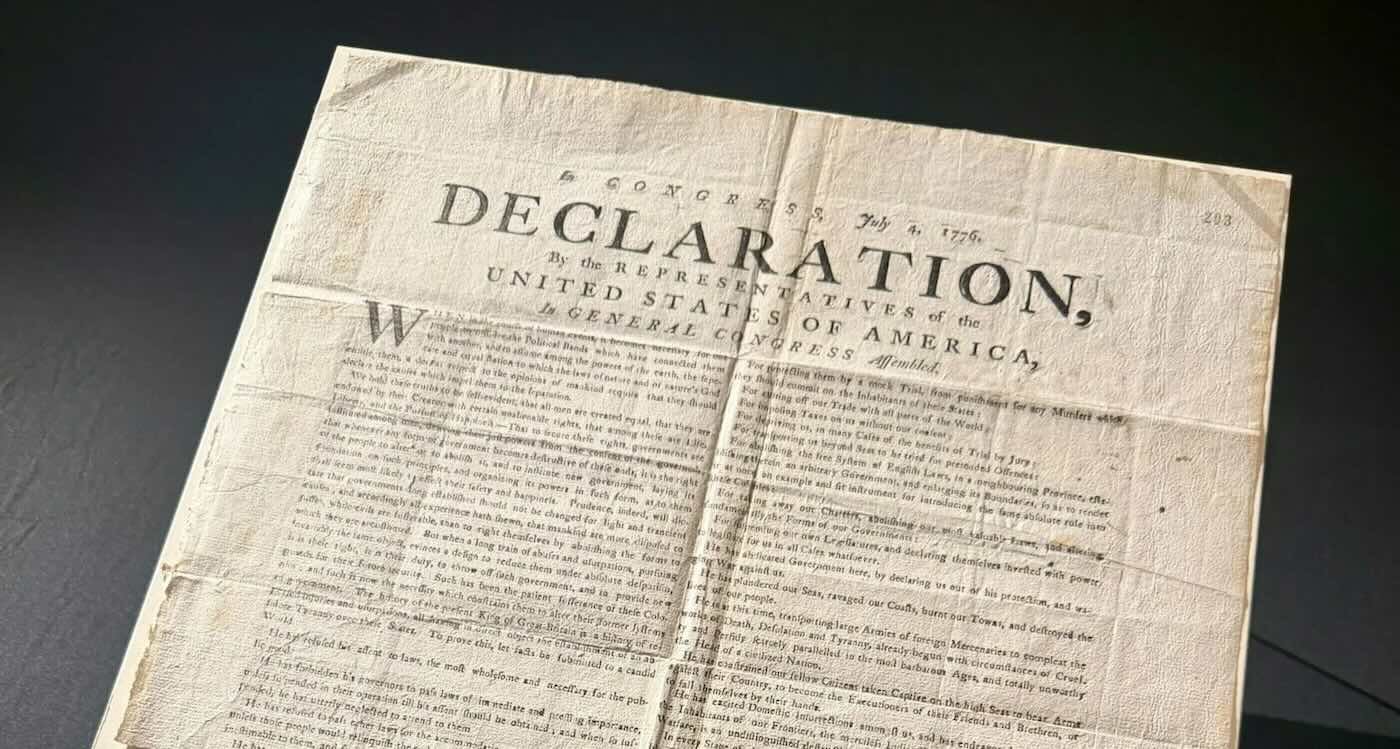
A rare 1776 printing of the US Declaration of Independence — one of just 11 known to survive and the only copy outside the United States — has been discovered by a volunteer sorting historical letters and papers at The National Archives in Kew.
As the Archives was preparing to open an exhibition charting the emergence of the United States for the 250th anniversary, a volunteer made an astonishing discovery: an unknown copy of the Declaration.
Michael Scurr, a volunteer on the institute’s America 250 – Royal Navy Admirals’ and Captains’ letters project, was cataloguing a box of correspondence when he the Declaration.
It was discovered among letters sent in by Thomas Fitzherbert, captain of HMS Raisonable, and the volunteer described his reaction in a video (see below).
This copy of the Declaration was taken from the papers of an American privateer (a private vessel commissioned by a government to attack enemy ships), the Dalton of Newburyport (Massachusetts), which was captured by the Raisonable on 24 December 1776.
It was printed in Exeter, New Hampshire, by Robert Luist Fowle sometime between the 16th and 19th July in 1776 for his newspaper, the New Hampshire Gazette or Exeter Morning Chronicle.
The National Archives, UK
There are (now) only 11 known surviving copies of these so-called ‘Exeter Declarations’ and, prior to this discovery here in London, there were none known outside of the United States.
CHECK OUT OUR LIST: 250 Reasons to Love America On Her 250th Birthday
While cataloguing a letter dated January 10, 1777, in which Captain Fitzherbert reports the capture of the Dalton, Michael noted a reference to documents seized from the ship.
On closer inspection of these records, one that Fitzherbert described as ‘another document’ proved to be the extremely rare ‘Exeter Declaration’.
The capture of enemy ships was a normal practice of warfare at this time. To ensure it was legal, however, the captors had to bring all the papers taken from any captured ship before a court.
Fitzherbert’s junior officer swore to the court that all seized papers from the Dalton had been provided. We now know this was not the case, as Fitzherbert had forwarded the Declaration to officers in the Royal Navy in London.
And, there it has been ever since, first with the Navy and finally with The National Archives, where it was discovered 250 years later. (Watch Michael’s reaction below…)
[Source: The National Archives, UK]
RELATED: France Salutes America, Flying Over Statue of Liberty–Launching Month of Celebrations for 250 Years of Friendship
SHARE THE EXCITING DISCOVERY On Social Media to Celebrate America’s Birthday…
