


A daily probiotic may offer more than just digestive support—it could also provide a small but meaningful boost to mental health, according to new research.
The study, published in the Journal of the American Geriatrics Society, explored whether probiotics—often described as “good bacteria”—could complement standard antidepressant treatment.
Researchers found that older adults who added a probiotic supplement to their routine saw slightly greater improvements in both depression and anxiety symptoms than those who took a placebo.
The study does not suggest that probiotics can replace antidepressants, but rather that they could potentially act as a supportive addition to existing treatments.
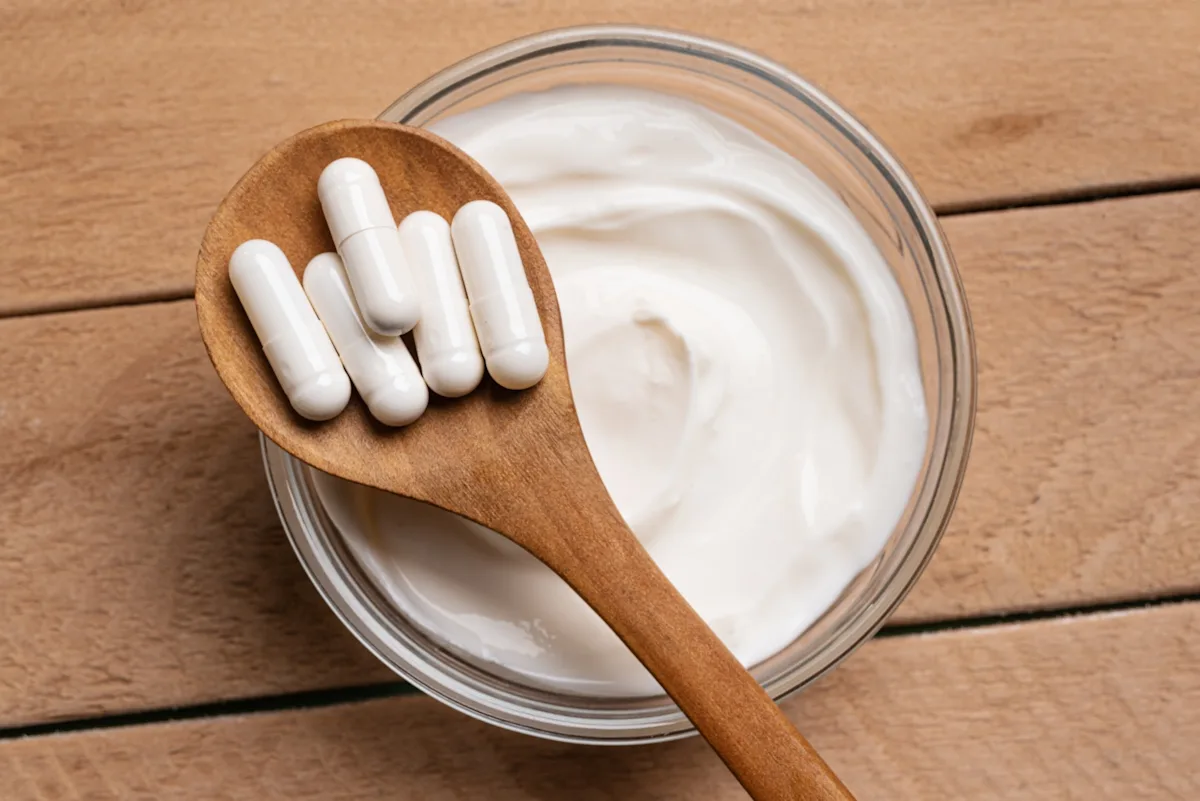
A stock image shows some probiotic capsules on wooden spoon and bowl of kefir or yogurt.
Inside The Clinical Trial
The study involved 58 adults aged 60 and older in India who had moderate depression. All participants continued with their usual antidepressant medication while taking part in the trial.
They were randomly divided into two groups: one received a daily probiotic supplement, while the other was given a placebo designed to look identical to the real treatment. The intervention lasted for 12 weeks, followed by an additional 12 weeks of monitoring to observe longer-term effects.
Both groups showed clear improvements in their symptoms over time. However, those taking the probiotic experienced somewhat greater reductions in depression and anxiety, suggesting that the supplement may offer an added benefit when used alongside standard care.
Measuring Changes in Mood and Biology
To understand what was happening, researchers did more than ask participants how they felt. They used established rating scales to measure depression and anxiety symptoms, while also examining biological markers.
These included brain-derived neurotrophic factor, or BDNF, a protein involved in the growth, maintenance and survival of nerve cells. They also analyzed participants’ gut bacteria through fecal microbiota profiling.
Taken together, the findings suggested that probiotic therapy contributed to symptom improvement. However, researchers did not find clear evidence that probiotics led to additional improvements in overall quality of life compared with placebo.
Brian Lutz, chief clinical officer at Blume Behavioral Health, told Newsweek that while this new research is exciting, there is a gap between the studies about all of the potential uses for probiotics and how they can be used clinically.
“Patients with anxiety and depression are eager to find low-cost and low-stigma treatments; therefore, probiotics are a potential option for these patients. This is an important topic; however, it is crucial that the clinician approaches this research carefully. There is a danger that hopeful patients will view the positive research and decide to delay or de-prioritize their current evidence-based treatment for the sake of trying probiotics,” he said.
Ultimately, according to Lutz, the main takeaway from this research is that adjunctive means additional, not alternative.
“If a positive relationship between probiotics and improved mental health continues to be seen, probiotics would best be used as one aspect of an overall treatment regimen, and should never replace therapy, medication, or any other evidence-based treatment,” he said.
A Modest but Promising Step
While the results are encouraging, they are not a sweeping claim that probiotics can transform mental health.
The trial was small and designed as a pilot study, meaning larger research will be needed to confirm the effect, identify who may benefit most and assess whether results hold up across wider groups of patients.
Still, the researchers say the early findings are promising enough to justify further study.
“The results of our study are novel, and we are now planning a follow-up, larger-scale clinical trial due to the encouraging findings,” said co-corresponding author Dr. Saibal Das, of the Indian Council of Medical Research – National Institute for Research in Bacterial Infections, Kolkata.
Co-corresponding author Abhinaba Ghosh, MBBS, MSc, PhD, a physician-neuroscientist from Tata Medical Center, Kolkata, said the broader aim is to turn such research into practical care.
“My vision is to develop affordable healthcare solutions and make them available to the larger population for meaningful public health impact,” Ghosh said.
Related Articles
Start your unlimited Newsweek trial
