


Southern California is home to a diverse array of woodland, desert, and mountain creatures, including mule deer, foxes, coyotes, bobcats, mountain lions, black bears, desert bighorn sheep, and much more.
Unfortunately, their habitats are heavily fragmented due to the countless roads, highways, and freeways that cut across the landscape.
One of the largest freeways is U.S. Route 101 — a route that stretches approximately 808 miles from Oregon to downtown Los Angeles. Despite speed limits that cap drivers at 65 miles per hour, traffic usually races by at speeds as high as 75 to 80 miles per hour.
Speeding freeways, paired with the natural migration of California wildlife, have long been a recipe for disaster, putting animals and drivers at risk of collision.
The Pew Research Center estimates that 1 million to 2 million wildlife-vehicle collisions occur each year in the United States, leading to about 200 deaths, 26,000 injuries, and more than $8 billion in associated costs.
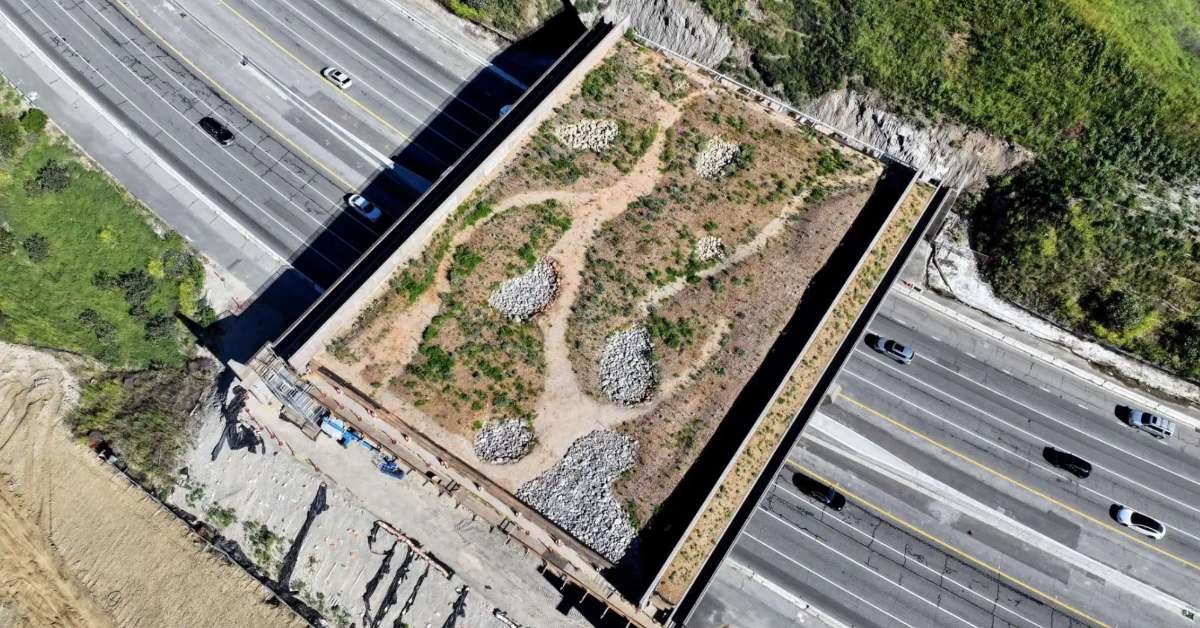
That’s why California began building the Wallis Annenberg Wildlife Crossing over Route 101’s 10-lane freeway in Agoura Hills in 2022.
And after four years of construction — and 30 years of planning — it is finally expected to be finished in early December 2026.
When it’s complete, it will be the largest wildlife crossing in the world.
“This is a vital crossing in one of the last undeveloped areas on the 101, and building a safe passage gives us a chance to ensure the future of the mountain lions in the Santa Monica Mountains and Los Angeles area,” Dr. Seth Riley — the wildlife branch chief of the National Park Service’s Santa Monica Mountains National Recreation Area — said in a press statement.
Rather than functioning as a simple bridge, it will be covered with native vegetation and designed to resemble a natural habitat, helping wildlife move across one of the busiest freeways in the country.
Image via Wallis Annenberg Wildlife Crossing
The project was inspired in part by the deaths of mountain lions, including the famous Los Angeles cougar P-22, whose story helped rally public support.
“You’re going to see this ecological transformation. And that part of it is going to be over one of the busiest freeways in the world — that, to me, is just such a hopeful statement for what’s possible,” said Beth Pratt, California’s regional executive director for the National Wildlife Federation. “We can redeem a freeway.”
On Earth Day, April 22, Pratt announced the updated deadline for the Wallis Annenberg Wildlife Crossing.
“The project will be officially ‘open for animal business’ on 2 December,” Pratt said.
On May 31, the Wallis Annenberg Wildlife Crossing Facebook page said that they received their first animal visitor as they neared completion of the “secondary structure” of the overpass.
“We saw our first hummingbird on the habitat in the 101 structure,” they shared.
Image via William Garrett (CC BY 2.0)
Another wildlife overpass in California also received its first animal visitors recently, when three mule deer were seen crossing over Route 97 in Siskiyou County while the bridge was still under active construction.
“While the contractor is still completing final touches, it’s incredible to see wildlife already embracing the new structure, even with workers still in the area,” Caltrans District 2 shared in a Facebook post.
“This wildlife overcrossing was designed to provide animals with a safer way to cross the highway while helping reduce wildlife-vehicle collisions for motorists traveling through the corridor.”
You may also like: Endangered monkeys kept dying on a road compared to a ‘meat grinder.’ Locals built them a bridge made from recycled fire hoses
Header image via Wallis Annenberg Wildlife Crossing
