


In grassroots and nonprofit community spaces across Greater Boston, leadership often looks less like institutional power and more like improvisation. It looks like pulling double shifts and answering crisis calls after midnight because there is no backup staff. Stretching one grant across three programs. Delaying salaries to keep community services running. It looks like carrying not only organizational responsibility, but also the emotional, relational and material weight of entire communities navigating inequality and philanthropy’s underinvestment.
A new report, Carrying the Weight, Leading the Change: How Women of Color Grassroots Leaders Navigate Inequities While Driving Solutions, developed in partnership with the Center for Women in Politics and Public Policy at UMass Boston’s Center for Women in Politics & Public Policy and Boston Women’s Fund, offers a rare, close look at these dynamics. The report focuses specifically on Greater Boston, but the conditions it documents feel strikingly familiar to grassroots leaders across the country. The study reveals what happens when women of color leaders become the infrastructure communities rely on while being denied the resources to sustain that work.
Among grassroots organizations operating with less than $1 million in revenue, women-of-color-led groups had average revenues just above $300,000. Many of these organizations were never resourced at levels that reflect the scale of the responsibilities they carry. Yet they continue to fill widening gaps left by weakened public infrastructures and inconsistent philanthropic investment. By centering smaller, often overlooked grassroots organizations, the research captures both the scale of inequity and the depth of leadership sustaining communities in real time. This is the everyday reality for many women of color grassroots leaders. What is at stake is not simply leadership retention, but community survival and well-being.
As the report states plainly, “women and gender-expansive grassroots leaders of color are holding communities together” as they absorb the consequences of structural neglect. Organizations are frequently funded to launch programs, but not to maintain staffing, provide living wages, offer benefits, or build long-term organizational capacity. Leaders are expected to produce transformative outcomes while operating within systems designed around scarcity.
What emerges is not simply a funding gap. It is a pattern: leaders essential to community survival and thriving are being asked to operate with chronic scarcity, limited institutional support, and mounting personal cost.
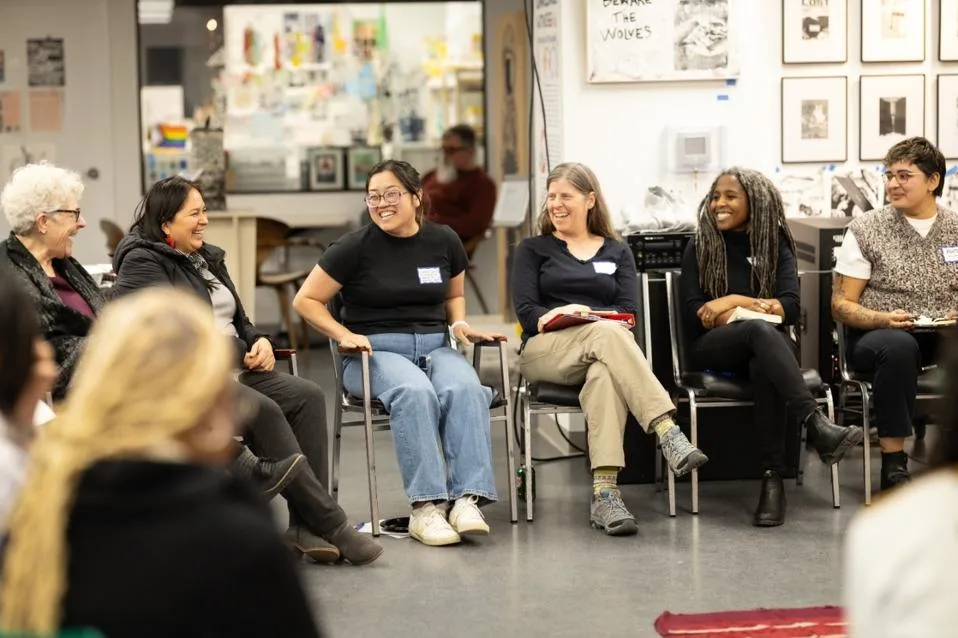
Community advocates collaborate on solutions to challenges ranging from civic participation to economic and birth inequity.
Chellypic Photography
Community Organizations Are The Real Social Safety Nets
The report notes that “grassroots organizations meet vital community needs” precisely where larger institutions fail. One leader described accompanying community members personally to appointments for services that remained inaccessible in their own languages. Another reflected that “there’s a lot to do and there’s the issue of financial restraint which impacts the program and expansion.”
As public institutions and social safety nets continue to weaken under austerity, political instability, and chronic disinvestment, grassroots organizations are increasingly forced to absorb responsibilities that governments and large institutions have either abandoned or failed to meet. Grassroots organizations provide food distribution, housing advocacy, violence prevention, reproductive health education, youth mentorship, immigrant support, crisis intervention, and culturally grounded care. These are not peripheral issues, but are core dimensions of public health, educational access, civic stability, and community infrastructure. In many neighborhoods, they are the first responders long before any formal institution arrives. Contrary to popular discussions, community organizations led by grassroots women of color leaders are not supplemental to broader systems of care, but rather, many function as the only social infrastructure that communities can rely on.
And yet, despite the essential role these organizations play, the report found that less than half of one percent of Greater Boston nonprofits explicitly focus on women and girls of color. Organizations serving women and girls of color received just $25 million out of Greater Boston’s $112 billion nonprofit ecosystem. This creates what the report repeatedly describes as a structurally unsustainable funding landscape. What the report now makes legible is that underfunding women of color grassroots leadership directly impacts entire community ecosystems.
What distinguishes these organizations is not simply the services they provide, but the trust they hold. Rapport and community relationships cannot be built overnight or activated only during moments of crisis. Rather, they are cultivated over years through consistency, proximity, care, and sustained investments. Many women of color grassroots leaders are deeply embedded within and connected to the communities they serve in ways that larger institutions often are not because they themselves live the realities they are responding to. The report thus challenges the assumption that small organizations are somehow less significant because they are smaller in scale.
Diana Hwang, founder and executive director of the Asian American Women’s Political Initiative (AAWPI), says the burdens leaders carry and the challenges facing communities are often inseparable.
JayPix Photoraphy
Diana Hwang, Founder and Executive Director of the Asian American Women’s Political Initiative (AAWPI), describes this relationship as inseparable.
“[For] grassroots leaders, the personal costs of leadership and the impacts on community are deeply interconnected,” she explains. “Many of us are part of the communities we serve and are experiencing the same endless violence, trauma, and attacks we are simultaneously working to address, so the personal and community impact cannot be separated.”
Scarcity Creates Fragile Community Ecosystems
Chronic underfunding has turned many essential organizations into permanently precarious institutions. What begins as leader exhaustion often escalates into organizational instability and, eventually, community vulnerability. When one leader burns out or leaves and organizational staff are underfunded, this weakens community infrastructures: programs disappear, entire mentorship pipelines can collapse, families lose trusted advocates, crisis response slows, institutional memory vanishes, and continuity of care is interrupted.
The report makes this connection unmistakable, noting that grassroots organizations’ sustainability is “closely enmeshed with leaders’ well-being.” In other words, when philanthropy destabilizes leaders through rigid outcomes and outputs demands, short-term grants, restricted funding, and chronic underinvestment in operational sustainability, it destabilizes the communities that depend on them. These far-reaching consequences compound within communities relying on organizations that philanthropy itself has made structurally unstable.
Leaders are expected to deliver transformational outcomes while operating within systems, as one participant explained, “that were never designed for us to work in.”
The Ripple Effects Extend Beyond Grassroots and Nonprofits
The ripple effects extend far beyond the nonprofit sector. When grassroots organizations weaken, the consequences surface elsewhere: in overwhelmed schools attempting to absorb unmet social needs, in hospitals responding to preventable public health crises, in families navigating crises without support, and in communities losing trusted spaces of advocacy and care. As one leader explained, “Our organization can tell stories that are not told…they fill a niche.” Another described community itself as what keeps her going: “My community…they give me motivation.”
Grassroots organizations frequently fill gaps in public services while navigating chronic underinvestment and growing community needs.
Chellypic Photography
Hwang argues that the mismatch between short-term funding cycles and long-term community change is itself part of the problem.
“The nonprofit industrial complex leaves many of us under-resourced, overworked, and constantly chasing funding because we never know if the support will still be there next year,” she says. “Yet the change we’re trying to create is long-term. Structural change takes time, but too often organizations are funded year-to-year, leaving leaders constantly chasing resources instead of focusing on the work itself and investing in the sustained work that real structural change requires.”
Philanthropic models that reward fiscal frugality, lean staffing, and measurable impact often end up praising women of color grassroots leaders for “doing more with less,” transforming chronic overwork into evidence of resilience rather than recognizing it as a symptom of structural underinvestment. This raises difficult but necessary questions about philanthropy itself and the structures through which wealth circulates. Philanthropy is often framed as a mechanism for public good and community investment. Yet many critics have pointed out that philanthropy also functions as a tax structure that allows wealthy individuals and corporations to redirect funds that might otherwise enter public systems. As Edgar Villanueva notes in Decolonizing Wealth and as the author of A New Era of Philanthropy similarly argue, charitable giving often enables donors to retain disproportionate influence over public priorities while communities remain dependent on inconsistent private generosity rather than stable public investment. That reality forces a broader conversation about what happens when vulnerable communities increasingly depend on private giving rather than durable public infrastructure.
Natanja Craig Oquendo, CEO of Boston Women’s Fund, argues that the problem is not simply insufficient funding but a system built around inequitable assumptions about whose leadership deserves sustained investment. As she explains:
“The hard truth is that this system is working exactly as designed — and that design has pushed brilliant women and gender-expansive grassroots leaders of color to the margins while praising them for surviving it. Philanthropy has grown comfortable funding our resilience — without ever asking what it costs us to keep showing up. The only equitable and sustainable path forward is redesign — and that work is overdue.”
The report ultimately asks philanthropy and institutions to confront a difficult truth: communities cannot sustainably depend on leaders who are themselves being depleted by the very systems that praise their resilience and overwork. The sustainability of grassroots leadership is inseparable from the sustainability of the communities leaders serve. When philanthropy underfunds women of color leaders, communities pay the cost.
How Philanthropy Can Sustainably Invest in Communities
Still, the report does not simply diagnose harm. It offers a blueprint for what philanthropy’s sustainable investment in grassroots community work could look like. That includes:
Flexible, multi-year funding models that allow organizations to plan beyond immediate crises.
Unrestricted grants that support staffing, rent, technology, benefits, succession planning, and operational infrastructure rather than only highly visible programming.
Investing not just in projects, but in ecosystems of leadership development and collective care.
Supporting women of color grassroots leaders will expand the cumulative benefits not only at the organizational level, but with enhanced outcomes that ripple outward into the betterment of the neighborhoods, families, and futures their work helps hold together every day. If philanthropy is serious about advancing equity, it must move beyond rewarding resilience and begin investing in the long-term infrastructure and leadership that communities need to thrive.
This article was originally published on Forbes.com
