


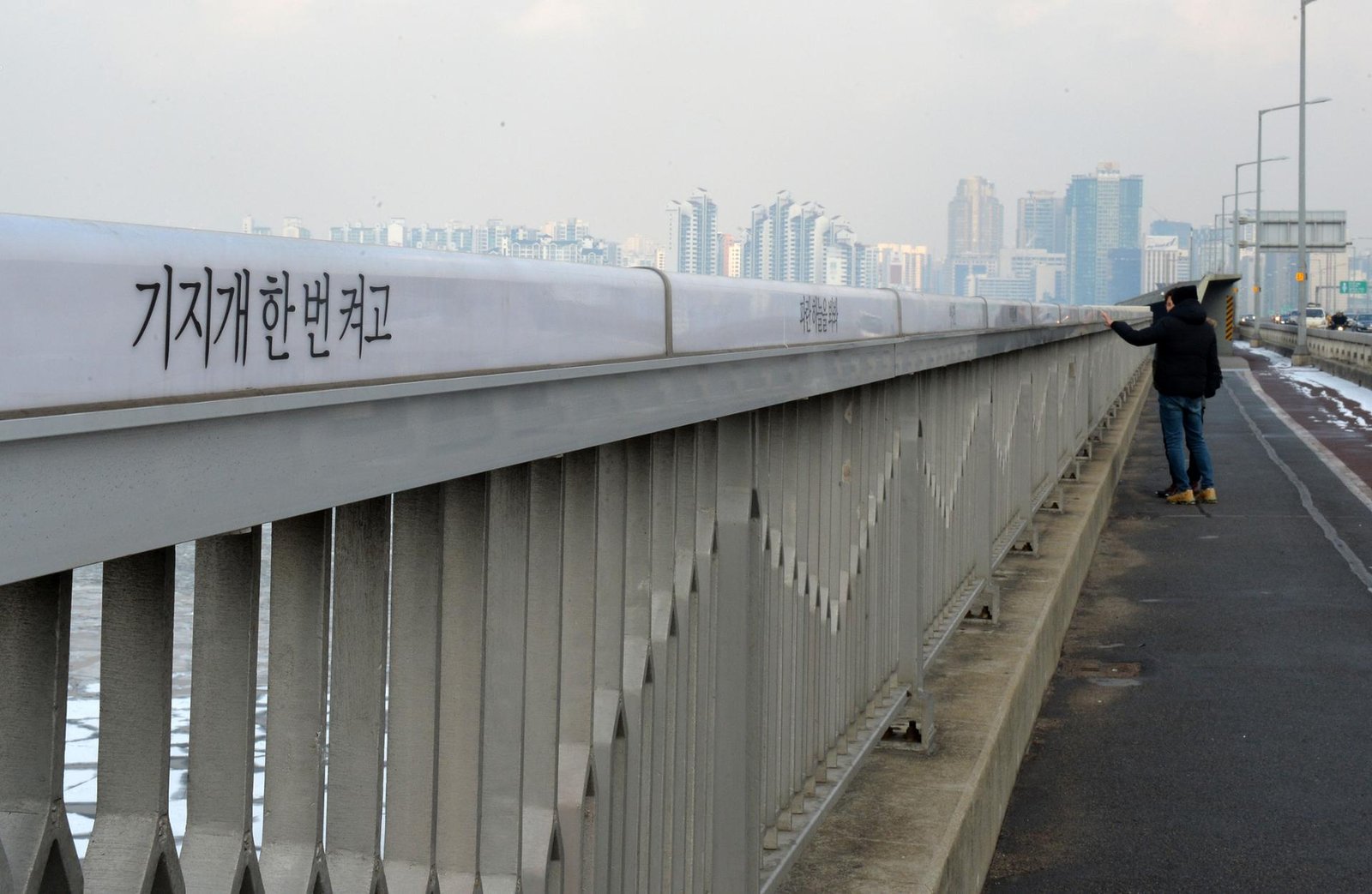
A suicide prevention message reading “Stretch your arms and legs” is displayed on Mapo Bridge in Yeouido, Seoul. Korea Times file
Korea is sharply augmenting the staffing of its national suicide prevention hotline to address a severe bottleneck in crisis call management, the Ministry of Health and Welfare said Monday.
Driven by a presidential directive to eliminate connection delays and reinforce the existing public safety net, the ministry will immediately expand the workforce of the crisis hotline, nearly doubling personnel from 103 counselors to 200 by October. Since the “109 hotline” was launched in January 2024, public awareness has sent inbound call volumes skyrocketing by 46 percent, jumping from roughly 219,000 in 2023 to over 352,000 in 2025. This explosive demand has outpaced current capacity, with an average of 1,118 daily calls but staff levels currently only able to handle approximately 532 calls each day.
To bridge this critical operational gap, the government is introducing targeted personnel adjustments and logistical support. Over 60 percent of the hotline’s traffic arrives between 4 p.m. and 3 a.m. To ease this pressure, the ministry is partnering with the specialized civilian NGO Lifeline Korea this month to divert overnight calls to external expert counselors. In July, authorities will establish a dedicated “rapid response team” to monitor callers as they wait to identify and intercept high-risk cases and deal with emergencies.
Recognizing that emotional burnout and caller abuse have fueled an unsustainably high turnover rate, officials are also raising counselor stipends, strengthening protections against abusive callers and deploying a 100 million won ($66,331) workplace wellness program backed by the Korea Medical Institute. Looking toward the winter, an artificial intelligence solution will debut in November to optimize paperwork, slashing administrative log-writing times from 20 minutes to just five.
“The 109 suicide prevention hotline is the very first safety net that receives rescue requests from citizens in desperate need,” Minister of Health and Welfare Jeong Eun-kyeong said during a site visit. “Through this staff augmentation, we will build a counseling system that does not miss a single call in order to protect the precious lives of our citizens.”
For foreign residents and international travelers navigating a crisis or requiring urgent care within Korea, specialized multilingual support resources are also available. Non-Korean citizens can access a comprehensive, 24-hour counseling hotline at 1577-1366, which delivers psychological and emotional support in a wide range of languages.
For time-sensitive emergencies, international residents and travelers are encouraged to utilize the 1330 Korea Travel Hotline to secure immediate three-way translation. Individuals can dial 1330 from any mobile phone and ask an English-speaking operator to establish a three-way call with emergency services, such as the 109 crisis hotline. A certified interpreter will mediate the conversation in real time, serving to reduce language barriers and secure swift medical or psychological intervention.
If someone you know exhibits warning signs of suicide, contact Korea’s Suicide Crisis hotline at 109. For foreign language assistance to connect with mental health professionals, call Danuri Portal’s helpline at 1577-1366.
This article was published with the assistance of generative AI and edited by The Korea Times.
