


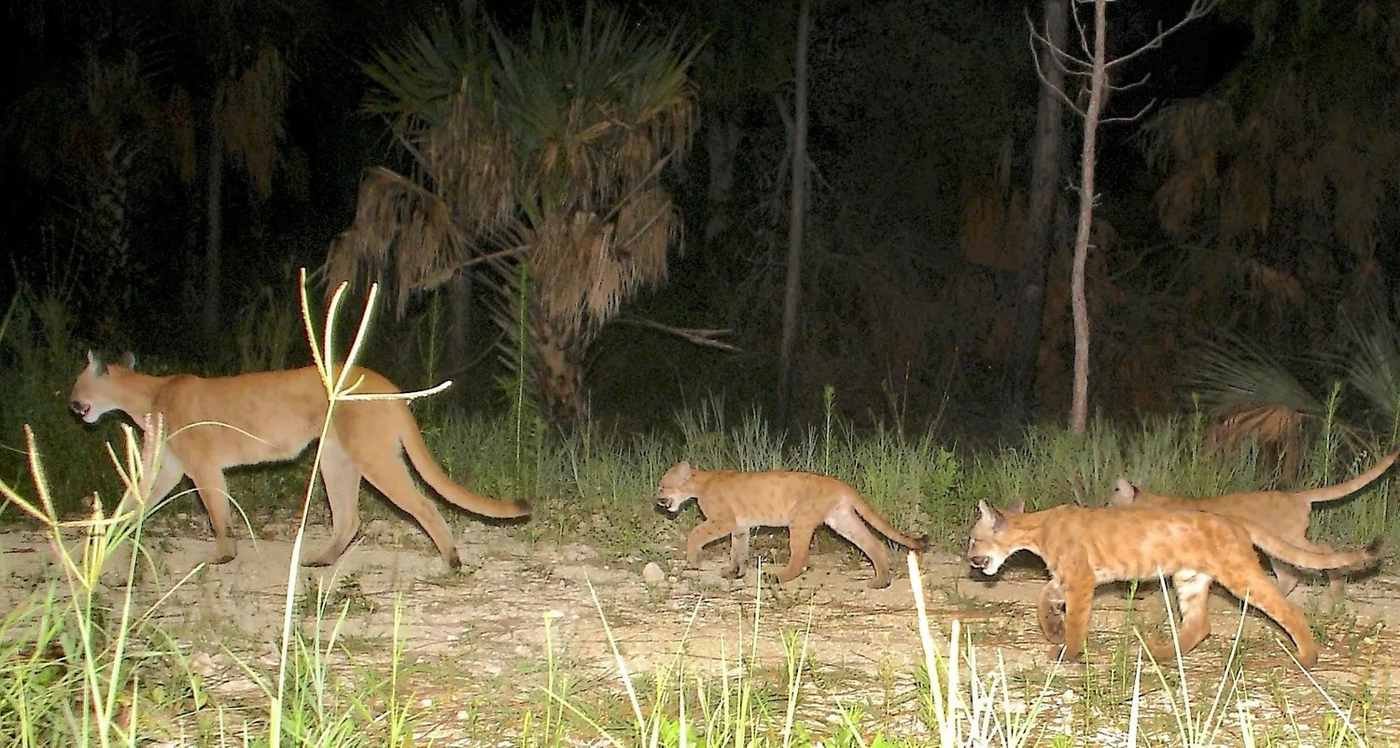
Florida panthers in the Picayune Strand – credit, David Shindle Conservancy of Southwest Florida
A huge area of the Everglades that was drained in an attempt to convert it to suburbia has been restored to a somewhat native ecosystem after 2 decades of reverse-landscape engineering.
Picayune Strand is a big, almost perfect rectangle of south Florida wetland located northwest of Everglades National Park, northeast of Thousand Islands Nat. Wildlife Refuge, and west of Florida Panther Nat. Wildlife Refuge.
It was part of an enormous land package bought by the real estate company Gulf American in the 1950s in the attempt to create America’s largest suburban housing development, called Golden Gate Estates.
But their effort to tame the swamp failed, even though substantial landscape alterations were made to try and dry out the area. Picayune Strand is 2 feet average lower elevation than the Golden Gate Estate land to the north, and this little difference made it virtually impossible to prevent flooding. The company went bankrupt.
One of the first projects identified and pursued by conservationists working under the Everglades Restoration Plan of 2000, Picayune Strand has changed a lot over the years. Since 1985, conservationists have been buying up all the private, often unbuilt-on land that Gulf American had managed to sell. It was tedious lawyer’s work, but by 2004, it was all consolidated into a conservation package.
Gulf American built 4 large canals to channel water off the land they wanted to develop, while the earth and stone they churned up was used to crisscross the area with causeways atop which ran roads. These were the first targets for groups like the Everglades Foundation, the Conservancy of Southwest Florida, and the US Army Corps. of Engineers.
The hydrology of the Everglades is defined by water flowing across the once-7 million square miles all in the same direction at roughly the same snail’s pace, a phenomenon described as “sheet flow” through a “river of grass.” Huge areas remained flooded all year, and plugging the canals was the first step towards restoring the natural hydrology.
ALSO CHECK OUT: ‘The Largest Environmental Restoration in History’ Continues to Restart the Heart of the Everglades
To restore this, the roads were torn up and the materials were chucked back into the canals from whence they came.
One of the 3 pump stations – credit, Brigida Sanchez US Army Corps of Engineers
From macro to micro
“Picayune is as good a place in South Florida that there is, in terms of getting it back to what it was before,” Michael Duever, an ecologist who has been monitoring the Picayune project, told Yale News. “We’re feeling that we’re in the range of 90 plus-or-minus percent of restoration.”
There had to be some compromises, as people still live in Picayune Strand. Part of that 10% Duever refers to being missing includes 3 pumping stations that pull rainwater out of the closed canals on the northern boundary of the Picayune project, and dump it into large basins that will leak it out in many directions. The water level at times is higher than natural, however, and at other times dryer.
Vegetation is coming back in a big way—not always ideally, but upland plants cannot now spread further south because of the continual water bodies. More native species that have missed the continual wetness are also returning—like a native, wild sunflower.
MORE AMERICAN WETLAND: Unprecedented Gift Preserves 8,000 Acres of ‘The Land Between the Rivers’ in Alabama: ‘America’s Amazon’
The restored Picayune is expected to help several endangered species, including the red-cockaded woodpecker and the Florida panther, while studies have already shown that the increased insect abundance is benefitting the bonneted bat, the largest of its kind in Florida with a greater-than-footlong wingspan.
“I kind of view Picayune Strand as a microcosm of the entire [Everglades] plan,” Stephen Davis, chief science officer at the Everglades Foundation, told Richard Mertens at Yale.
SHARE This Great Restoration Success In The Great American Swamp…
