


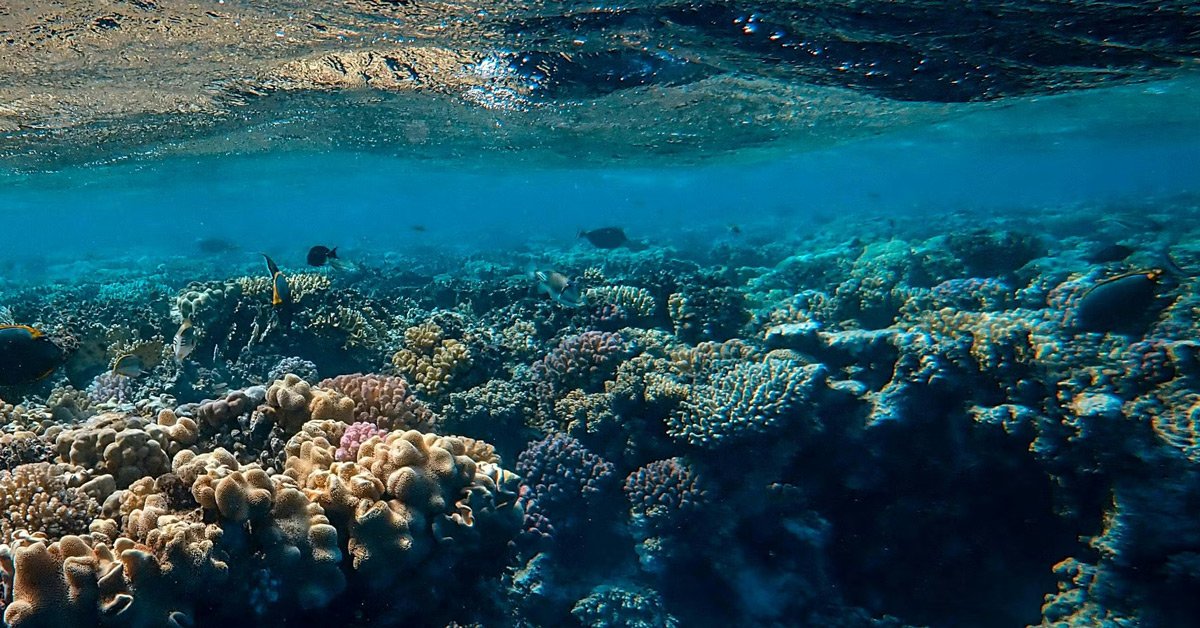
Lord Howe Island lies in the middle of the ocean, about 700 kilometers northeast of Sydney. It’s covered in lush forest and fringed by the world’s most southerly coral reef ecosystem.
This reef system isn’t as famous as its northern neighbor, the Great Barrier Reef. Our new research, in the Journal of Applied Ecology, shows it plays an outsized role in keeping vast coral regions across the Pacific connected — and alive.
A small number of other reefs in the region serve a similar function. Knowing which reefs matter most for recovery and adaptation to ocean warming — and protecting them now — could make the difference between regional reef collapse and long-term resilience.
Tiny coral babies in a vast ocean
Coral reefs are in global decline, but this loss is not just about dying corals — it’s about breaking the natural connections that allow reefs to recover after marine heatwaves, cyclones, and other threats.
Right now, climate change is rapidly reducing the ability of coral larvae to travel between reefs, shrinking their chances of survival by undercutting recovery.
These tiny coral babies can sometimes spend many weeks in the surface waters of the open ocean, carried by currents across hundreds or even thousands of kilometers before settling and beginning to grow.
The movement of larvae provides a constant source of replenishment for reefs, both near and far away, which is especially important when reefs are damaged.
Without this constant replenishment, some damaged reefs simply cannot recover. Connectivity isn’t a nice-to-have for coral reefs. It’s their lifeline.
Tracking dispersal across 850 reefs
Our study used ocean circulation models to simulate the trajectories of coral larvae across the southwestern Pacific Ocean from 2011 to 2024, tracking the movement of larvae across 850 reefs.
These reefs spanned the Great Barrier Reef, New Caledonia, the Coral Sea, and Lord Howe Island.
We traced how two key coral growth forms (fast-growing branching corals and slower-growing massive corals) move between reefs under current conditions and under projected global climate warming scenarios of 1°C, 2.5°C and 4°C above pre-industrial temperatures.
We then examined how corals moved between different types of reef, including reefs that were naturally resistant to heat stress, those that recover quickly after disturbance, and those that stay cooler because of local water currents and upwelling that naturally reduce water temperature around the reef.
This allowed us to ask not just which reefs are connected, but which kinds of reefs are sending and receiving different types of larvae.
A fragile network
We found that only a handful of reefs act as genuine hubs — places where larvae both arrive from distant sources and depart to “seed” reefs far away. Lose these stepping stones, and the entire network begins to fragment.
The Coral Sea reefs emerged as crucial bridges in this network, linking the southern Great Barrier Reef with New Caledonia and beyond. But perhaps the most striking finding involves Lord Howe Island.
Our modeling identified Lord Howe as a potential refugium: a place where corals may be able to persist even as warming intensifies, potentially owing to its more temperate, southerly position.
Lord Howe Island is home to the world’s most southern coral reef ecosystem. Photo by Dylan Shaw/Unsplash
Yet its very isolation — what makes it a likely survivor — also means it has limited natural connectivity with surrounding reefs.
This situation therefore cuts both ways: While isolation helps protect its coral from extreme heat stress, it also means the reef relies less on new larvae that others could need for recovery. It therefore also means Lord Howe needs protection — not just for itself, but for the entire regional reef system that may one day depend on it.
Another important finding is that the reefs most resistant to heat stress (those classified as naturally resistant) tended to export larvae to a relatively smaller number of reefs within the wider network.
But there are techniques that enable the intentional movement of larvae from heat-tolerant reefs to more vulnerable locations. These include assisted gene flow, in which scientists deliberately move warm-adapted adult corals or their offspring to reefs that are more vulnerable to heat stress, helping to spread heat-tolerant genes more quickly across reef networks.
Protecting our marine superhighways
Our results make clear that marine protected areas should not be managed as isolated reserves but as an interconnected network, with transboundary cooperation between Australia and Pacific Island nations.
The larval corridors linking the southern Great Barrier Reef, New Caledonia, and Lord Howe Island do not fall within national boundaries. Neither can our conservation response.
Reefs are already fighting against warming oceans. The waters of the Lord Howe Rise and South Tasman Sea, the vast oceanic region between Australia and New Zealand through which these larval corridors flow, are under threat from industrial fishing.
Industrial fishing, pollution, and climate change are pushing these ecosystems to the brink, with longlines intersecting surface waters.
This cumulative pressure across these newly identified larval transport superhighways adds yet another layer of pressure onto these already stressed ecosystems.
Our research adds a new and crucial dimension to high seas protection. Our region sits directly across the larval corridors that connect and sustain coral reef systems. Protecting this ocean is not just about what lives here. It is about what passes through — fundamental for migratory and connected populations.
The least we can do is protect the superhighways through which their future flows — invisibly, at the ocean surface, some larvae no bigger than a grain of rice, carrying the genetic potential to rebuild what we stand to lose.
This article is by Kate Marie Quigley from James Cook University and Elise Thérèse Gisèle Dehont from Memorial University of Newfoundland and was originally published by The Conversation.
Header image by Francesco Ungaro/Unsplash
