


The post What the Newest Research Reveals About Veterans with PTSD and Service Dogs appeared first on A-Z Animals.
Quick Take
2024 NIH research confirms service dogs significantly reduce PTSD severity, anxiety, and depression compared to standard care alone.
Studies show service dogs help normalize cortisol levels, physically recalibrating the veteran’s “fight or flight” stress response system.
Specialized task training, like “blocking” in crowds, directly reduces social isolation and improves daily community participation.
Anyone who has spent enough time around a service dog can tell you just how conscientious, caring, and patient these animals can be. They are trained to deal with tough situations and support marginalized people, handling stress with an unmistakable grace that eludes even the most emotionally intelligent humans. That grace extends to more nebulous psychiatric issues like post-traumatic stress disorder (PTSD). Indeed, the latest research in this arena provides a clear picture of just how effective service dogs can be in reducing the severity of PTSD symptoms in military veterans.
For decades, our four-legged friends have provided welcome care and compassion for veterans suffering from PTSD. However, earlier research and reports on service dogs for PTSD were often anecdotal or based on self-report, with limited rigorous clinical evidence. As recently as 2024, large-scale clinical studies have provided evidence of just how effective service dogs can be for veterans. By using longitudinal tracking and physiological markers, researchers have found that service dogs significantly lower PTSD symptoms as well as social isolation for veterans. Let’s learn more about this groundbreaking study and how its findings provide a welcome strategy of relief for long-suffering military veterans.
National Institute of Health Study
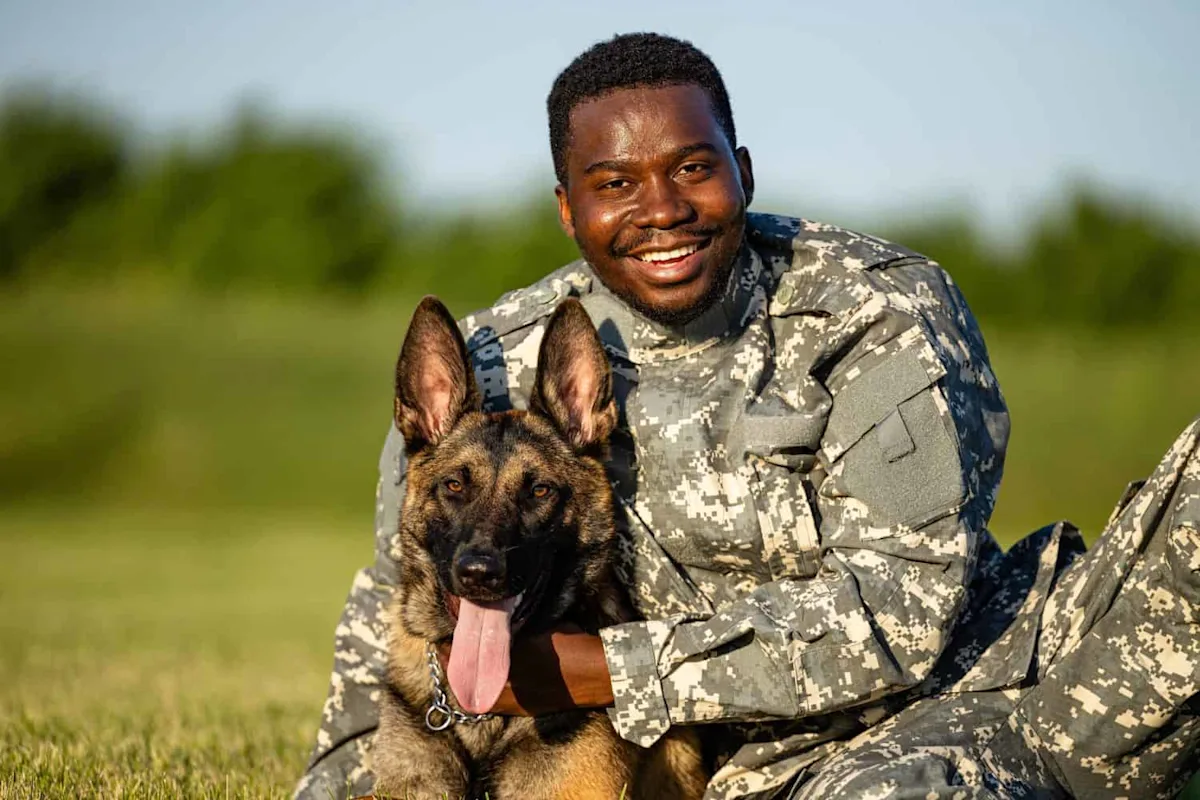
A 2024 NIH study found that service dog companionship greatly improved the wellbeing of veterans with PTSD.
©24K-Production/Shutterstock.com
The notion that professional animal support and companionship could help people suffering from mental anguish has bounced around scientific circles for years. In 2024, researchers decided to test the theory scientifically. Enter Dr. Marguerite E. O’Haire, a professor at the University of Arizona. She spearheaded the largest ever nationwide study comparing service dog partnerships to usual care alone. The trial, supported by the National Institute of Health and the Department of Veterans Affairs, followed 156 veterans over a 12-month period, with some secondary analyses conducted at the three-month mark. Researchers compared those who received a service dog to those sitting on a waitlist while receiving standard clinical care. What they found was nothing short of spectacular.
Veterans paired with service dogs exhibited significantly lower PTSD symptoms across almost every tested metric. Indeed, 81 participants who received service dogs “reported significantly lower PTSD symptom severity, anxiety, and depression. They also reported “less social isolation and higher companionship than the 75 participants in the control group who were waitlisted for a service dog.”
More broadly, the study recorded considerable improvements in the “Big Four” areas of psychiatric distress: anxiety, companionship, depression, and social isolation. Comparing the results to the PCL-5, or the PTSD checklist, clinicians found that veterans paired with service dogs showed a much higher rate of clinically significant improvement. This means that their outlook and associated PTSD symptoms improved to a clinically significant degree, though most participants still met criteria for PTSD.
Cortisol Awakening
This wasn’t the only study of its kind to make considerable headway, either. A separate but related study was titled “The cortisol awakening response in a 3-month clinical trial of service dogs for veterans with post-traumatic stress disorder.” This study, also featuring Dr. Marguerite E. O’Haire, tested the relationship between cortisol, PTSD, and service dog companionship. As the body’s main stress hormone, cortisol can make or break a person’s ability to relax. For veterans with PTSD, cortisol can be a self-inflicted weapon. Often, their ability to regulate cortisol is broken; this leaves them feeling exhausted yet hyper-vigilant.
This study, published in Scientific Reports, found that veterans with service dogs had cortisol profiles resembling those of healthy adults. More precisely, researchers found that “veterans with service dogs have a higher, less blunted CAR in comparison to veterans receiving usual care alone. In veterans with a blunted morning cortisol response, service dog placement could help boost their morning cortisol response.”
These findings point to a link between a service dog’s impact and physiological relief. When cortisol spikes, it can derail a person’s entire day, plunging them into waves of anxiety and panic. A service dog’s constant care helps regulate a veteran’s circadian rhythm, and therefore, their stress response system. This care could take the form of waking someone from a PTSD-related nightmare or simply grounding them during a panic attack.
Evolved Care
Both the cortisol awakening response study and the 2024 landmark study suggest that service dogs might be the missing link between medical and holistic care. PTSD prevents people from engaging in normal activities. This limitation is particularly evident in social engagement and participation. The 2024 NIH study, in particular, found that service dogs acted as a sort of social lubricant mixed with security guard. They allowed veterans to feel safe in unfamiliar environments and provided a social link to others.
Despite the multiple benefits of service dogs, there are still limitations to what these animals can accomplish when it comes to treating veterans with PTSD.
Geared But Grounded
Service dogs can reduce PTSD symptom severity in veterans, but they do not provide a “cure.”
©New Africa/Shutterstock.com
Researchers have been careful to highlight the limitations of their results. They stress the fact that, while service dogs considerably reduce PTSD symptoms in veterans, they do not provide a “cure.” Symptoms indeed become more manageable for patients, but the underlying disorder remains. Much like a prosthetic limb, service dogs improve a patient’s function without providing a complete fix.
The 2024 NIH study also found that while service dogs greatly improve the wellbeing of veterans, veterans’ partners or family members don’t necessarily benefit from having a professional care dog in the house. Furthermore, the burden of caring for a dog affects patients differently. The food, exercise, and grooming requirements for a service dog may simply be too much for certain individuals, leading to even more stress. Additionally, because a canine companion makes the patient’s disability visible to the wider public, a service dog can lead to unwanted attention and questions.
The post What the Newest Research Reveals About Veterans with PTSD and Service Dogs appeared first on A-Z Animals.
