


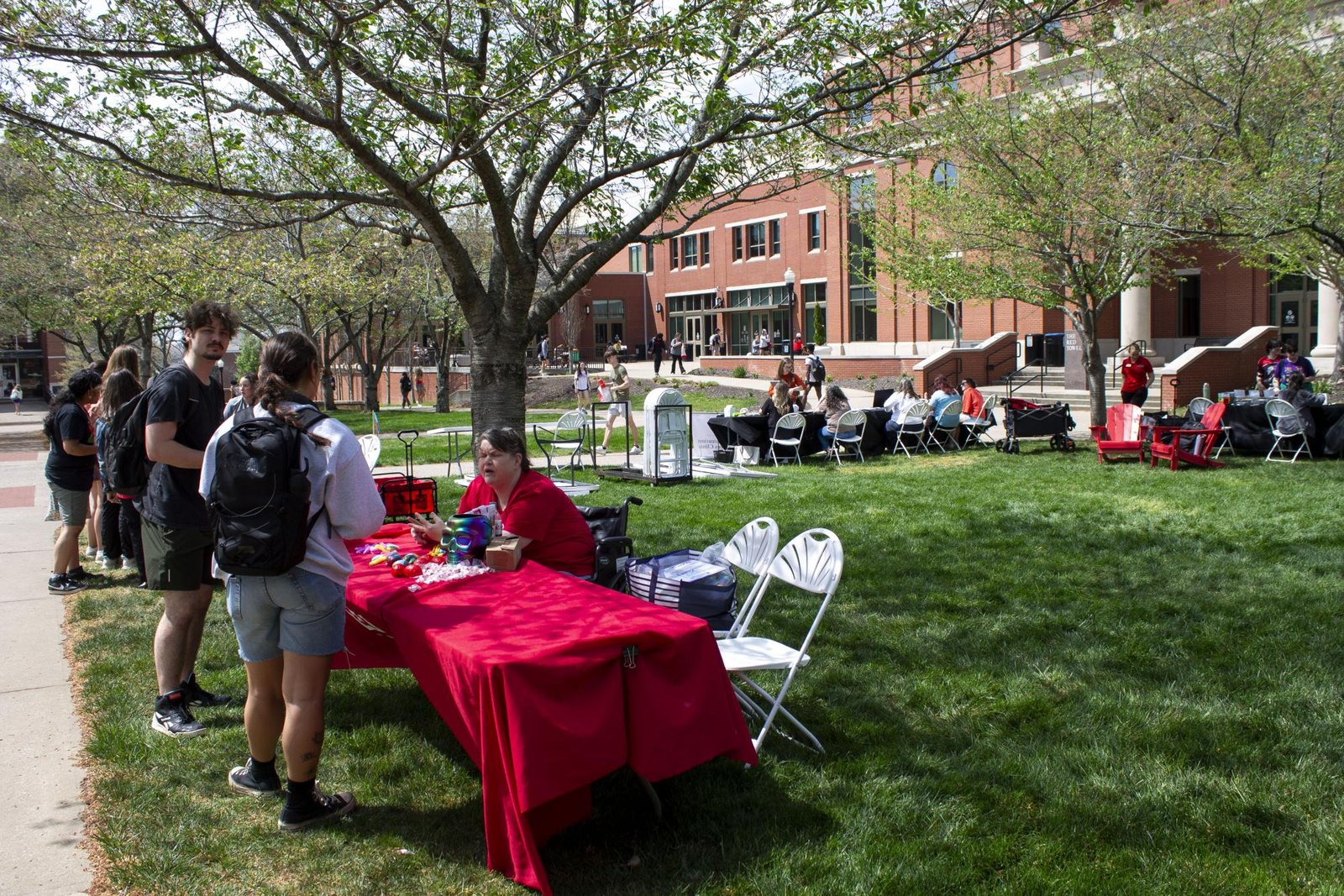
(Left to right) Freshman nursing major Malici Colburn and sophomore accounting major Reagan Abbot learn about the WKU Counseling Center from mental health therapist Elizabeth Madariaga. The WKU Counseling Center offers free counseling services to students. (Brendan Culler)
Maclaine Moore, freshman, said the Kelly Autism Program helped her make friends she didn’t believe she could otherwise make on her own.
Moore joined the Kelly Autism Program staff and other organizations for the third Neurodiversity Awareness Fair in Centennial Mall on Tuesday. Student Support Services-Disabilities hosted the event alongside several partner organizations.
Moore, part of the Kelly Autism Program Student Advisory Board, said a big benefit of the program is “finding friends who are also on the spectrum.”
Neurodivergence includes differences in brain structure and biochemistry, like those of individuals with autism, ADHD, obsessive-compulsive disorder, dyslexia and dysgraphia, according to the Cleveland Clinic. These differences often include difficulties with sensory and social information processing and executive dysfunction.
“The idea is that the world is not built for neuro-diverse people, so generally we need a little bit of support,” said Center for Innovative Teaching and Learning program specialist April McCauley.
The Kelly Autism Program provides services for individuals of all ages who live with autism spectrum disorder, as seen on its website. The Circle of Support is specifically tuned to the needs of qualifying college students.
“Having a community is really nice for that sense of belonging, having like-minded people who understand being on the spectrum and who don’t find some of the things I do off-putting and who actually understand,” Moore said.
Kelly Autism Program also provides peer tutoring opportunities for students like senior biology major Drake Calhoon, who is in her second year as a Kelly Autism Program Circle of Support tutor. Calhoon primarily tutors students in the Kelly Autism Program on STEM topics.
“Learning to communicate with my peers with ASD (Autism Spectrum Disorder) has been really beneficial,” Calhoon said. “It’s been a really rewarding job throughout my college.”
Calhoon said her interest in genetics and genetic counseling first drew her to the Kelly Autism Program, but that she plans to go to law school and focus on health policy, a field she now has first-hand experience in.
Alongside tutoring, Kelly Autism Program offers students access to private rooms at no additional cost, study sessions, social events, mental health counseling and regular advising meetings. Kelly Autism Program also has specialized resources and opportunities that students on the spectrum may not otherwise have access to, like sensory rooms for overwhelmed individuals to decompress, according to Moore.
McCauley emphasized the importance of advocacy in making these resources known to those who might need them or others who want to support them.
“I think everybody wants to help,” McCauley said. “They just don’t know how, and they don’t really understand how big of an impact neurodiversity can have on some people.”
McCauley said these began as discussion-based informational sessions that struggled to draw attendees and participants. She said she found part of the problem was the fear that comes with such touchy topics.
“Sometimes the conversations make you feel like, ‘Oh no, I’m going to say something wrong,’” McCauley said. “We need to be personable and approachable and have some fantastic activities.”
The fair featured a booth with drawing materials from Arts for All Kentucky, which provides accessible art education opportunities for those with disabilities. Sonja Byrd, Arts for All programs assistant, believes accessible art education and participation are important, too.
“It can kind of fill in some gaps expression-wise if you have somebody who has difficulty verbalizing,” Byrd said. “It’s really nice getting people off tech and doing something with their hands, something expressive. Without getting too philosophical, I think art is something that separates humans.”
The Hilltopper Nutrition booth featured a blind taste-testing challenge with a mystery ingredient to bring awareness to food-related sensory issues that many on the spectrum struggle with. The booth also provided nutritional tips to fill in gaps that might be created by such a sensitivity.
McCauley emphasized the importance of understanding the complex nature of neurodivergence.
“Some of it feels like a superpower, and some of it does not, and some things can be a superpower in some contexts and a real challenge in other contexts,” McCauley said.
She explained how awareness and resources can help steer neurodivergent individuals into careers that suit both their struggles and strengths. For example, someone with ADHD may flourish in a fast-paced, chaotic environment, like working as an emergency responder.
“In that context, a lot of their characteristics are strengths,” McCauley said. “It really is dependent on context and what kind of supports you get or don’t get.”
