


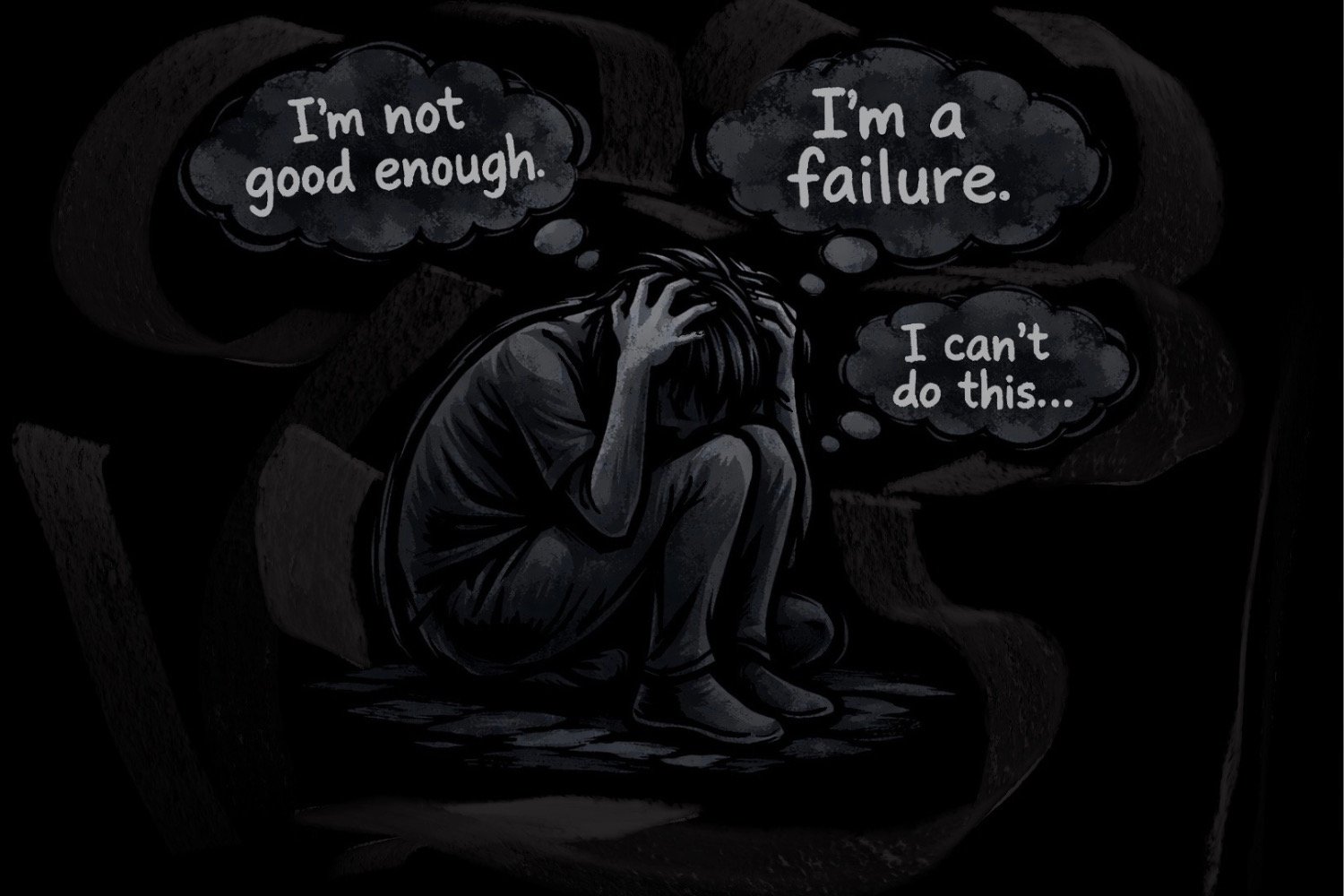
Negative thoughts run through a person’s mind, amplifying their anxiety. According to verywellmind.com, research has found that constant rumination is a common effect from many mental health disorders, including generalized anxiety.
Panic attacks, full body shut-down, unable to speak to anyone. This is the exact experience of Carlmont junior Maya McGinlay.
McGinlay was diagnosed with anxiety in her freshman year of high school. However, she’s been going through it her whole life, and the disorder has gained more prominence in her late middle school years.
McGinlay has had a double-sided experience. Although she believes anxiety is understood by many, she also finds that she has been misunderstood by others, including teammates on her sports team.
“I always had panic attacks during practices, and everyone was asking if I was okay, but also didn’t realize I was struggling,” McGinlay said.
While McGinlay was misunderstood, she still felt free to talk about it with others.
“I’m pretty open about it, because I know it’s a pretty normal thing,” McGinlay said.
Anxiety disorder: Both common and uncommon
According to the Cleveland Clinic, an anxiety disorder is present in someone when it hinders their ability to handle daily life, an overreaction occurs out of proportion to a regular situation, and they feel out of control when responding to certain situations, such as a bad test score. Symptoms range from mental to physical, including difficulty concentrating, muscle tension, difficulty sleeping, and uncontrollable or obsessive thoughts.
Anxiety disorder is often confused with being a single mental health condition. Still, it is actually broken down into multiple different subcategories, including social anxiety, panic disorder, and even certain phobias.
According to the World Health Organization, the disorder has been known to affect 359 million people in 2021 alone, but despite its prevalence, only 25% of those who are diagnosed receive treatment. This is due to a lack of awareness, insufficient investments in treatments, a shortage of trained professionals, and social stigma.
Nicole Vidalakis, a licensed clinical psychologist, agrees that multiple factors lead to the social stigma around anxiety, including experiences living in a different country.
“If parents came to the U.S. from a country where they did not have full access to food, shelter, or clothing, then the idea of a child being upset over an emotional problem like anxiety seems frivolous,” Vidalakis said.
While Vidalakis believes that there is a social stigma around anxiety, she also believes that most families are understanding of anxiety experiences.
“Most families are very understanding about how much pressure children are under today, especially after living through COVID-19 and the use of screens, which can make kids feel detached and vulnerable,” Vidalakis said.
Other experiences: The need to hide
Isla Tiwari*, a sophomore in high school, feels the necessity to hide her anxiety struggles.
“I don’t really talk about it with anyone I know other than my parents, because I want to make sure that I keep a good impression,” Tiwari said.
“
I don’t really talk about it with anyone I know other than my parents, because I want to make sure that I keep a good impression.
— Isla Tiwari
Tiwari felt well-supported by her family, but was afraid that her struggles were becoming a nuisance.
“I’ve talked about it so much that it is getting to a stage where it is kind of annoying,” Tiwari said.
Tiwari suffers from social anxiety, a subcategory of anxiety disorder that makes social interaction scary. One of her struggles is the fear of her image.
According to the Anxiety & Depression Association of America, social anxiety causes a huge fear of being called out for imperfections. This often prompts those who suffer to focus on maladaptive perfectionism, which is defined as attempting to strive for unreasonably high standards, often because of fear.
“I often distance myself from others because I’m worried they’re going to judge me for the way I look,” Tiwari said.
The result of an active taboo
Vidalakis says that anxiety can stem from factors that don’t involve school or work stress. Some of these factors include gender and sexuality, isolation, feeling a lack of purpose in life, or poor sleeping and eating habits.
Another main factor is a lack of ability in certain respects. One of Vidalakis’s examples was language barriers.
“If English is a second language and a school or job requires fluency, that can be difficult,” Vidalakis said.
While all these factors cause anxiety to be a common experience for individuals, the taboo that has been placed on anxiety can cause an individual to feel overall alone and misunderstood.
For McGinlay, she initially felt alone when she was in fifth grade, and her test-taking anxiety was more prominent.
“People questioned what was wrong with me and told me just to take the test, but it’s not that easy. And I felt at that point that they didn’t understand,” McGinlay said.
*This source’s name has been changed to protect their privacy in accordance with Carlmont Media’s Scot Scoop Anonymous Sourcing Policy.
