


Case presentation
A patient in their 30s was received in transfer after a motor vehicle collision in which they hit an oncoming car and were ejected from the vehicle. Emergency Medical Services (EMS) reported the patient was found suspended on a fence post entering at the right thigh and exiting the sacrum. A left lower extremity deformity was also noted. The patient and pole were separated from the rest of the fence and brought to a local Emergency Department (ED) where initially a Glasgow Coma Scale (GCS) score of 14 was noted. The patient subsequently became hemodynamically unstable, and massive transfusion was employed. The patient was then intubated, given broad-spectrum antibiotics and tetanus prophylaxis, and, once stabilized, transferred to our hospital for further care.
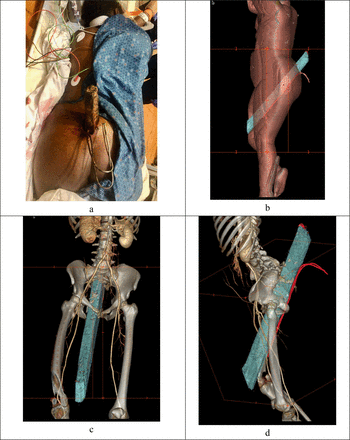
Upon arrival, the patient’s GCS score was 3T with stable vital signs. Venous blood gas on admission was notable for a lactate level of 5.0 mmol/L and a hemoglobin level of 14.9 g/dL. Exam revealed a large wooden post and attached metal wiring entering the right medial thigh and exiting the back just below L5 (figure 1a). The patient had a palpable dorsalis pedis pulse on the right lower extremity (RLE), and urine was grossly bloody. Given the patient stability and complex injury pattern, CT angiography was pursued to investigate for vascular injury. This revealed a comminuted sacral fracture, complete transection of the R inferior pubic ramus, and a right ureteral injury without obvious vascular injury (figure 1c, d).
(a) Wooden post exiting patient at L5. (b) 3D reconstruction showing wooden post trajectory. (c) 3D reconstruction with bone and vessels, anterior to posterior view. (d) 3D reconstruction with bone and vessels, sagittal view.
What we did and why
We proceeded to the operating room for further investigation and foreign body removal. The post and wire protruding from the sacrum were cut using a reciprocating bone saw to facilitate supine positioning. At laparotomy, the bilateral internal and external iliac arteries and veins and bilateral ureters were isolated and controlled with vessel loops. Control of the RLE vasculature distal to the post was impossible as the post was covering and displacing the vessels posterolaterally. The foreign body was then removed via the leg, after which there was modest venous oozing from the groin and sacrum. We packed the groin, abdomen, and sacral wounds, placed a temporary abdominal closure device, and obtained repeat CT angiography to re-evaluate the genital-urinary system and determine if there was sacral or retroperitoneal bleeding amenable to angioembolization, of which there was none. The patient was then transferred to the trauma Intensive Care Unit (ICU) for further resuscitation. Broad-spectrum antibiotics were continued.
After consultation with urology, orthopedics, plastics, and neurosurgery, the patient was taken back to the OR. This exploration revealed injuries to the anterior and posterior walls of the rectum, bladder trigone, and right ureter, a torn thecal sac, and open sacral and pubic ramus fractures. Operative intervention was pursued during the next 48 hours. The rectal injuries were managed with proctectomy and end sigmoid colostomy. The bladder injury was repaired primarily, and the right ureter was reimplanted. The thecal sac injury was managed with a lumbar drain and a S2 dural closure with fat graft plug. The soft tissue injuries were repaired with multiple debridements until the wounds were eventually closed. The patient was ambulating and tolerating a diet on post-trauma day 36 and was discharged for rehabilitation.
Pelvic injuries present unique surgical dilemmas in trauma care. Open pelvic injuries are a rarer form of pelvic injury associated with higher mortality given the complexity of injury pattern, with initial case series describing mortality rates as high as 50%.1 2 Multidisciplinary care and improvements in trauma care have decreased these mortality rates in the modern era. The tenants of the management of open pelvic trauma include initial resuscitation and stabilization from life-threatening injuries followed by identification of the associated injured organs and a staged approach to surgical repair.1 3 Penetrating rectal injury management is nuanced and may necessitate fecal diversion.4 Management of the bleeding associated with pelvic injuries is paramount, as hemorrhage is a major driver of the morbidity and mortality. The management of pelvic bleeding varies based on institutional resources and injury pattern, and there is no ‘one size fits all approach’.5 6 This case presented a unique vascular problem as this patient was hemodynamically stable without obvious vascular injuries on imaging, but removal of the foreign object was required. Concern for potential iatrogenic injury during foreign body removal was a strong influence for the operative approach described here. This case highlights the complex injury pattern typical of transpelvic penetrating injury and the success obtained with a coordinated multispecialty approach to care.
