


SINGAPORE – An artificial intelligence tool that can predict fracture risk in seconds and wearable sensors for fall risk assessment are among the solutions being developed under a new $37.9 million programme to help Singaporeans age more healthily with technology.
Musculoskeletal health and mobility is one of three focus areas under the Future Health Technologies 2 (FHT2) programme.
Beyond assessing fracture and fall risks, the projects also involve the use of bone organoids – lab-grown tissue cultures derived from stem cells – to predict drug responses in patients. This will enable doctors to optimise fracture prevention strategies for those at higher risk.
Musculoskeletal conditions are among the most overlooked health challenges of our time, said National Research Foundation (NRF) chief executive John Lim at the launch of the initiative on March 28.
This is despite such conditions being the leading cause of disability worldwide, affecting more than 1.7 billion globally, he noted.
“Research and innovation are critical to gaining new insights and advancing our understanding of musculoskeletal health,” said Mr Lim.
“The FHT2 programme aims to translate promising AI and robotics research outcomes across musculoskeletal health, mental well-being and rehabilitation into clinical workflows by 2030, while also shifting care upstream from treatment to early detection, prevention and functional recovery in the community.”
The programme is an effort by the Singapore-ETH Centre, a collaboration between the NRF and the Swiss university ETH Zurich.
The second focus area is mental well-being and cognitive health.
A platform that integrates large language models, behavioural science and real-world data to build apps that deliver personalised interventions will be created. Such interventions include resilience-building support for anxiety, depression and stress in young people.
The third focus area is rehabilitation and recovery, such as the use of technology for upper limb rehabilitation following a stroke.
The programme is the second phase of the Future Health Technologies initiative.
The first phase, which began in 2020 and ended in March, yielded innovations such as a cognitive screening tool to detect early signs of dementia and an app that uses a chatbot to coach users in areas such as healthy eating, stress management and physical activity.
NRF is investing $30.5 million in the programme, with ETH Zurich, NHG Health and NTU contributing the rest of the funding.
The second phase is aimed at accelerating clinical translation, said Assistant Professor Bryan Tan, co-director of the FHT2 programme.
“We’re looking to adopt many of these promising technologies into our health system and have patients directly benefit from these technological advances,” said Prof Tan, who is also co-chair of the Musculoskeletal Integrated Care Workgroup at NHG Health.
FHT2 was launched during a scientific congress at Woodlands Hospital on March 28, as part of healthcare cluster NHG Health’s Musculoskeletal Day 2026.
At the event, Minister for Health Ong Ye Kung noted the efforts to improve community health services in Woodlands, such as by enhancing services at 11 community health posts found at active ageing centres in the town.
Such services include providing support to residents with diabetes and asthma, as well as those who have low-risk results in colonoscopy screenings, he said.
If successful, the enhancements will be extended to other areas under NHG Health, and eventually to other health clusters, said Mr Ong, who is also Coordinating Minister for Social Policies.
“Our objective is to make healthy living a natural part of everyday life,” he said.
Health Minister Ong Ye Kung (centre) participating in a mass exercise at the NHG Health Musculoskeletal Day at Woodlands Hospital on March 28.
ST PHOTO: GAVIN FOO
Mr Ong had previously said that three towns in the north of Singapore – Yishun, Sembawang and Woodlands – have a higher prevalence of chronic illnesses.
For example, the prevalence of diabetes in the north is 10.5 per cent compared with the national average of 8.8 per cent, based on Health Ministry data. The prevalence of hypertension in the region is 35.9 per cent, compared with the national average of 33 per cent.
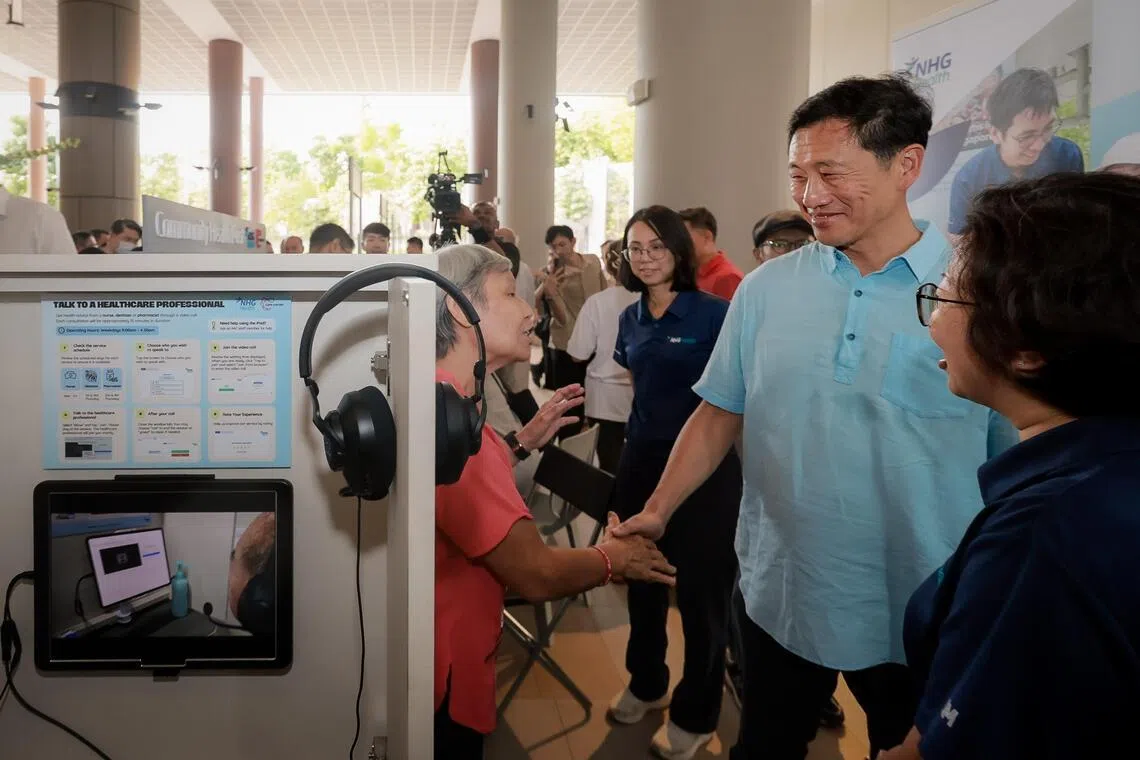
During the event, NHG Health also unveiled a prototype of “health pods”, which will be installed at the community health posts.
These will provide dedicated spaces for one-on-one consultations with a community nurse and a booth where residents can have teleconsultations with dietitians, pharmacists or nurses.
