


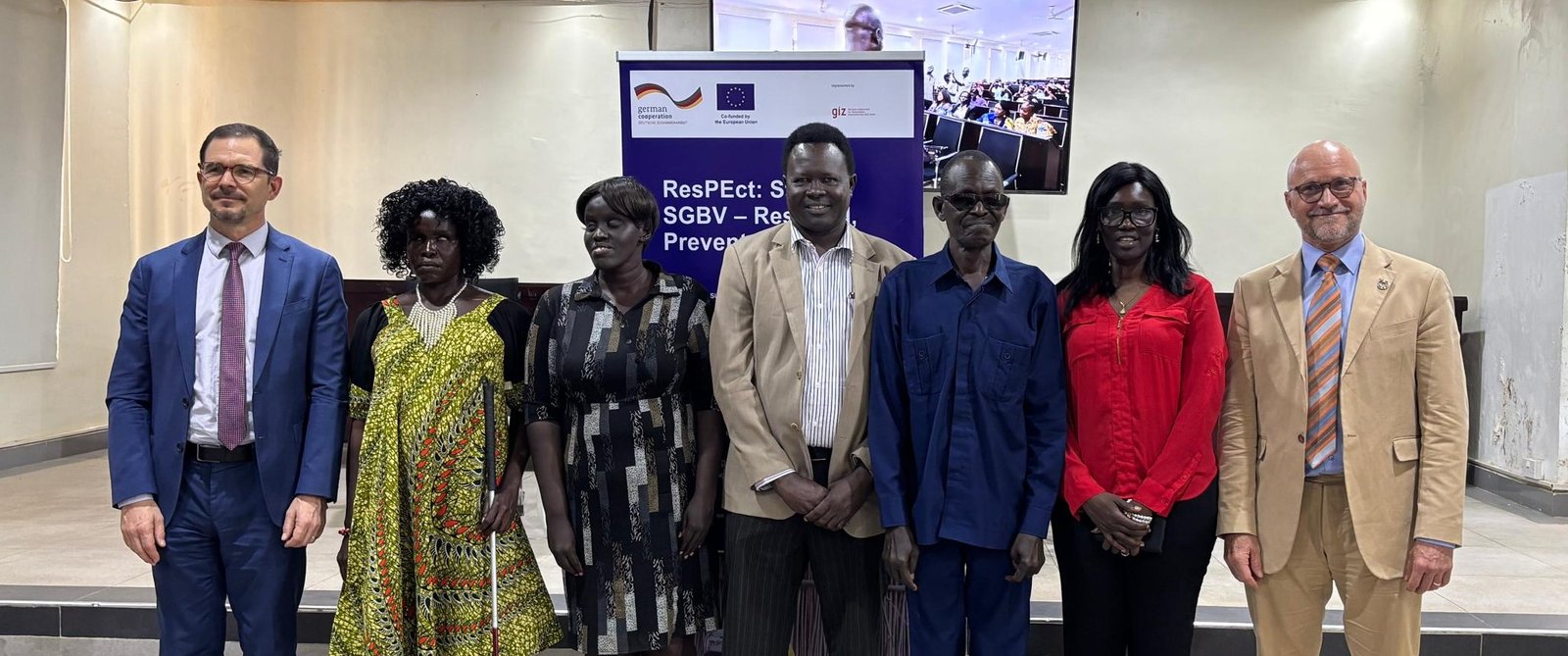
Stakeholders, mental health experts and disability rights advocates gathered at the University of Juba on Thursday to discuss the mental health challenges facing women with disabilities in South Sudan.
The panel discussion, titled “Mental Health – Invisible Wounds: Mental Health, GBV, and the Lived Realities of Women with Disabilities in South Sudan – Let us take action!” was organized by the ResPEct project to mark International Women’s Day 2026.
The ResPEct project is co-funded by German development cooperation and the European Union and implemented by GIZ. The event brought together government officials, development partners, civil society groups and experts working on gender-based violence and disability inclusion.
Participants discussed ways to promote mental well-being, raise awareness and address challenges faced by vulnerable communities across the country.
Germany’s ambassador to South Sudan, Gregory Bledjian, said the theme “Invisible Wounds” highlights the often unseen trauma and exclusion experienced by women and girls with disabilities.
He said the discussion aimed to examine how gender-based violence uniquely affects women and girls with disabilities, explore the mental health impacts of violence, trauma and exclusion, and identify gaps in services and policies.
“Women and girls with disabilities face multiple risks, including higher exposure to sexual and gender-based violence and barriers to reporting abuse or accessing care,” Bledjian said.
European Union ambassador to South Sudan Pelle Enarsson said mental health should be treated as both a health and development priority.
“When mental well-being is compromised — whether by conflict, trauma, stress, economic hardship or social stigma — individuals’ ability to learn, work, participate in civic life and support their families becomes severely limited,” he said.
“In this way, mental health becomes a national development priority. Many wounds are invisible, yet real, and require recognition, care and action.”
According to South Sudan’s 2008 census, about 5% of the population — roughly 420,000 people — were living with disabilities. More recent estimates suggest the number could exceed 1 million people, or about 16% of the population.
Reports indicate that about 75% of persons with disabilities face disadvantages when accessing services. High levels of trauma and post-traumatic stress disorder have also been reported, particularly among women and children.
Elizabeth Atong, project coordinator at GIZ, said the event provided an important platform to address the intersection of mental health, gender-based violence and disability.
She said the session, organized in the spirit of International Women’s Day, aimed to encourage reflection on mental health, psychosocial support and access to services for persons with disabilities, particularly in efforts to prevent and respond to gender-based violence.
“I hope today’s discussion will inspire meaningful dialogue, shared learning and practical recommendations that contribute to stronger support systems for vulnerable communities in South Sudan,” she said.
Participants emphasized the need for stronger policies, improved access to mental health services and community-based support systems to ensure women and girls with disabilities are not left behind.
