


Safety guardrails for implementation
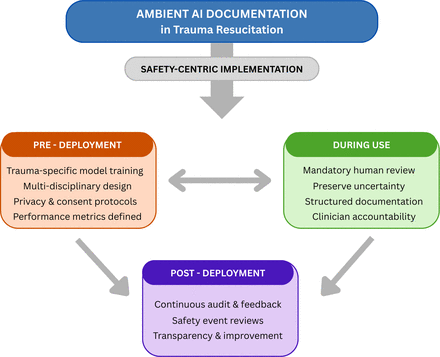
Ambient AI documentation systems should be implemented in trauma care with safety guardrails (figure 1).
Safety-centric implementation of ambient artificial intelligence (AI) documentation in trauma resuscitation.
First, clinician accountability must be maintained. Draft documentation generated by AI systems must be subject to mandatory human review of high-risk elements, including primary survey findings, neurologic status, anticoagulation history, procedures performed, and disposition decisions. The reviewer must be identifiable in the medical record and accountable for the accuracy of the documentation.
Second, uncertainty must be noted in the documentation and not resolved prematurely. Documentation systems should allow for documentation such as “unknown,” “unable to assess,” “history unreliable,” or “pending verification” rather than transforming incomplete information into definitive statements. Documentation in trauma care must reflect the reality of incomplete information at the time of resuscitation, and not the appearance of complete knowledge.
Third, structured documentation must be emphasized for safety-critical elements. Unstructured free-text narrative can be susceptible to errors, ambiguity, and misinterpretation when automatically generated. Structured documentation fields for neurologic assessments, procedures, vital sign trends, and transfusion events can minimize the spread of errors and improve data quality for research and quality improvement.9
Fourth, implementation of AI documentation systems must be multidisciplinary. Trauma nurses, prehospital leaders, trauma program directors, and quality improvement teams should participate in the design, deployment, and monitoring of AI documentation systems. Documentation errors should be investigated as patient safety events. A multidisciplinary investigation ensures that the needs of all stakeholders are represented.
Fifth, trauma-specific training and validation must be conducted prior to deployment. AI documentation systems must be trained on trauma-specific conversations, tested using curated trauma scenarios, and validated for accuracy in high-acuity resuscitations before clinical use.
Sixth, continuous audit is necessary. Ambient AI documentation systems should be audited continuously for recurrent error patterns, bias, and unintended consequences. The rate of errors should be measured and used to drive continuous improvement.
