


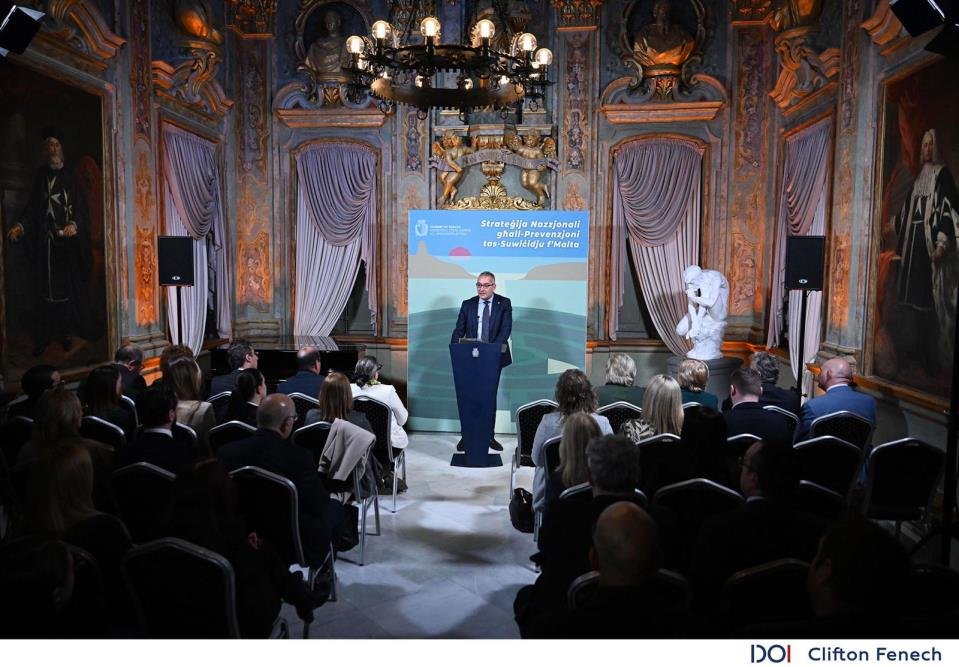
The Ministry for Health and Active Ageing has launched the first National Suicide Prevention Strategy, which will guide the country’s work in this area for the period 2026-2031.
The strategy, prepared by the Mental Health Services, establishes a comprehensive framework of targeted actions to strengthen prevention, early and timely intervention, and support services for people who may be at risk, the government said in a statement.
The strategy builds on the framework of the Mental Health Strategy for Malta 2020-2030 and is linked to measures 37 and 38 of the Vision Malta 2050 plan, which places mental health and the wellbeing of the Maltese population as a national priority and aims to help identify mental health challenges at an early stage.
The Minister for Health and Active Ageing, Jo Etienne Abela, thanked the experts and all stakeholders who contributed to the development of this strategy, particularly Dr Antonella Sammut, who led the research and prepared the first draft of the document.
“This strategy represents an important step in our work to continue strengthening mental health services and protecting the wellbeing of our community. Although Malta has one of the lowest suicide death rates in Europe, every life lost is a tragedy that leaves a profound impact on families and on society as a whole,” said Minister Abela.
The strategy includes measures aimed at increasing awareness, improving access to services, and promoting early intervention, government said. Minister Abela emphasized that suicide prevention is a collective responsibility. He stated that it requires an approach involving not only the health sector but also other sectors, as well as the entire community.
Malta already offers several crisis intervention services, including the Psychiatric Emergency Service operating 24 hours a day from the Emergency Department at Mater Dei Hospital, the Crisis Resolution and Home Treatment Team, the Crisis Intervention Home Treatment Service for children and adolescents, as well as the national helpline 1579.
Minister Abela explained that society is changing rapidly and that it is also necessary to consider the effects that the COVID-19 pandemic has left on mental health. This strategy is designed to respond to these realities in a proactive and inclusive manner, government said. “Its main objective is to strengthen prevention, awareness, and support systems so that more people receive the help they need in time.”
